causes of hair loss
Alopecia areata: what is known about treatment, prognosis and comorbid conditions
Alopecia areata is an autoimmune disease in which hair falls out in patches, sometimes on eyebrows, eyelashes and the body. Below is what PubMed data show about severity, treatment of severe forms and comorbid conditions.
This article is general information: diagnosis and treatment are for a dermatologist to determine in person.
What “severe” means
An international consensus of 64 hair and scalp experts (Delphi method) showed that severity is not only about the area of hair loss: independently of it, outcomes are worsened by disease duration of 12 months or more, three or more relapses, inadequate response to treatment, rapid progression, difficulty concealing it, involvement of eyebrows, eyelashes and beard, nail involvement, impaired quality of life, and anxiety or depression due to the disease (ASAMI Consensus Survey Study Group, JAMA Dermatology, 2024, doi:10.1001/jamadermatol.2023.5869).
Treating severe forms in real life
A therapy review notes that topical and intralesional corticosteroids remain first-line for limited disease, but high-level evidence is scarce for extensive disease; Janus kinase (JAK) inhibitors are described as having changed the prognosis of severe forms, and baricitinib is approved for severe alopecia areata on the basis of randomized trials. It also lists limits: high cost, relapse after discontinuation and long-term safety questions, so careful patient selection is needed (Ferrara, Inflammopharmacology, 2026, doi:10.1007/s10787-026-02273-8).
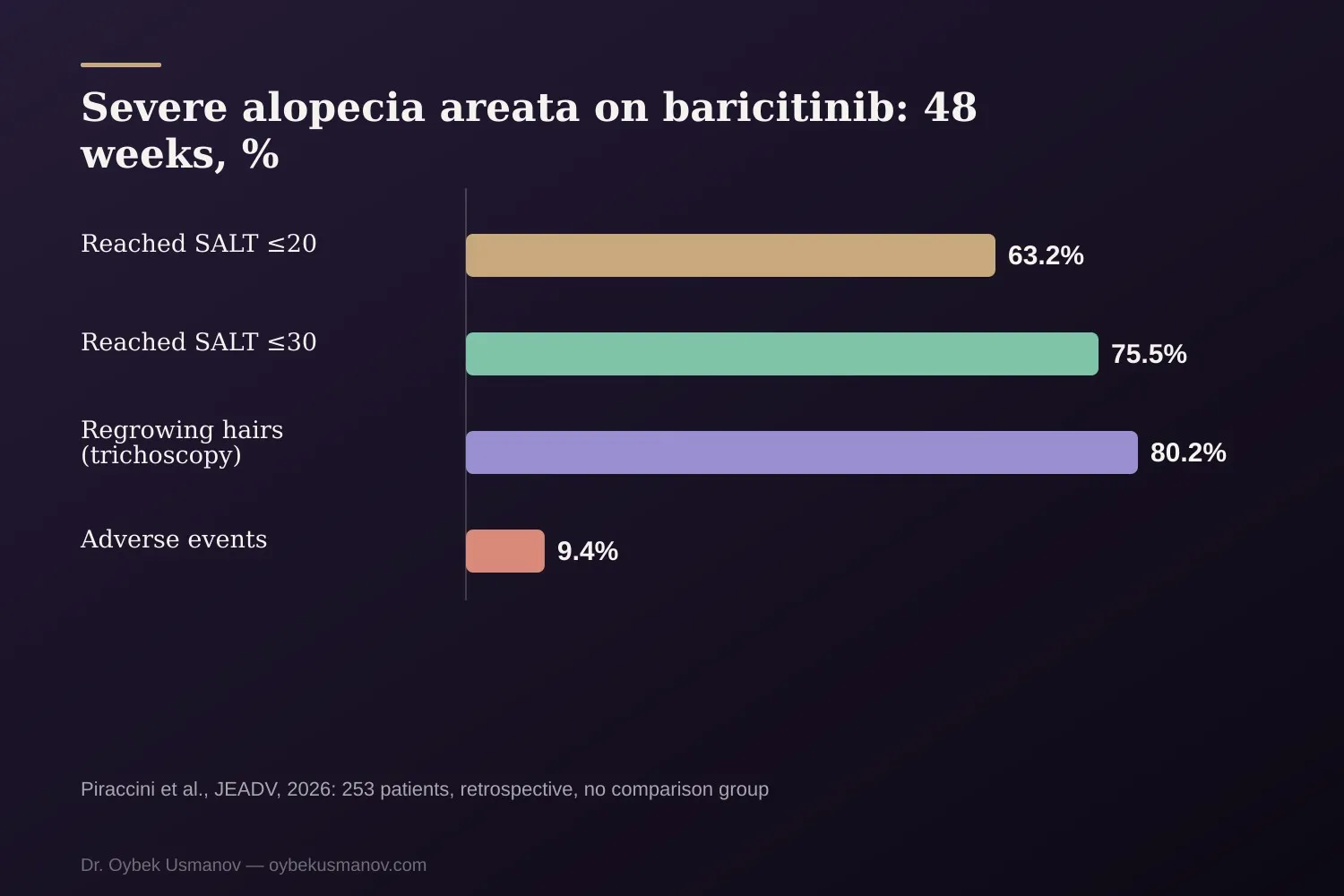
In a retrospective observation of 253 adults with severe alopecia areata in Italy, after 48 weeks on baricitinib 63.2% reached SALT ≤ 20 and 75.5% SALT ≤ 30; mean SALT fell from 93.7 to 26.5 and the share of regrowing hairs on trichoscopy rose from 7.1% to 80.2%. Adverse events occurred in 9.4%, and quality of life, anxiety and depression scores improved (Piraccini et al., Journal of the European Academy of Dermatology and Venereology, 2026, doi:10.1111/jdv.70067).
Important: this is an observation with no comparison group and the result cannot be applied to everyone. The drug is prescribed and monitored only by a doctor.
Comorbid conditions
A meta-analysis of comorbidities in alopecia areata (102 studies) found the highest odds for vitamin D deficiency, lupus, vitiligo, metabolic syndrome and Hashimoto’s thyroiditis (Ly et al., American Journal of Clinical Dermatology, 2023, doi:10.1007/s40257-023-00805-4).
A meta-analysis of trace elements found lower vitamin D and zinc in patients (Wu et al., Journal of Cosmetic Dermatology, 2025, doi:10.1111/jocd.16740). And on thyroid antibodies: alopecia areata is linked to the presence of antibodies, not to diagnosed hypo- or hyperthyroidism, and the authors do not support routine thyroid screening without symptoms (Kinoshita-Ise et al., The Journal of Dermatology, 2019, doi:10.1111/1346-8138.14940).
When to see a doctor
- If hair falls out in patches or round areas.
- If eyebrows, eyelashes or body hair fall out.
- If nails change or the disease returns.
- If shedding is accelerating quickly: early referral matters.
- Do not try hormones or strong drugs on your own: the doctor chooses the regimen.
What we do
A hair transplant in alopecia areata is a separate question: we found no PubMed data on which to base confident advice, so the decision is individual and follows a dermatologist. Send photos of your head on WhatsApp and tell us how long the shedding has been going on.
This article is general information and does not replace a consultation.