treatment
Oral minoxidil for hair loss: what is known about efficacy and safety
Low-dose minoxidil pills are increasingly prescribed for hair loss. But what is known about efficacy and safety? Below are PubMed data: what trials and reviews showed.
This article is general information: the drug is prescribed and monitored only by a doctor. There are no doses or regimens in this article.
Status of the drug
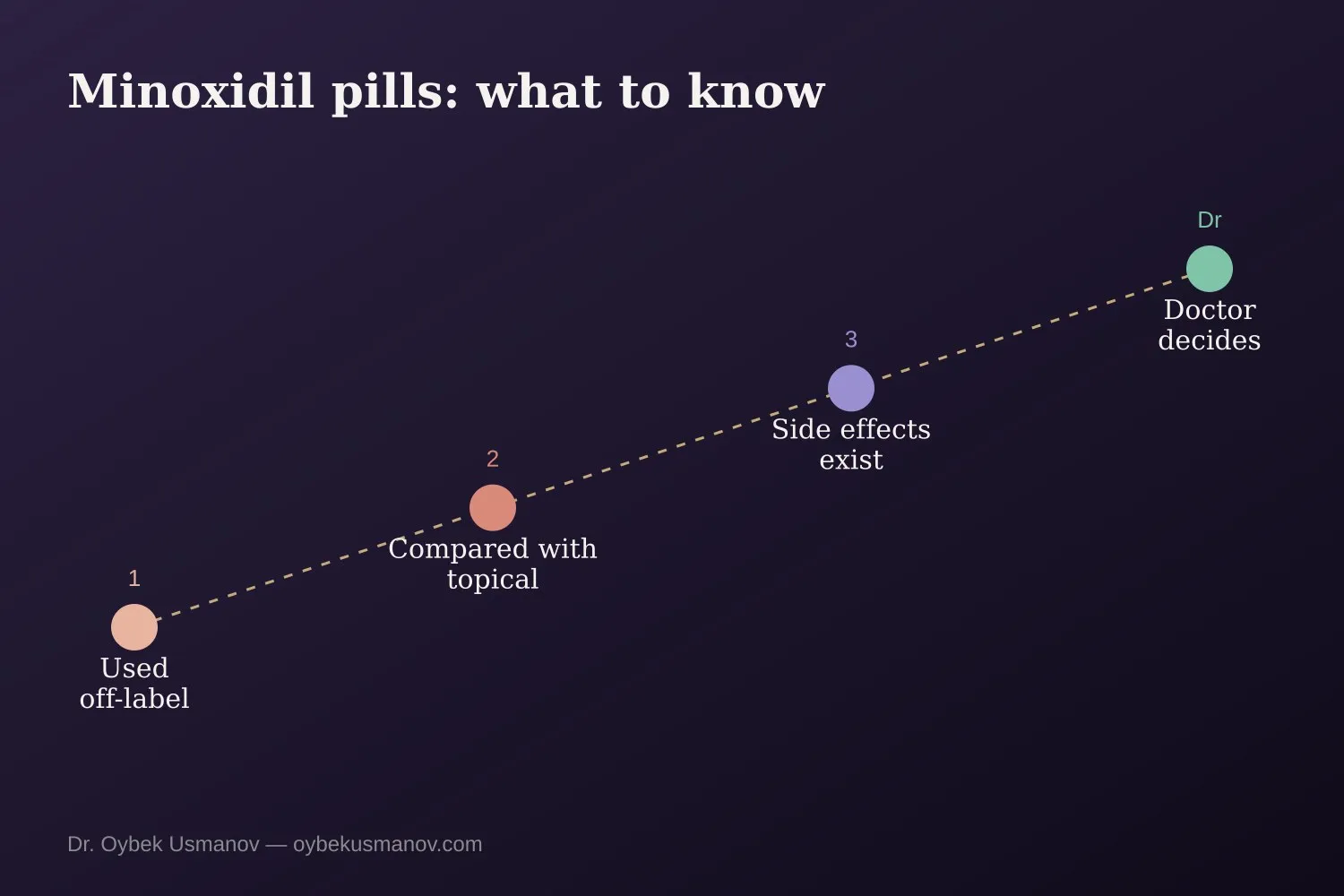
Topical minoxidil is FDA-approved for androgenetic alopecia in men and women, while oral and sublingual forms are not approved and are used off-label (Gupta et al., Journal of Dermatological Treatment, 2022, doi:10.1080/09546634.2021.1945527).
An expert review stresses that oral minoxidil at doses below those that lower blood pressure is used in various hair loss conditions, but there is no standard of best practice (Olsen et al., Journal of the American Academy of Dermatology, 2025, doi:10.1016/j.jaad.2025.04.016).
What the comparison with topical use showed
In a double-blind randomized trial, 90 men with androgenetic alopecia (68 completed) received either oral or topical minoxidil for 24 weeks. No significant difference between groups was found in hair density in the frontal and vertex areas; on photographic assessment the oral form was better on the vertex (24%; 95% CI 0–48) but not on the front. The most common adverse effects were hypertrichosis (22 of 45, 49%) and headache (6 of 45, 14%) in the pill group. The authors concluded that pills did not beat the topical form (Penha et al., JAMA Dermatology, 2024, doi:10.1001/jamadermatol.2024.0284).
Adverse effects in a large cohort
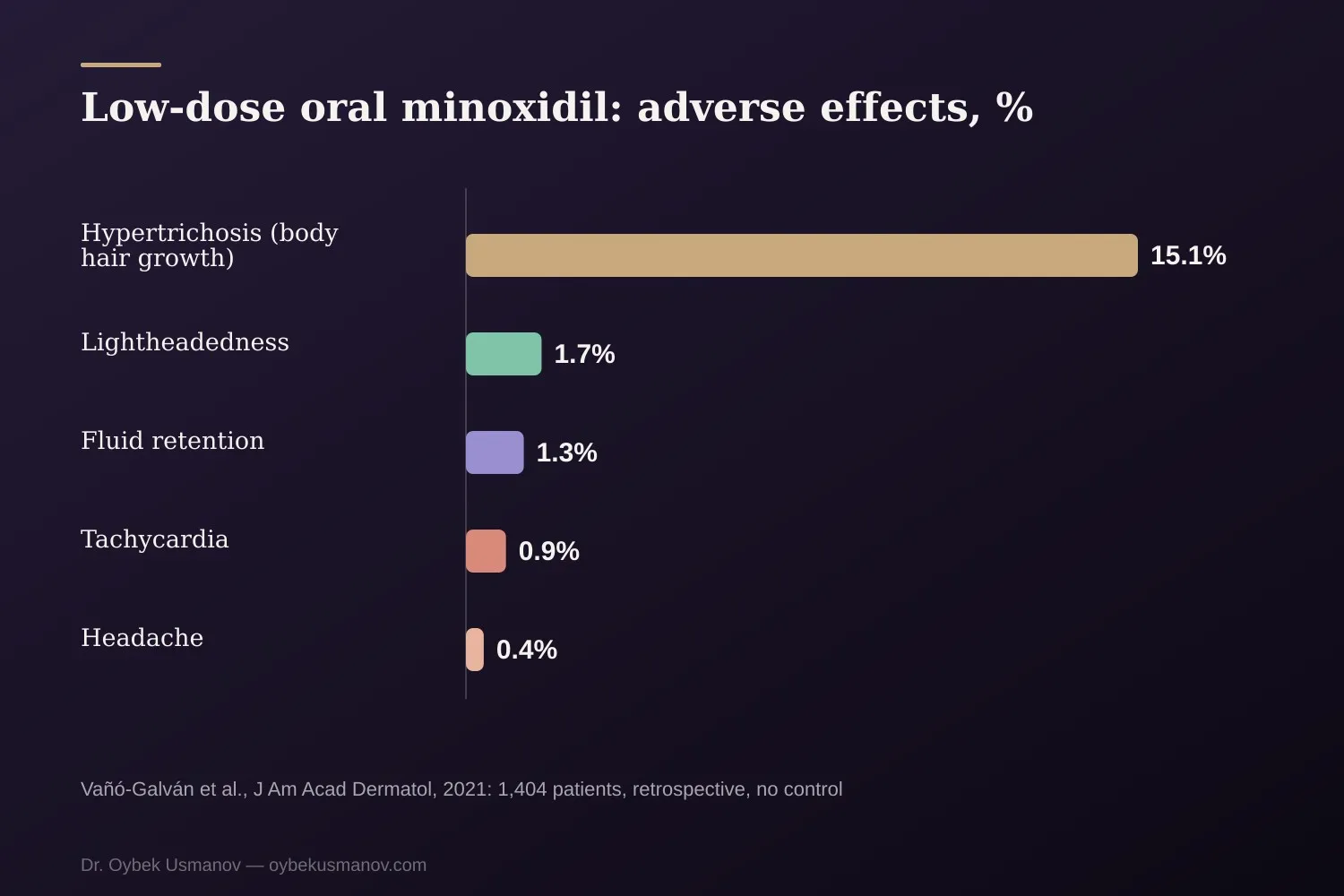
In a multicentre retrospective study of 1,404 patients treated with low-dose oral minoxidil for at least 3 months, the commonest effect was hypertrichosis (15.1%); systemic adverse effects were lightheadedness (1.7%), fluid retention (1.3%), tachycardia (0.9%), headache (0.4%), periorbital oedema (0.3%) and insomnia (0.2%). No life-threatening effects were seen; limitations are the retrospective design and lack of a control group (Vañó-Galván et al., Journal of the American Academy of Dermatology, 2021, doi:10.1016/j.jaad.2021.02.054).
A review of 17 studies (634 patients) concluded that pills are effective and well tolerated in healthy patients who find topical use hard, but larger randomized studies are needed to define the best protocol (Randolph & Tosti, Journal of the American Academy of Dermatology, 2021, doi:10.1016/j.jaad.2020.06.1009).
Who should discuss it with a doctor and when
- If the topical form does not suit because of irritation, inconvenience or poor adherence.
- If hair loss is androgenetic and steadily progressing.
- If you have heart disease, blood pressure problems or swelling: tell your doctor.
- If dizziness, palpitations or swelling appear: see a doctor urgently.
- Do not take the drug on your own, and do not buy pills “for hair” without a prescription.
What we do
Drugs are prescribed by a dermatologist or your local doctor; at the clinic we discuss transplant and assess whether it suits your type of hair loss. Send photos of your head on WhatsApp and tell us what you take.
This article is general information and does not replace a consultation.