treatment
Caffeine shampoo for hair loss: what studies show
Caffeine shampoos are advertised as a way to “stop shedding”. What do studies show? Below is what PubMed offers: with figures, with caveats about sponsors and with what a doctors’ consensus says.
This article is general information: the choice of products for hair loss is for a doctor to determine after a diagnosis.
Does caffeine reach the follicle
A laboratory study showed that caffeine from a shampoo applied for 2 minutes penetrates through hair follicles faster and in greater amounts than through the rest of the skin (Otberg et al., Skin Pharmacology and Physiology, 2007, doi:10.1159/000101389).
That explains why caffeine is studied for hair, but does not prove it improves growth.
What randomized studies showed
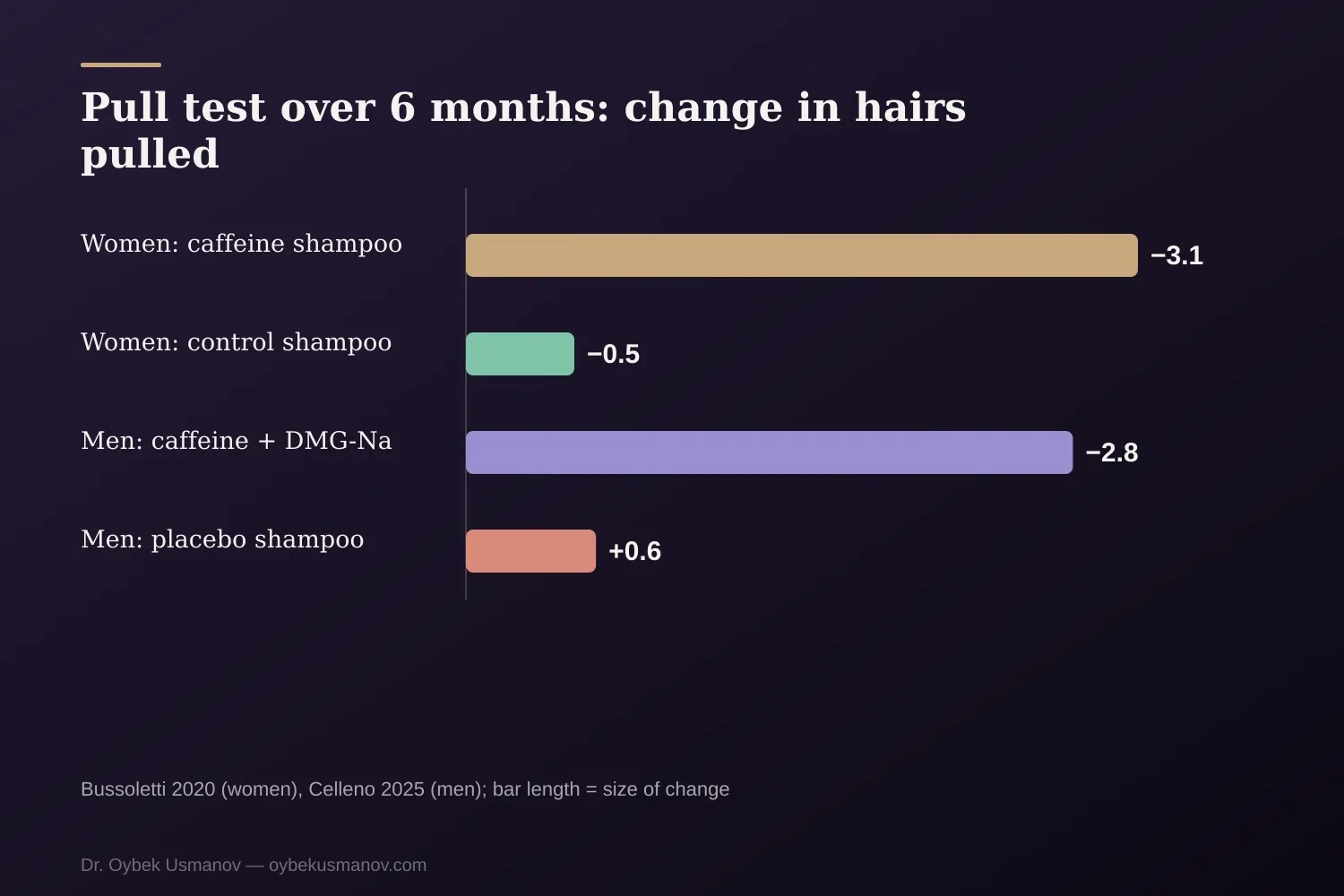
In women with androgenetic alopecia, a double-blind study compared a phyto-caffeine shampoo with a control one over 6 months: the number of hairs pulled in the pull test fell by 3.1 versus 0.5 (p < 0.001); most secondary measures also improved and both shampoos were well tolerated (Bussoletti et al., Giornale Italiano di Dermatologia e Venereologia, 2020, doi:10.23736/S0392-0488.18.05499-8).
In 154 men with male pattern hair loss, a shampoo with caffeine and dimethylglycine sodium salt (DMG-Na) was compared with a placebo shampoo over 24 weeks: in the pull test the number of hairs pulled fell by 2.8 versus a rise of 0.6 (p < 0.001), with no adverse events. In a subgroup of 30, phototrichogram showed increases in hair number and share of growing hairs. Among the authors are company employees (Celleno et al., Journal of Cosmetic Dermatology, 2025, doi:10.1111/jocd.70390).
In a study of 77 people, a shampoo with caffeine and adenosine raised hair density versus baseline; hair diameter did not change significantly, and 71.05% of participants were satisfied. This is a comparison with baseline, not a control, and among the authors are company employees (Chen et al., Journal of Cosmetic Dermatology, 2024, doi:10.1111/jocd.16347).
What the doctors’ consensus says
A Canadian consensus of 11 doctors (Delphi method), which reviewed 45 interventions for androgenetic alopecia, did not recommend caffeine, nor shampoos and lotions with fermented papaya, mangosteen and caffeine, though it included ketoconazole shampoo among those recommended with near consensus. Among the authors are employees of a cosmetics company (Landells et al., Journal of Cutaneous Medicine and Surgery, 2025, doi:10.1177/12034754251368849).
That does not mean caffeine is harmful. It means that in the doctors’ judgment evidence was not enough to recommend it.
Limits: what to look at
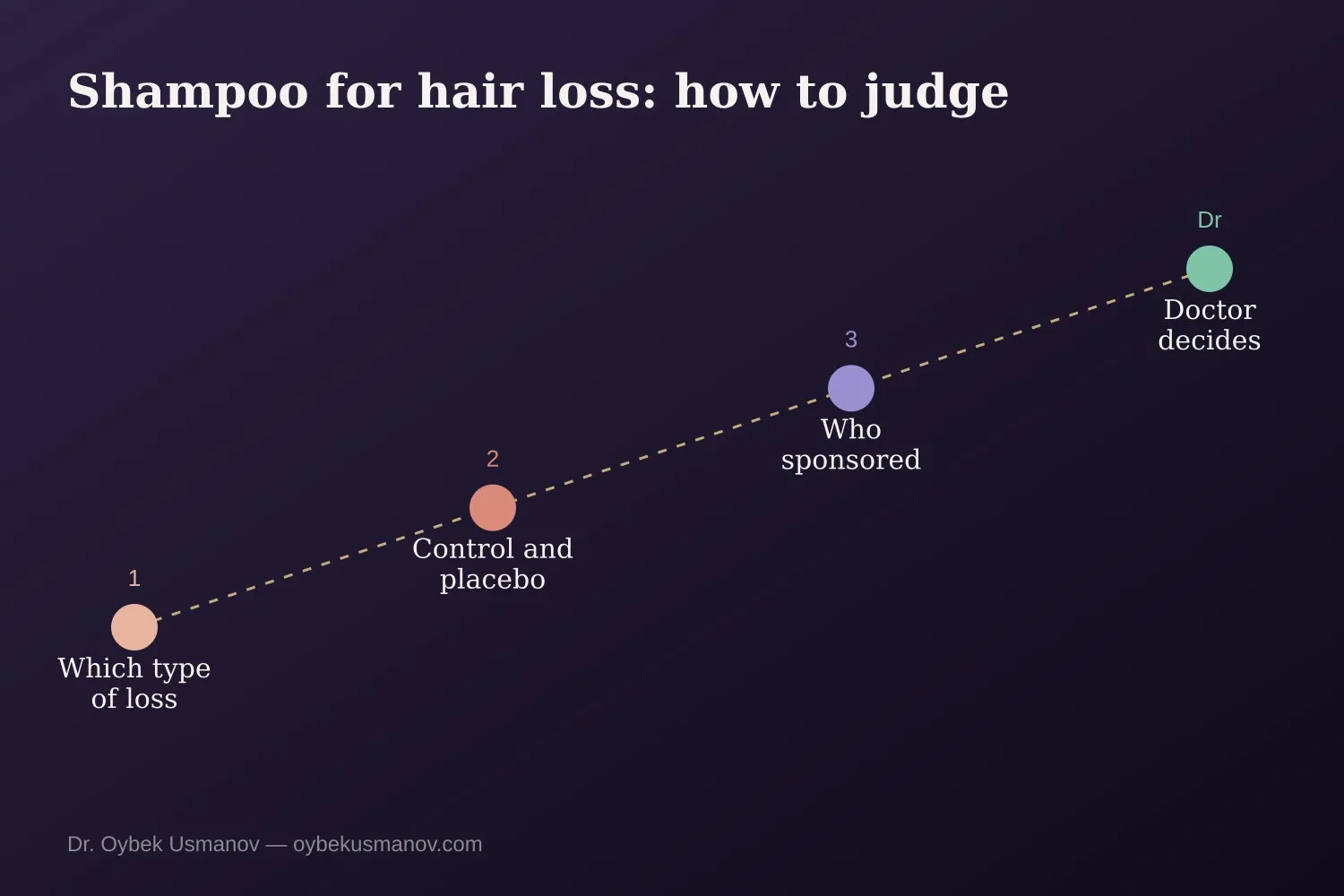
- Measurements were mostly by hair pull test, not actual thickening.
- Studies are short: 6 months or less.
- Some studies were run or funded by manufacturers.
- The results do not show that a shampoo replaces treatment of androgenetic alopecia.
- For other types of hair loss (diffuse, patchy, scarring) there are no data.
What we do
If your hair loss turns out to be androgenetic alopecia, we will discuss options including transplant, and say honestly when it is not needed. Send photos of your head on WhatsApp and tell us what you use.
This article is general information and does not replace a consultation.