
methods
FUE vs DHI: what is the difference, and which should you choose?

It is one of the most common questions before surgery: “Which is better, FUE or DHI?” Many clinics present DHI as a separate, more “advanced” technology and charge more for it. Let’s sort it out without the marketing.
What they share
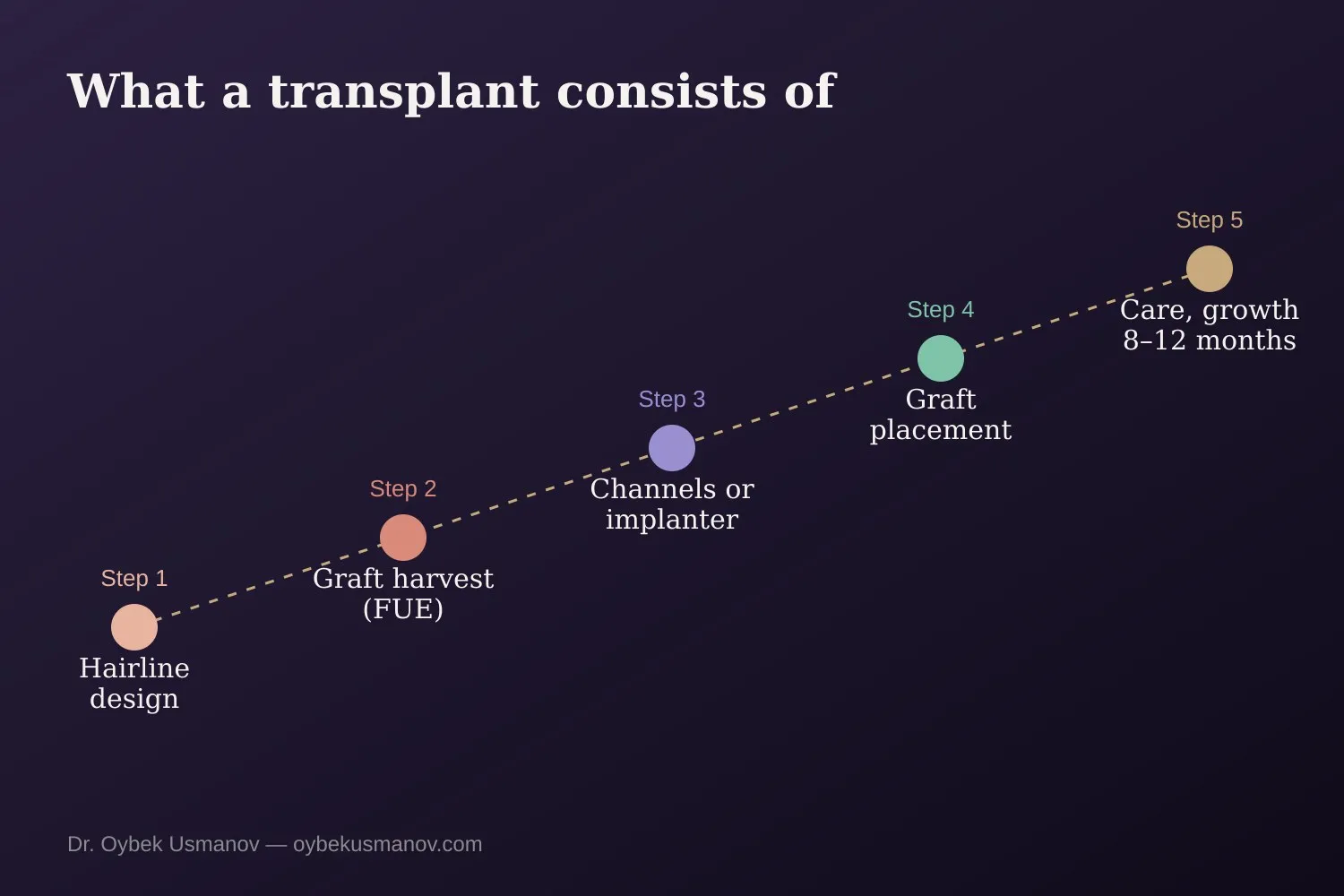
A hair transplant is always three actions: take grafts (groups of one to four hairs with their follicles) from the donor area at the back of the head, prepare them and place them in the thinning area. The modern standard for harvesting is FUE (follicular unit excision): grafts are extracted one by one with a small punch, with no strip of skin and no linear scar.
A 2026 review calls FUE the most widely used technique because it is minimally invasive, has a fast recovery and gives natural-looking results (Romera de Blas et al., Frontiers in Medicine, doi:10.3389/fmed.2026.1750989).
Where they differ
The difference is not in the harvest but in the placement. In classic FUE the surgeon first makes small channels in the skin and then inserts the grafts. In DHI the graft is loaded into a special pen-like implanter and placed directly, without pre-made channels. The harvest in both cases is FUE.
So comparing FUE and DHI as two independent operations is not entirely fair: DHI is a placement variant that usually relies on the same harvest.
- Channels plus forceps placement: the classic route, often quicker on large sessions.
- Implanter (DHI): lets the surgeon set angle and depth at the moment of insertion; often chosen where precision matters, such as the hairline or eyebrows.
- Both need experience: the result is decided by the hands doing the placement.
What the research says
We searched PubMed for controlled studies directly comparing DHI with “standard” FUE on survival and density. We did not find convincing comparative work. That does not mean there is no difference; it means claims like “DHI survives X percent better” are not backed by strong data.
What is well studied is what drives graft survival. A Chinese expert consensus on FUE covers seven stages — preparation, harvest, dissection and trimming, preservation, implantation, postoperative care and complication prevention — and shows that survival depends on each of them (Zhang et al., Plastic and Reconstructive Surgery, 2025, doi:10.1097/PRS.0000000000012228).
A review of FUE complications adds technical factors: punch design, graft handling, density of placement and the time a graft spends outside the skin (Romera de Blas et al., 2026).
Terminology in advertising
Clinics often coin their own names for FUE variants. The authors of a 2026 paper specifically examined the muddle around “unshaven” FUE and proposed standard definitions so patients understand what is being offered (Jimenez et al., Dermatologic Surgery, 2026, doi:10.1097/DSS.0000000000005049). The same applies to DHI: one abbreviation can hide different approaches.
- Ask who exactly extracts and who places the grafts — the surgeon or technicians.
- Ask what precisely differs in the proposed method and why it costs more.
- Ask how many grafts are planned and where they will come from.
- Ask to see results with the time since surgery stated.
What we do
At Dr. Usmanov’s clinic the transplant is performed with FUE, and the surgeon personally extracts and places the grafts. Whether this suits you and how many grafts you need depends on your donor area and the extent of loss. Send photos on WhatsApp — the surgeon will tell you what is realistic, regardless of fashionable names.
This article is general information and does not replace a consultation.