procedures
Beard transplant: who is a candidate, how donor hair is chosen and what to expect
For many men a beard is part of their image, and when it grows sparsely, in patches or not at all, it noticeably affects self-esteem. A beard transplant (FUE) is one way to solve it. Here is who it suits, how a surgeon picks the hair to transplant and what is known about results.
Who is a candidate
Men most often come with a genetically sparse beard, patchy growth or facial scars — after burns, injury or surgery. Not everyone with an uneven beard needs a transplant: sometimes it is enough to wait, check hormones or use conservative treatment, and a doctor should decide that.
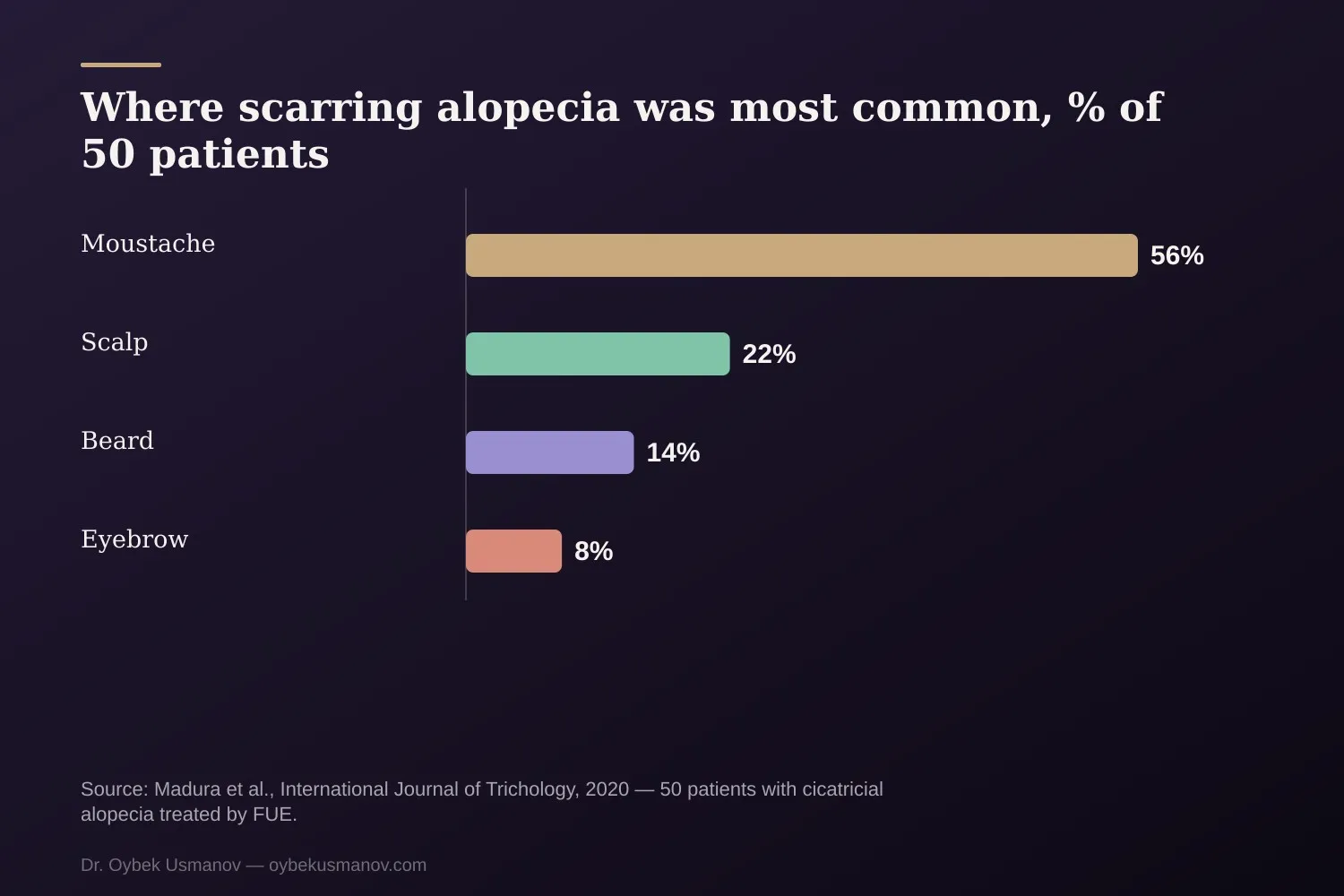
Medical literature studies facial scarring alopecia separately. In a prospective series of 50 patients with cicatricial alopecia treated with FUE, the most commonly affected area was the moustache (56%), then the scalp (22%), beard (14%) and eyebrows (8%). An excellent to very good outcome was rated in 82% of patients, while another 18% were lost to follow-up. The authors stress that the result is good when the stability of the disease is taken into account (Madura et al., International Journal of Trichology, 2020, doi:10.4103/ijt.ijt_52_19).
Where the hair comes from
For a beard the hair is usually taken from the back of the head or from areas near the beard zone, such as the neck and cheeks. The surgeon assesses not only the quantity but the quality of donor hair.
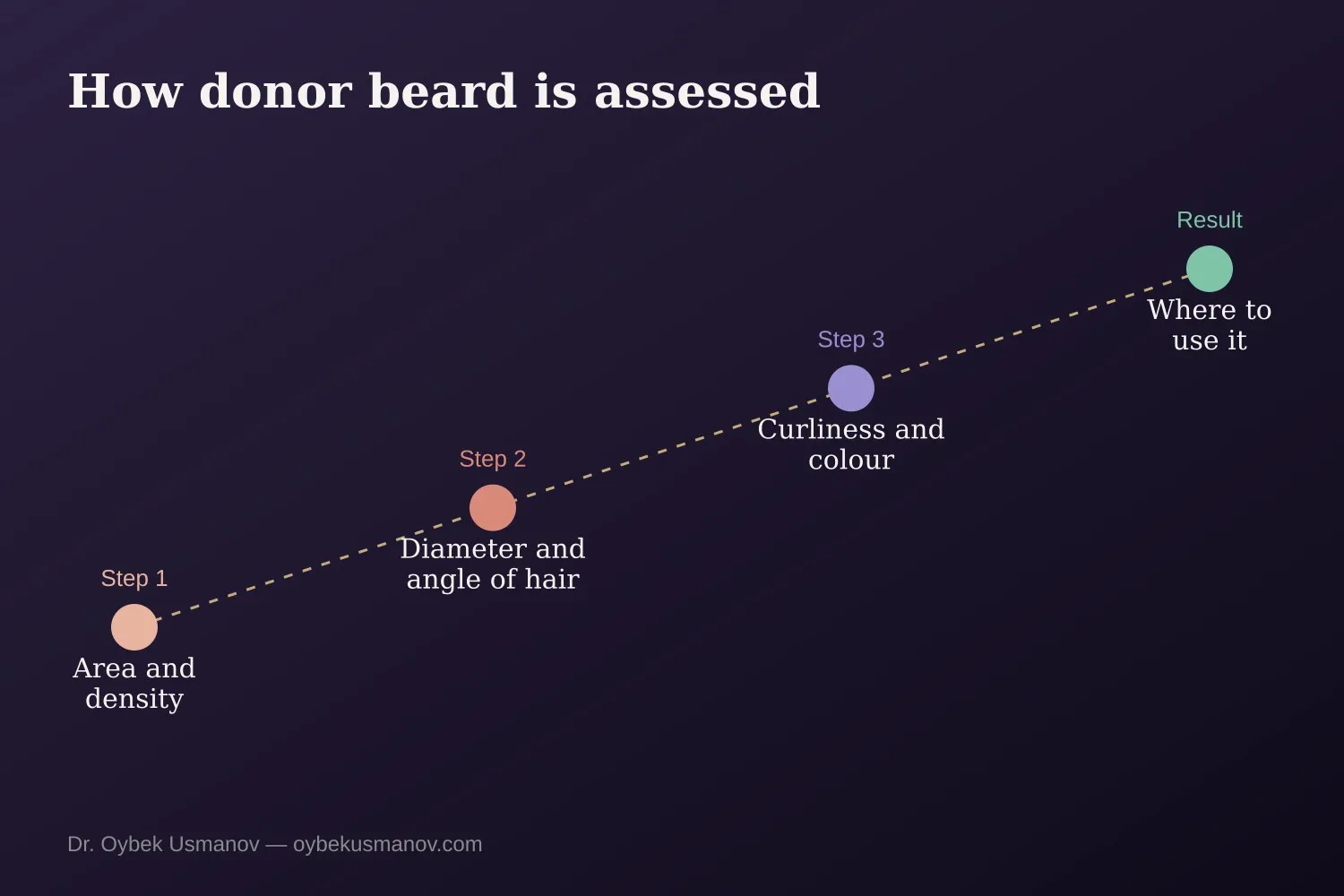
For the donor beard itself (when it is used for hairline or other areas) a two-step evaluation system has been proposed. First suitability is screened: area, density, diameter and angle of the hair to the skin. A beard is judged unsuitable if the donor area is limited to the perioral region, density is below 8 follicular units per cm², diameter below 60 μm or angle to the skin below 10°. Then diameter, curliness and colour contrast with native hair are scored to decide where to use it: thin (60–80 μm), straight hair with minimal contrast suits hairline correction, while thicker hair suits the parietal area (Zhao et al., Dermatologic Surgery, 2025, doi:10.1097/DSS.0000000000004662).
What about scars
Scar tissue has a poor blood supply, which limits graft survival. In a series of 18 patients with post-burn scars in the beard area, nanofat grafting was used before FUE. At 12 months the mean survival of transplanted follicles was 83.2% and patients were satisfied with the result (Evin & Guray Evin, Plastic and Reconstructive Surgery, 2024, doi:10.1097/PRS.0000000000010759).
This is a narrow sample and a special technique, and cannot be transferred to an ordinary beard transplant. But it shows that with scars a result is possible, though it needs preparation.
What to expect and when
- First weeks: scabs and mild swelling as after a scalp transplant; the surgeon sets the care.
- After a few weeks the transplanted hairs usually shed — expected, like shock loss on the scalp.
- New growth appears after a few months, and the result is judged at around a year.
- Timings differ slightly between sources, and your surgeon will give the exact guide.
What we do
Beard transplant is among the clinic’s services. Send photos of your face and the back of your head on WhatsApp — the surgeon will assess whether you have donor hair and whether a transplant is right for you.
This article is general information and does not replace a consultation.