procedures
Hair transplant for women: how it differs and who is a candidate

More and more women come to consultation about a hair transplant, expecting it to go as it does for men. In fact the approach differs: a different pattern of loss, different causes and more care with the donor area. Here is what differs and who is really a candidate.
How women’s hair loss differs
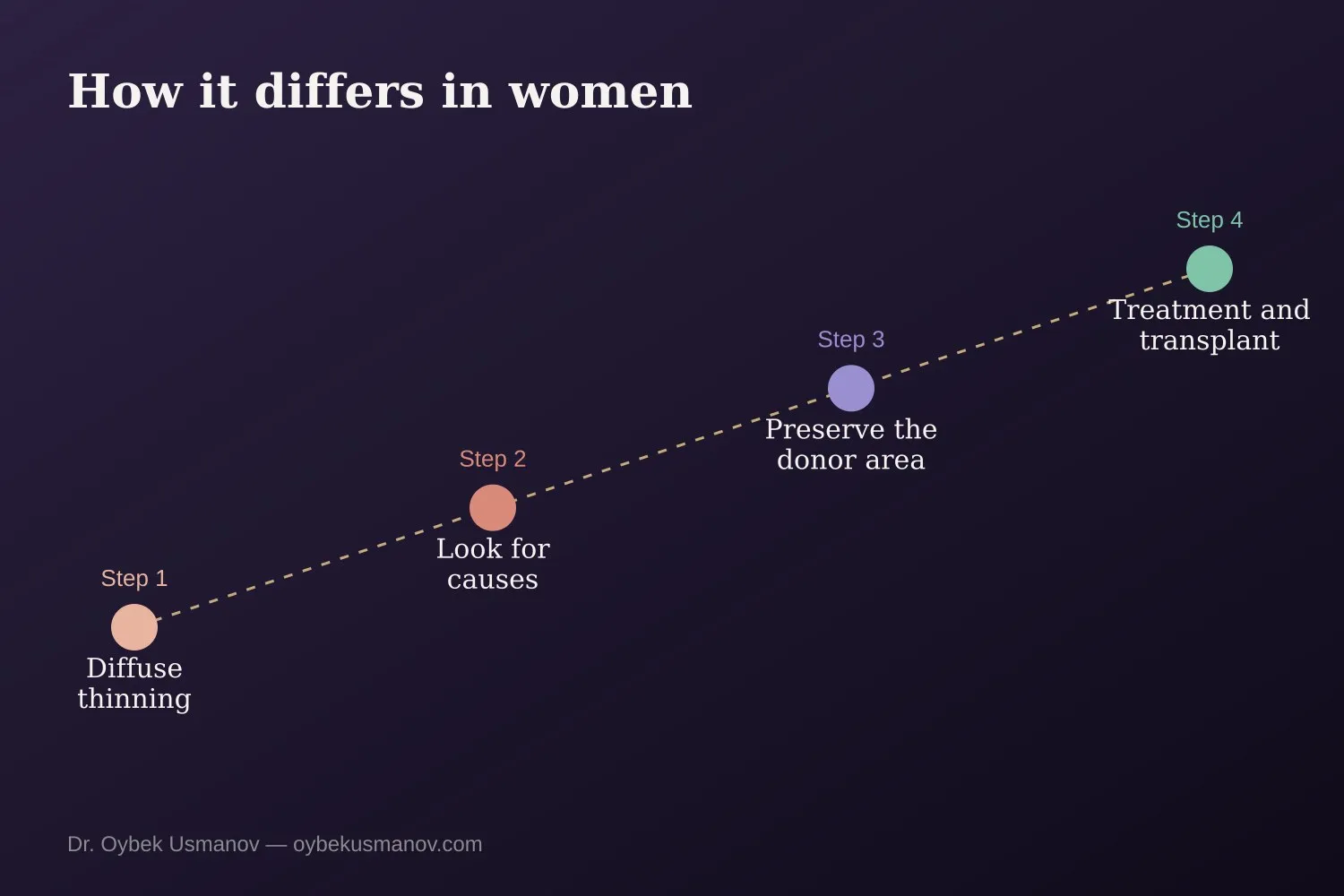
A 2025 review of 24 studies describes the difference this way: women more often have diffuse thinning across the crown and temples, whereas men usually present with localized recession of the hairline and thinning at the crown. Women also present later. Hair loss strongly affects self-esteem in both sexes, but women more often face social pressure (Queen & Avram, Journal of Drugs in Dermatology, 2025, doi:10.36849/jdd.8988).
Causes first
The same review stresses that women should be evaluated for systemic contributors to hair loss and for scarring and traction alopecia. This is not a formality. Diffuse thinning can be linked to hormonal, metabolic and other factors, and a transplant does not treat the cause. So investigation and conservative treatment often come first, with surgery discussed later or as an addition.
Donor area and technique
In women with diffuse loss the donor area may be less reliable. A report of two cases of diffuse alopecia found the occiput, usually presumed a stable donor, also involved; the authors advise verifying it by examination rather than assuming (Xu et al., Frontiers in Medicine, 2026, doi:10.3389/fmed.2026.1797275).
The review also notes technique: women more often choose FUT because it preserves the donor area and allows long hair, whereas men may be treated with FUT or FUE. The aim of a transplant in women is to restore density where it is needed while preserving the donor (Queen & Avram, 2025).
What is said about results
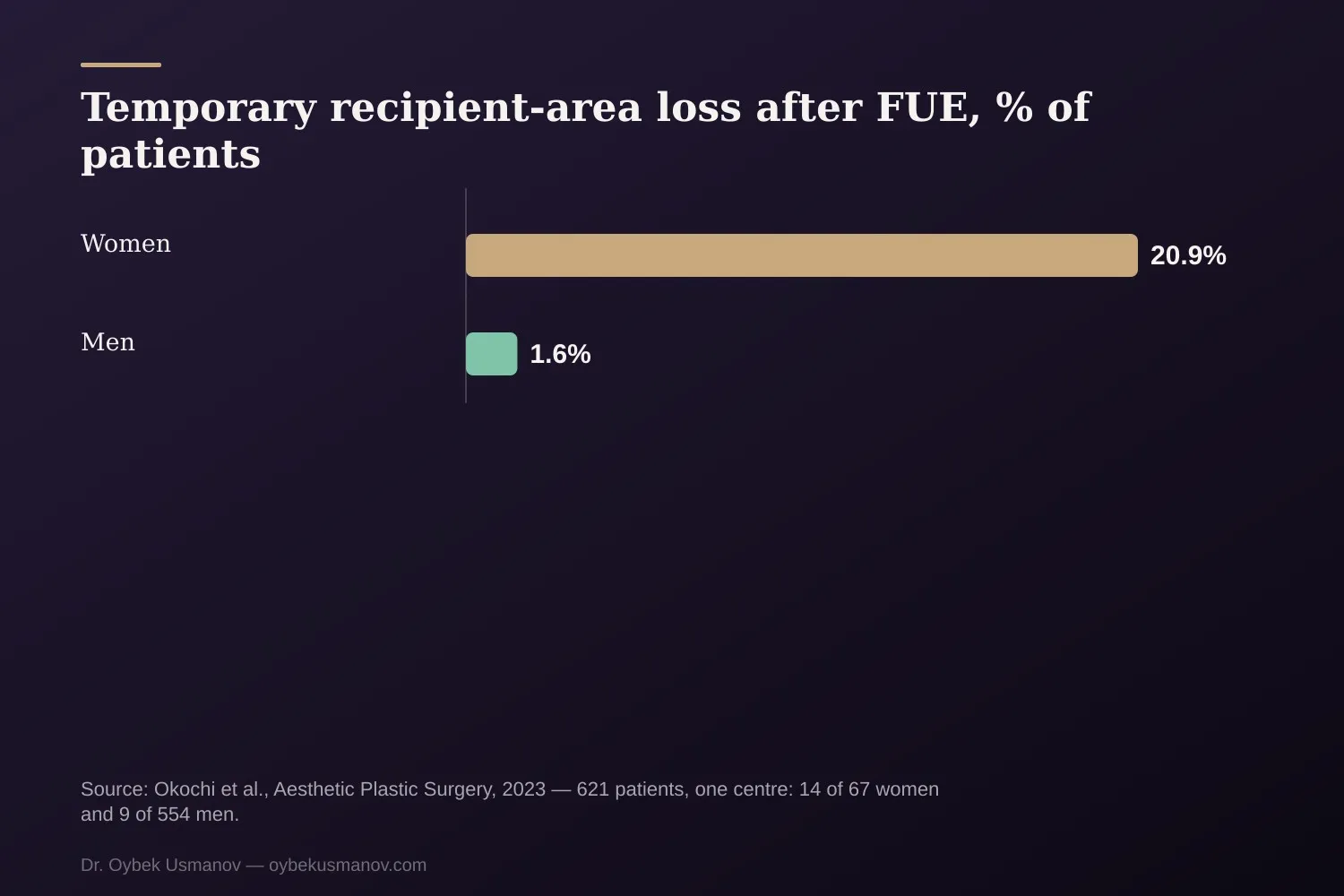
One early-period nuance is worth knowing. In a Japanese study of 621 patients after FUE, temporary loss in the recipient area (shock loss) was noted in 14 of 67 women — roughly one in five — and in only 9 of 554 men. Among women the risk was higher in those over 40 with female pattern hair loss (Okochi et al., Aesthetic Plastic Surgery, 2023, doi:10.1007/s00266-023-03699-z).
This is one clinic, and shock loss here meant temporary thinning of existing hair in the recipient area. It does not mean failure, but it stresses honest preparation and patience.
Who is a candidate
- Localized loss after injury, surgery or burns, with a sound donor area.
- A high hairline someone wants corrected.
- Stable, confirmed forms of loss where the cause is clear and the process is under control.
- Scarring of the scalp when the disease is quiet and inactive: only a doctor decides, after investigation.
What we do
Hair transplant for women is among the clinic’s services. Send photos of your head on WhatsApp (front, top, parting and back) and tell us how long the loss has gone on — the surgeon will say which tests are needed and whether a transplant suits you.
This article is general information and does not replace a consultation.