self-check
The Norwood scale: how to find your stage of hair loss
“What Norwood stage am I?” is a question almost everyone asks before a consultation. The Norwood–Hamilton scale is the best-known classification of male pattern hair loss: it describes where and how much hair recedes. Here is how to use it and where its limits lie.
What the scale is
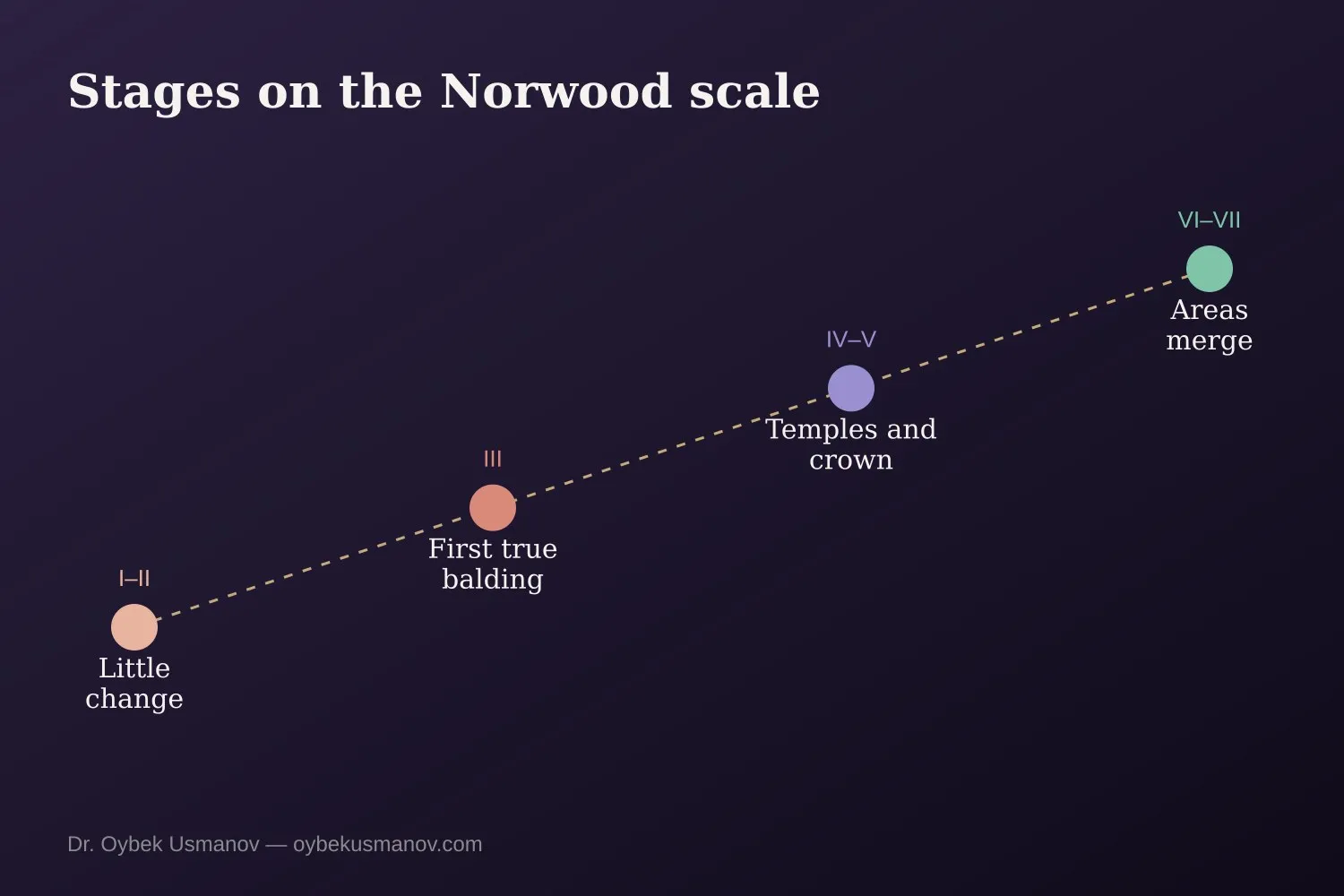
The scale splits male pattern loss into seven stages — from I (hardly any change) to VII (hair remains only at the sides and back). There is also a variant with early thinning at the crown. It is a visual classification: the surgeon looks at the shape of the hairline and the state of the crown.
For women a different scale, the Ludwig scale, is used, because female loss usually shows as diffuse thinning rather than receding corners.
The stages in plain words
- I — the hairline is unchanged or nearly so. No noticeable loss.
- II — slight recession at the temples, a “mature” hairline. For most men this is an age-related norm, not balding.
- III — the first stage counted as balding: the temples have receded deeply. There is a variant with thinning at the crown and almost untouched temples.
- IV — deeper recession at temples and forehead, a separate area of loss at the crown; a strip of hair still lies between them.
- V — the front and crown areas grow, the strip between them becomes narrow and sparse.
- VI — the strip disappears: the front and crown areas merge.
- VII — the most advanced stage: hair remains as a narrow band at the sides and back.
How to find your stage
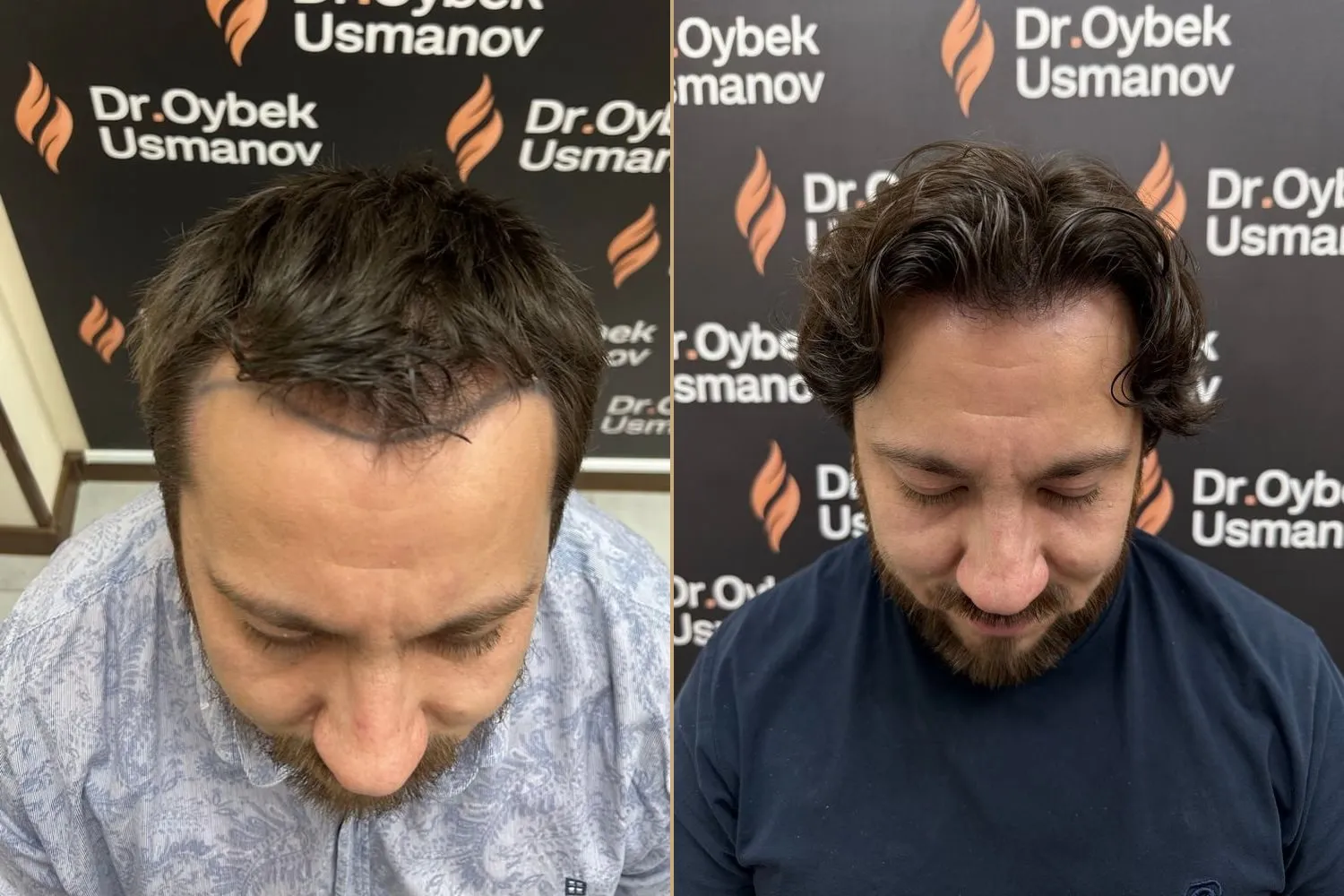
- Take photos in even daylight: front, top, sides and back. You cannot see your own crown, so ask someone or use a second mirror.
- Wet the hair and comb it back: the hairline shows more clearly.
- Compare the photos with the stage descriptions. If you are torn between two, note both.
- Repeat every few months in the same light — the trend matters more than one picture.
Why self-rating goes wrong
Classic scales rely on subjective assessment. The authors of a 2025 paper proposing AI-based grading say it directly: traditional systems, including Norwood–Hamilton, depend on the observer and are limited in accuracy and reproducibility, especially at intermediate grades (Xi et al., Scientific Reports, 2025, doi:10.1038/s41598-025-23561-3).
In practice, “somewhere between III and IV” is a perfectly normal self-assessment. The exact stage is for the surgeon to determine at examination.
What the scale will not tell you
- The cause of the loss. Male pattern loss is the most common cause but not the only one.
- The speed of the process: two heads at the same stage can thin at different speeds.
- Whether a transplant suits you and how many grafts you need. That depends on donor area, density and area, not on the stage alone.
A link to general health
Studies note an association between androgenetic alopecia and lipid and metabolic markers. In a prospective study of 108 men with a control group, the severity of alopecia on the Norwood–Hamilton scale went together with deranged lipid profiles, especially from stage IV. The authors suggest considering early screening for dyslipidemia (Sathyanarayanan & Sundaram, Cureus, 2024, doi:10.7759/cureus.51741).
Note this is an association, not proof that balding causes illness or the other way round. But it is a good reason to have blood tests once a year and discuss them with a physician.
What we do
Our site has a short Norwood scale test to help you orient yourself. And if you send photos on WhatsApp, the surgeon will tell you your stage, the cause of the loss and whether a transplant suits you now.
This article is general information and does not replace a consultation.