procedure
How a FUE hair transplant works: the day of surgery, step by step
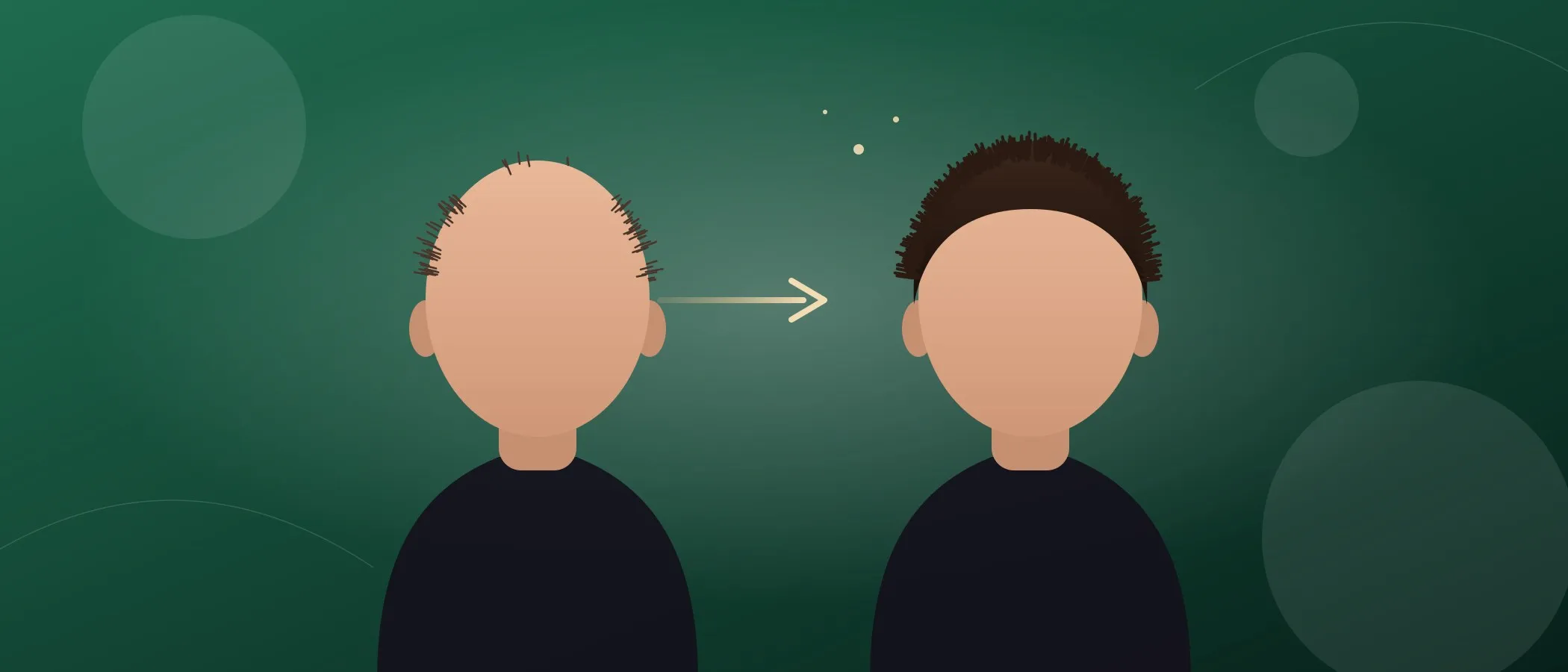
Before a first transplant almost everyone fears the unknown: what exactly will be done, how long will it take, will it hurt. Let us walk through the day of surgery in order. This is the general outline of FUE; the details (timing, order, graft count) depend on your case, and your surgeon will explain them at consultation.
What the day consists of
FUE (follicular unit excision) means extracting individual follicular units from the donor area and placing them in the thinning area. Modern reviews call it the most widely used transplant technique because it is minimally invasive with a fast recovery (Romera de Blas et al., Frontiers in Medicine, 2026, doi:10.3389/fmed.2026.1750989).
An expert consensus on FUE splits a graft’s journey into stages: preparation, harvest, dissection and trimming, preservation, implantation, postoperative care and complication prevention — and shows that the result depends on every link (Zhang et al., Plastic and Reconstructive Surgery, 2025, doi:10.1097/PRS.0000000000012228).
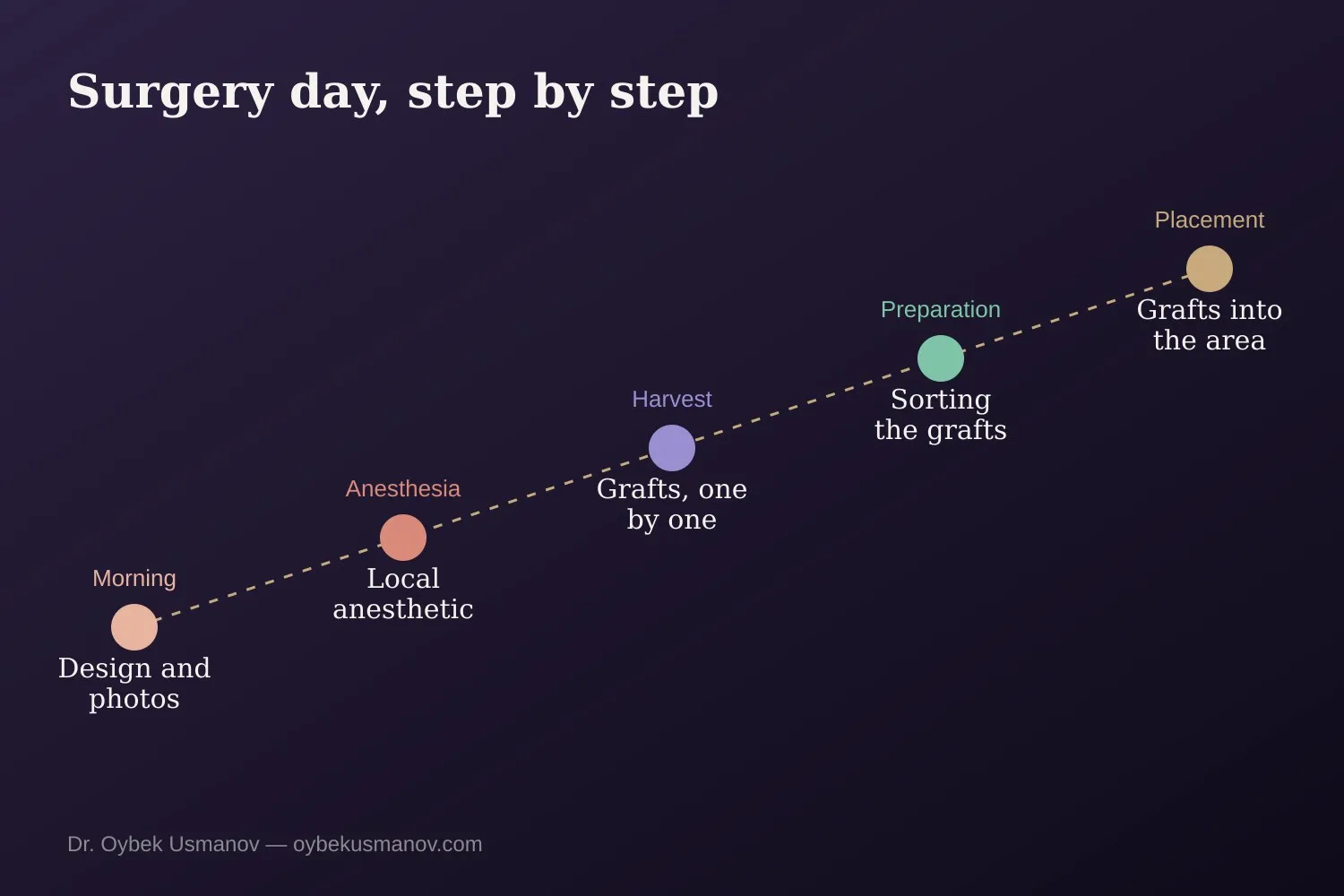
Step 1. Design and photos
The morning starts without a scalpel: the surgeon examines the donor area, takes photos and draws the hairline with you. It has to suit your face and age, not only the wish for “thicker”. This is also when they agree how the donor area will be trimmed.
Step 2. Anesthesia
The operation is done under local anesthesia: both donor and recipient areas are numbed. The unpleasant part is a brief sting at the first injections. After that the skin loses sensation and you feel only touch and pressure. If anything bothers you during the procedure, tell the surgeon right away.
Step 3. Graft harvest
The surgeon extracts follicular units one by one with a small cylindrical punch, usually from the back of the head. Microscopic marks remain and heal without a linear scar.
A key term here is transection: damage to a follicle during harvest. In a small series of 10 patients using a modified punch, the mean transection rate was 3% (Brigante & Wells, Cureus, 2026, doi:10.7759/cureus.102271). That is one author’s data on one technique, not a norm for everyone, but it shows that the care of the tool and the hand can be measured.
Step 4. Preparing the grafts
Extracted grafts are sorted by the number of hairs and kept in a special solution so they do not dry out. It is the invisible part of surgery, but according to the consensus, preservation and gentle handling affect survival.
Step 5. Placement
Grafts are placed in the thinning area. Angle, depth and density are decided here — what makes the result natural: hair must grow in the same direction as your own. That is why we believe the surgeon should do the placement.
During a long operation there are usually breaks so you can stretch, eat and drink water.
What you will feel afterwards
- Numbness and mild tightness of the skin in the first hours as the anesthetic wears off.
- Swelling and scabs in the first days; we wrote about them in the article on the first wash.
- Fine hairs will shed after a few weeks — that is shock loss, and it is expected.
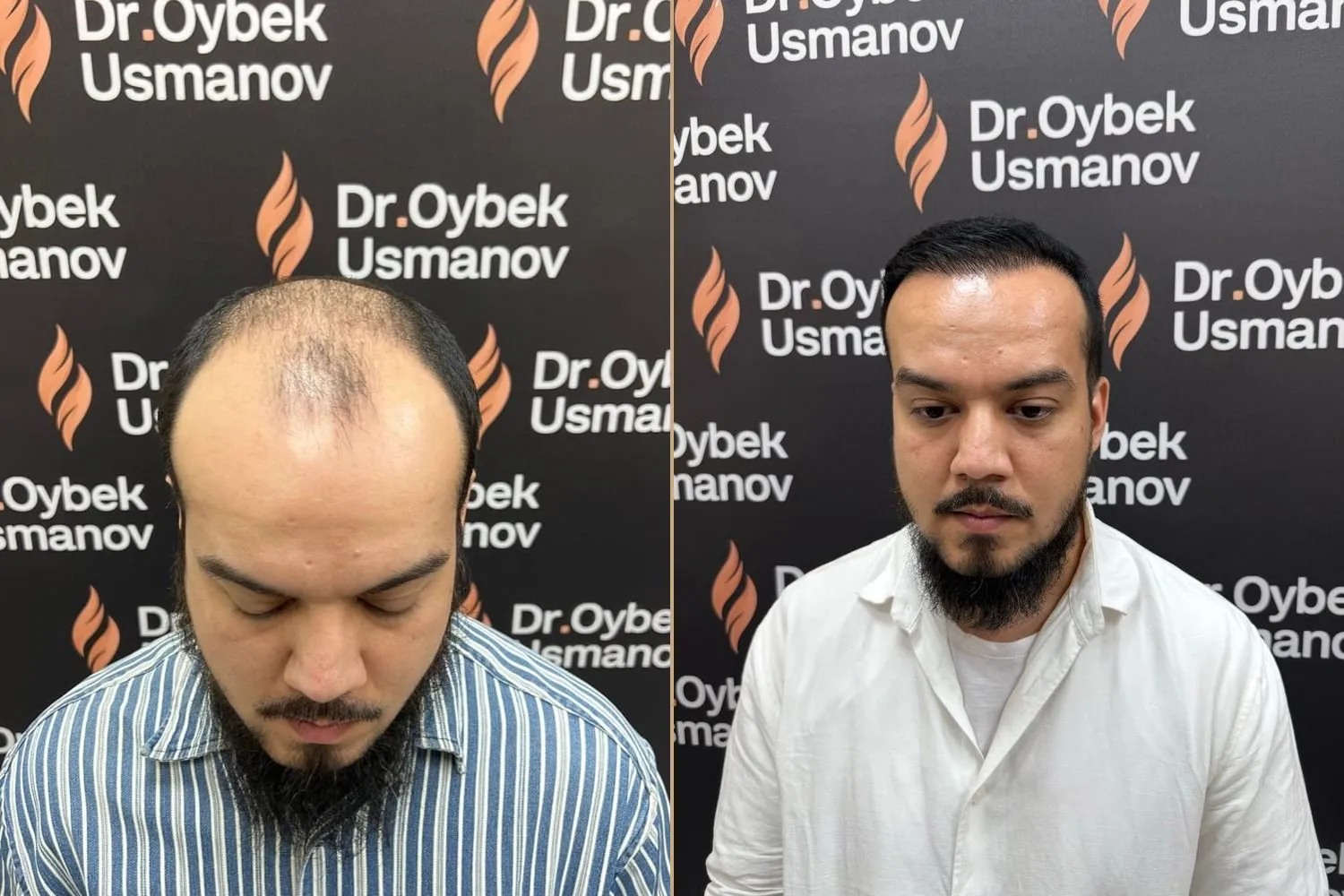
- The result shows at 8–12 months, not earlier.
What we do
At Dr. Usmanov’s clinic the surgeon personally harvests and places the grafts. You can send photos on WhatsApp to find out whether a transplant suits you and how many grafts you need.
This article is general information and does not replace a consultation.