recovery
The first 72 hours after a hair transplant: what is normal and what to do
The first three days after a transplant are the most anxious. The scalp is covered in scabs, the forehead may swell, and the skin alternates between numbness and itching. Most of this is expected. Here is what counts as usual, what studies say, and what you should know before leaving the clinic.
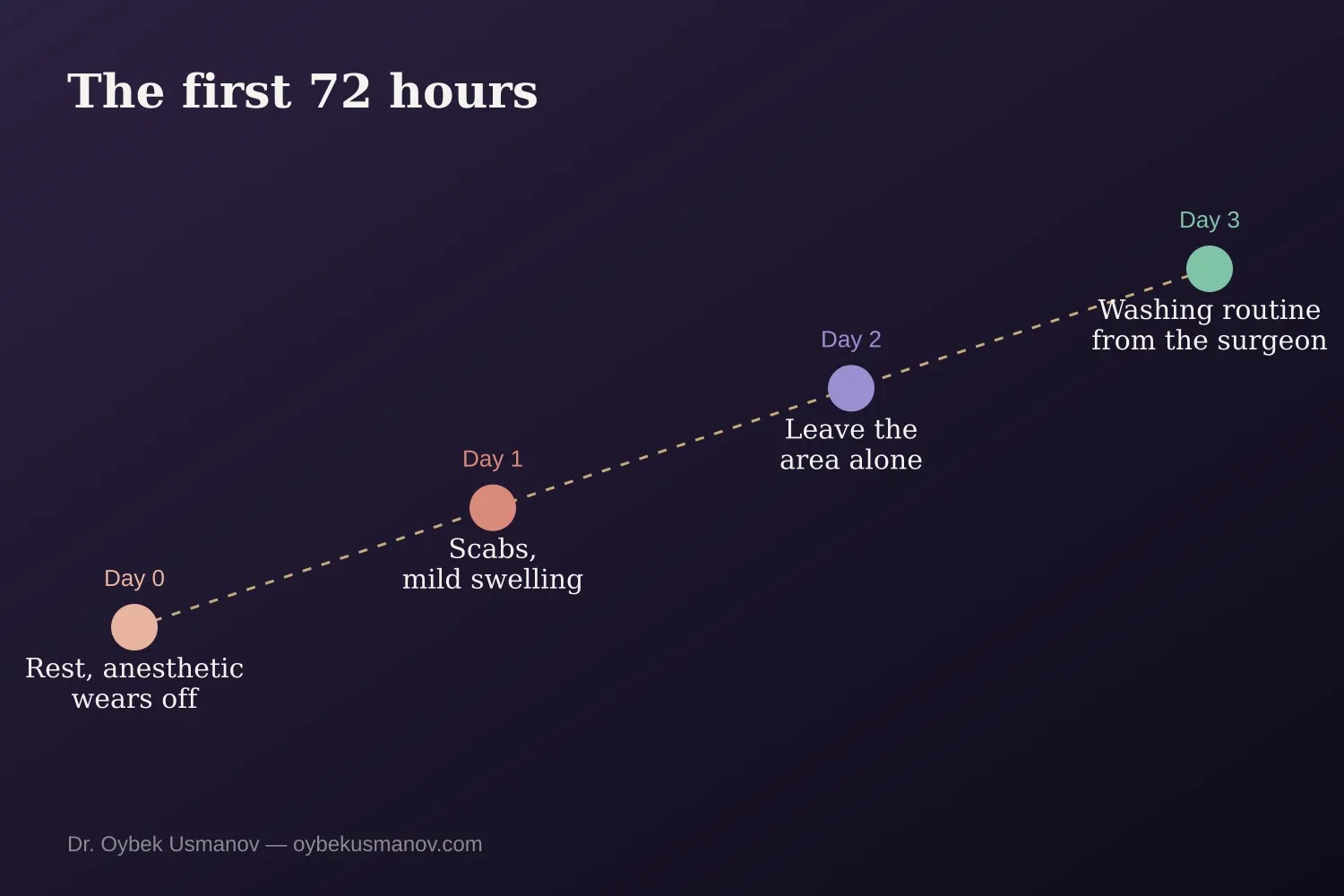
What usually happens
Right after surgery the anesthetic gradually wears off: the skin becomes more sensitive, with mild pain or tightness. Every graft leaves a tiny wound that dries quickly and forms a scab. This is the normal path of healing, not a sign of trouble.
A review of FUE complications lists the common early events as pain, edema, bleeding and infection, with more serious conditions rare (Romera de Blas et al., Frontiers in Medicine, 2026, doi:10.3389/fmed.2026.1750989).
Forehead swelling: what studies say
Swelling of the forehead and eyelids is common, and patients ask most often how to prevent it. An Iranian study of 340 patients split them into eight groups by prevention method. Physical measures — head position during sleep, pressure bands, ice — did not show satisfactory results. The best was adding triamcinolone to the tumescent anesthetic solution: only 3 of 117 patients in that group developed swelling (Gholamali et al., Journal of Cutaneous and Aesthetic Surgery, 2010, doi:10.4103/0974-2077.69018).
This does not mean advice about a raised headboard or cold is harmful: many surgeons give it by habit and for comfort. But prevention done by the surgeon during the operation is more reliable. So at consultation ask how your clinic handles swelling and follow its instructions.
What happens and how often
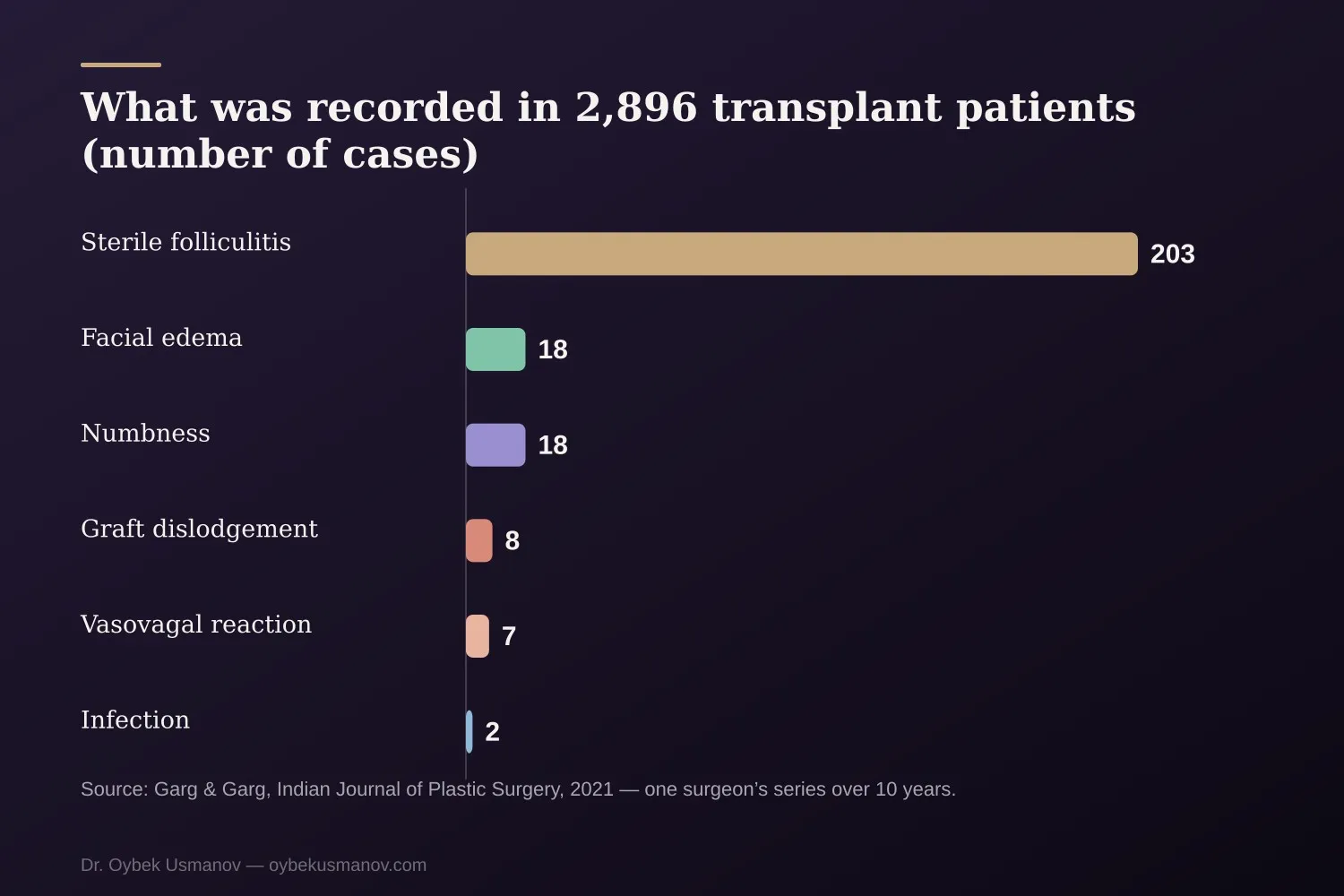
A large series shows the scale. An Indian surgeon operated on 2,896 patients over ten years and recorded every complaint and complication. The most common was sterile folliculitis — 203 patients. Facial edema was noted in 18, numbness in 18, graft dislodgement in 8, a vasovagal reaction in 7 and infection in two diabetic patients. There were no major or life-threatening complications in this series (Garg & Garg, Indian Journal of Plastic Surgery, 2021, doi:10.1055/s-0041-1739255).
That is one surgeon’s data from one clinic, so it cannot be applied to you as a forecast. But it shows the order of magnitude: most events are mild and temporary, and truly serious ones are rare. The author stresses that detailed counselling, history and allergy checks and careful examination reduce risk.
What to do in the first three days
- Follow the clinic’s written routine: what to apply and when — every clinic has its own.
- Do not touch or scratch the area: you can dislodge a graft and introduce infection.
- Do not wash your hair earlier than your surgeon said.
- Avoid exertion, steam rooms, saunas and direct sun until your surgeon allows.
- Take only the painkiller your surgeon prescribed.
- If you are unsure about anything, take a photo and message your surgeon.
When to message your surgeon at once
- Severe, increasing pain that the prescribed painkiller does not ease.
- Fever, chills, pus or a bad smell from the wounds.
- Swelling that grows until you cannot open your eyes, or sharp redness.
- Bleeding that does not stop with pressure.
- Grafts clearly displaced or lost with blood.
What we do
After surgery the patient receives a care routine and stays in touch with the surgeon. If you are only planning a transplant, send photos on WhatsApp — the surgeon will explain how recovery goes in your case.
This article is general information and does not replace a consultation.