causes of hair loss
Dandruff and hair loss: are they linked and what do studies say
Dandruff, itching and hair loss often occur together, and many think dandruff “kills” hair. The data are more complex. Below is what PubMed studies show and what they do not.
This article is general information: diagnosis and treatment are for a doctor to determine in person.
What was found in dandruff
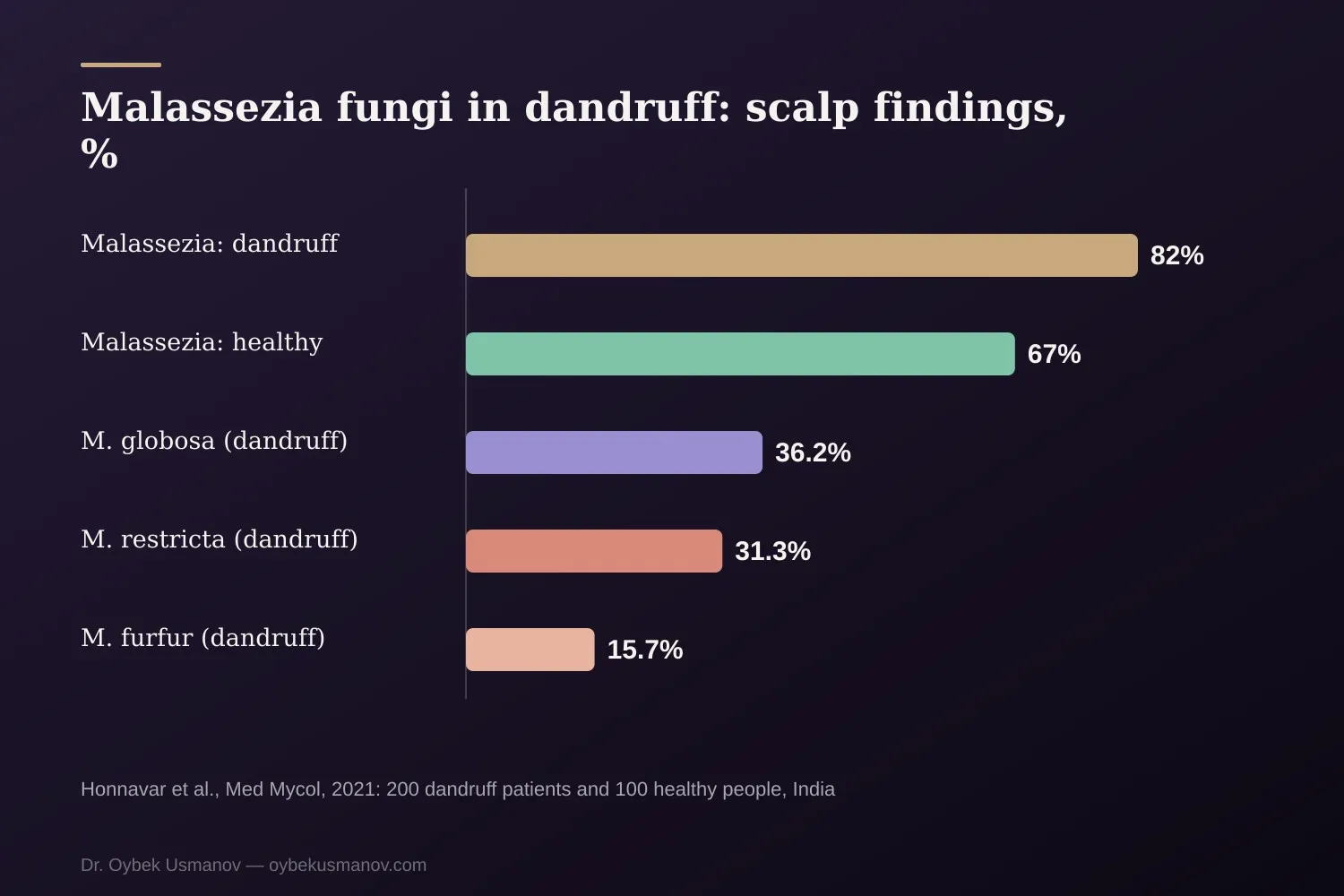
In a study of 200 patients with seborrhoeic dermatitis or dandruff and 100 healthy people in India, Malassezia fungi were isolated from the scalp in 82% of patients and 67% of healthy people. The commonest were M. globosa (36.2%), M. restricta (31.3%) and M. furfur (15.7%); M. restricta in particular was significantly more common in dandruff than in healthy people. Severe forms were more frequent in rural residents. The authors write that moderate to severe hair loss and itching were strongly associated with dandruff (Honnavar et al., Medical Mycology, 2021, doi:10.1093/mmy/myaa050).
Important: Malassezia is found in healthy people too, so the fungus alone does not equal disease, and the study covers one country and one group.
The scalp microbiome
A systematic review of the hair-follicle microbiome (55 studies, 1,811 patients) showed that in seborrhoeic dermatitis and dandruff, as well as scarring alopecias and acne, the share of Staphylococcus is more often raised; in seborrhoeic dermatitis and dandruff Cutibacterium is reduced, whereas Cutibacterium acnes appears more prevalent in androgenetic alopecia. The authors stress the strong heterogeneity of methods and that the causal significance of these shifts is unclear (Franz et al., Clinical and Experimental Dermatology, 2026, doi:10.1093/ced/llag251).
Another review notes that in seborrhoeic dermatitis Malassezia, Staphylococcus and Brevibacterium are increased, and antifungals remain a mainstay of treatment (Shah et al., Archives of Dermatological Research, 2024, doi:10.1007/s00403-024-03235-2).
The upshot: dandruff is a sign of an inflammatory scalp state, but this does not prove it causes hair loss by itself.
When to see a doctor
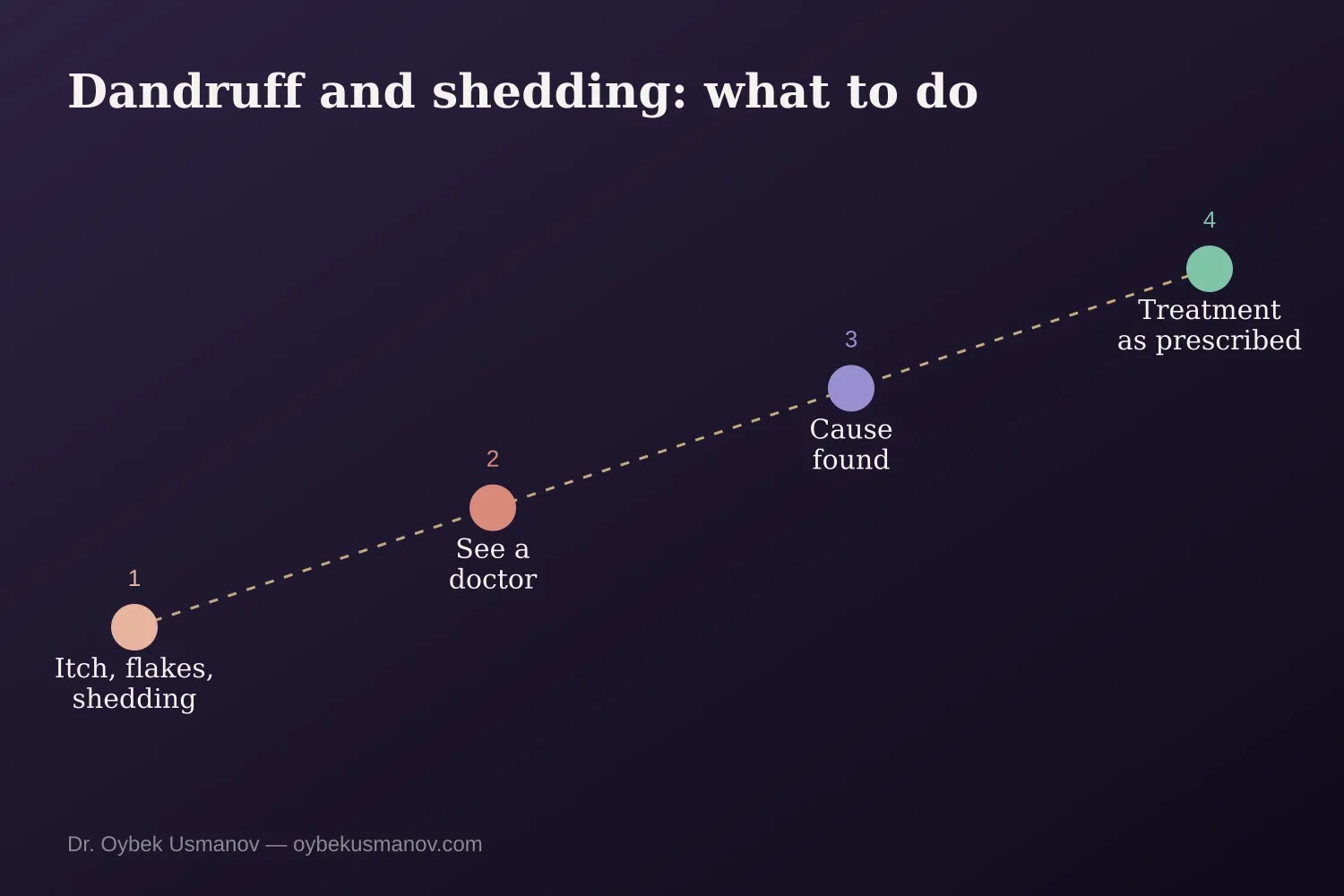
- If dandruff comes with severe itching, redness or crusts.
- If hair thins, bald patches appear or shedding increases.
- If ordinary dandruff products do not help.
- If flaking appears on the face or other areas: seborrhoeic dermatitis is possible.
- Do not choose medicines and supplements on your own.
What we do
If your hair loss turns out to be androgenetic alopecia, we will discuss options including transplant, and say honestly when it is not needed. Send photos of your head on WhatsApp and tell us about the dandruff and itching.
This article is general information and does not replace a consultation.