basics
The donor area: why the whole result of a hair transplant depends on it
When people talk about a transplant they usually discuss the hairline and graft count. But the main question is where the hair comes from. The donor area is a resource that cannot be replenished, and how it is handled decides both today’s result and your options in ten years. Here it is in plain words.
What the donor area is
It is the area at the back and sides of the head where hair is usually resistant to androgenetic balding, so follicles taken from there keep their properties and go on growing in the new site. In Orentreich’s donor dominance theory this is the “safe donor area”. Indian authors stress that knowing its limits is important to avoid losing transplanted hair (Punia et al., Indian Journal of Plastic Surgery, 2024, doi:10.1055/s-0044-1787655).
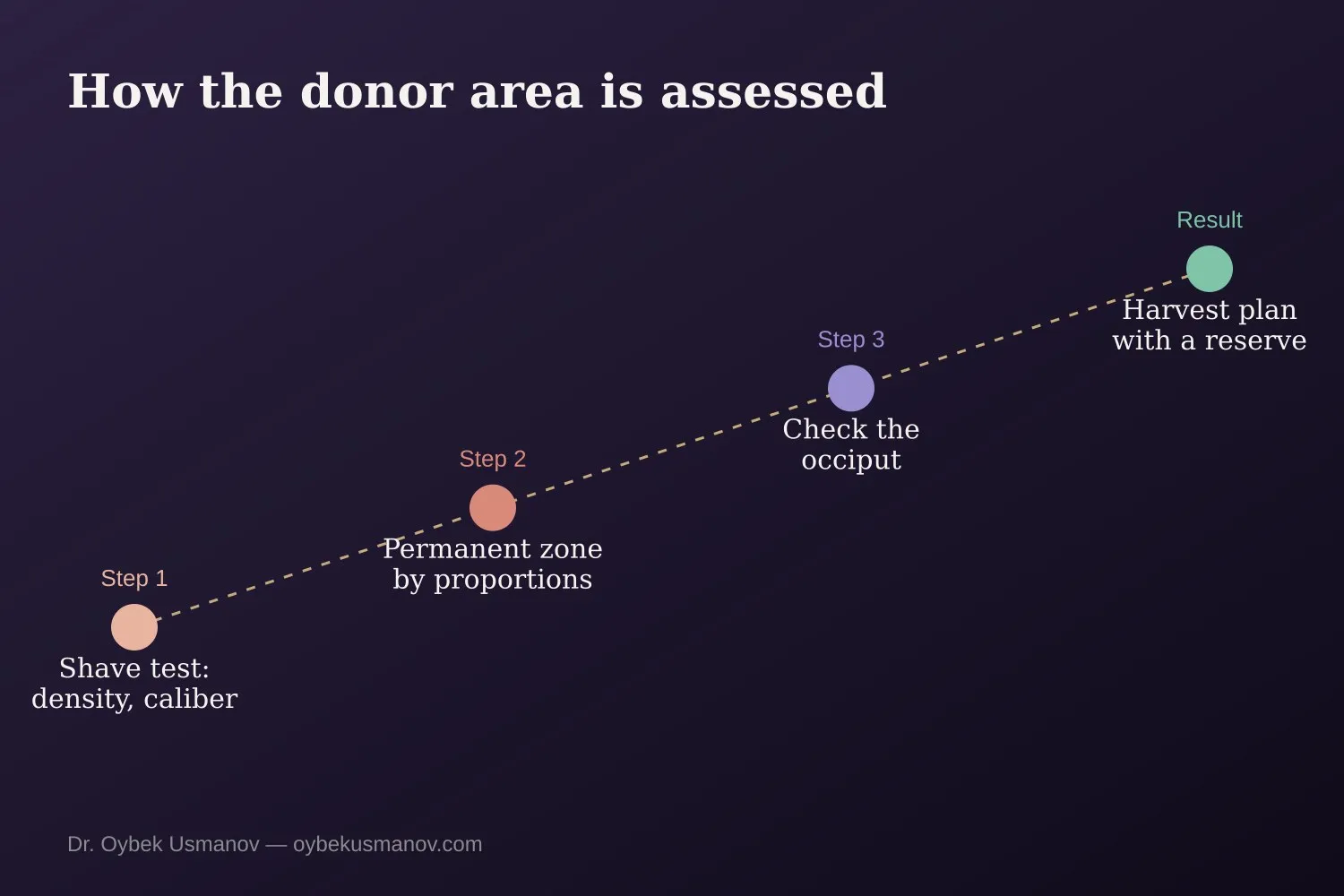
How the permanent zone is assessed
The limits of the “safe” zone differ between people, and general diagrams do not fit everyone. A study from India proposed calculating the permanent zone from the patient’s own head proportions: the distance from the vertex to the point where occipital hair quality and density change, divided by the whole distance to the occipital protuberance. The range found was 0.43–0.53. In patients where this method was applied, over 90% had no significant reduction in density of transplanted hair (Punia et al., 2024).
Another approach is the shave test. In a series of 128 patients the surgeon shaved an area before surgery and assessed density and caliber of the hair to tell permanent from non-permanent donor sites (Umar, Aesthetic Surgery Journal, 2015, doi:10.1093/asj/sjv137).
Why the occiput cannot be trusted by default
In diffuse loss the occiput may be involved too. In a report of two men with diffuse alopecia, trichoscopy and biopsy showed follicular miniaturization at the occiput as well; the authors stress that donor stability should be confirmed, not assumed (Xu et al., Frontiers in Medicine, 2026, doi:10.3389/fmed.2026.1797275). So before surgery the surgeon must assess your own donor.
What affects the donor area after surgery
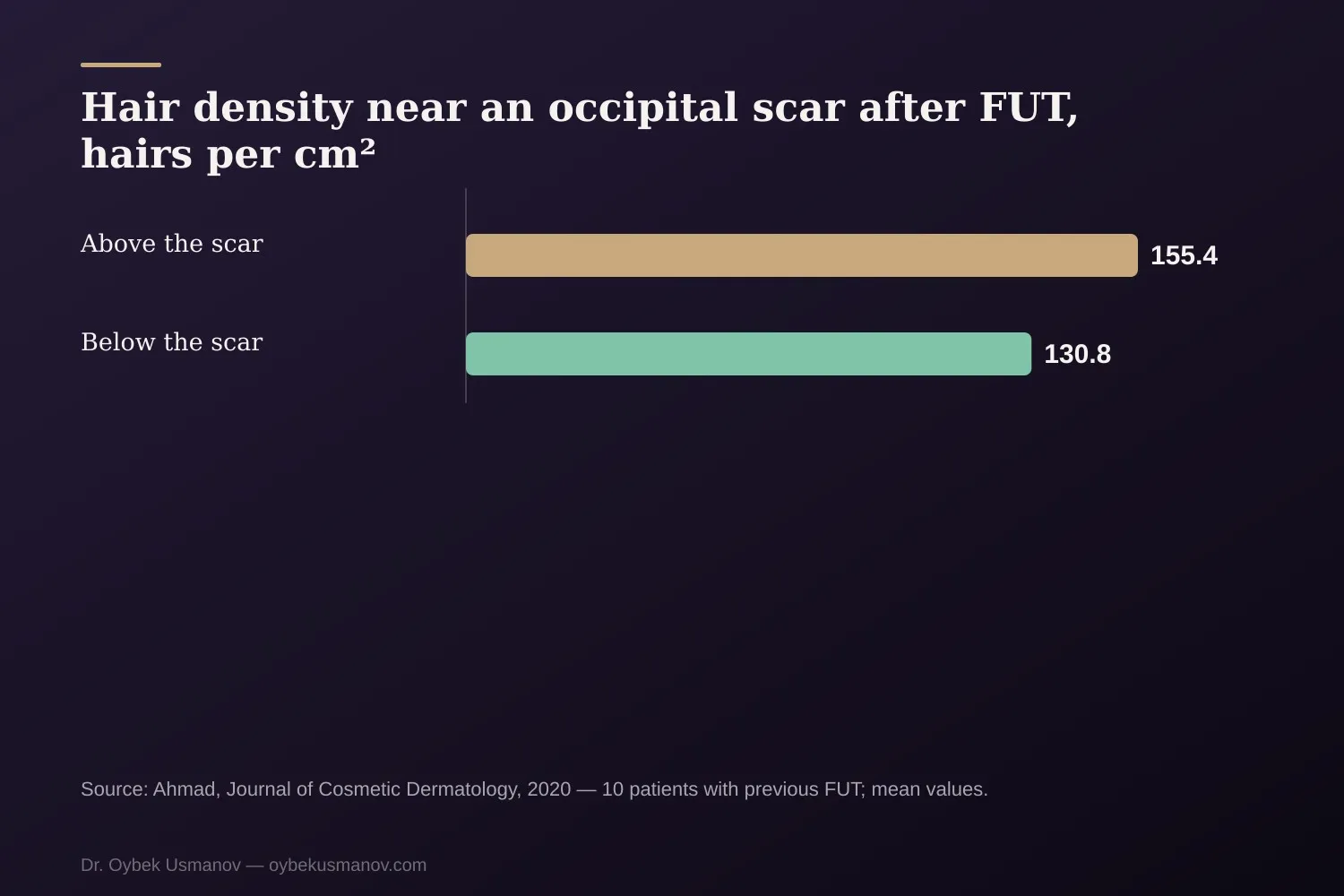
The harvest method matters. In a study of 10 patients with previous FUT (strip surgery), density around the occipital scar was measured: above the scar it averaged 155 hairs per cm², below it 131. The author concludes that FUT affects the donor area beyond the scar itself (Ahmad, Journal of Cosmetic Dermatology, 2020, doi:10.1111/jocd.13325). It is a small series, but it shows why gentle harvesting and planning matter so much.
What this means for you
- The donor supply is limited: it must be spent with the future in mind, not all at once.
- The surgeon should assess your own donor, not rely on a general “norm”.
- In diffuse loss the donor needs special checking, often with trichoscopy.
- The gentler the harvest, the more hair remains for a possible repeat procedure.
- If donor hair is scarce, other sources such as the beard are discussed, but only the surgeon decides.
What we do
The surgeon assesses the donor area from photos and on examination. Send photos of the back and sides of your head in good light on WhatsApp, and we will tell you what donor you can count on.
This article is general information and does not replace a consultation.