procedures
Eyebrow transplant: who is a candidate, where hair comes from and what result is realistic
Eyebrows set the expression of the face, and when they are sparse, asymmetric or lost after injury or burns, it is very noticeable. An eyebrow transplant (FUE) is one of the most delicate operations: direction of growth, angle and naturalness matter most. Here is who it suits and what studies actually show.
Who is a candidate
People most often come with sparse or asymmetric eyebrows, after injury or burns, after a failed correction or tattooing, or with areas where hair stopped growing. If the cause is an active condition (for example autoimmune or inflammatory), it must be brought under control first: the surgeon decides.
Where the hair comes from
Eyebrow hair is fine, so donor hair is chosen for its caliber. In a Chinese study of 81 patients, hair from the area behind the ear was used: it grows slowly and is fine, like eyebrow hair. On average about 400 follicular units were transplanted in women and about 480 in men, and surgery took three to four hours. No significant complications were noted over 15 months of follow-up, and mean satisfaction was 4.90 out of 5 (Cheng et al., Journal of Plastic, Reconstructive & Aesthetic Surgery, 2024, doi:10.1016/j.bjps.2024.09.008).
This is one clinic and a retrospective study, but it shows why a surgeon does not use just any hair for eyebrows: the choice of donor determines naturalness.
What about scars and burns
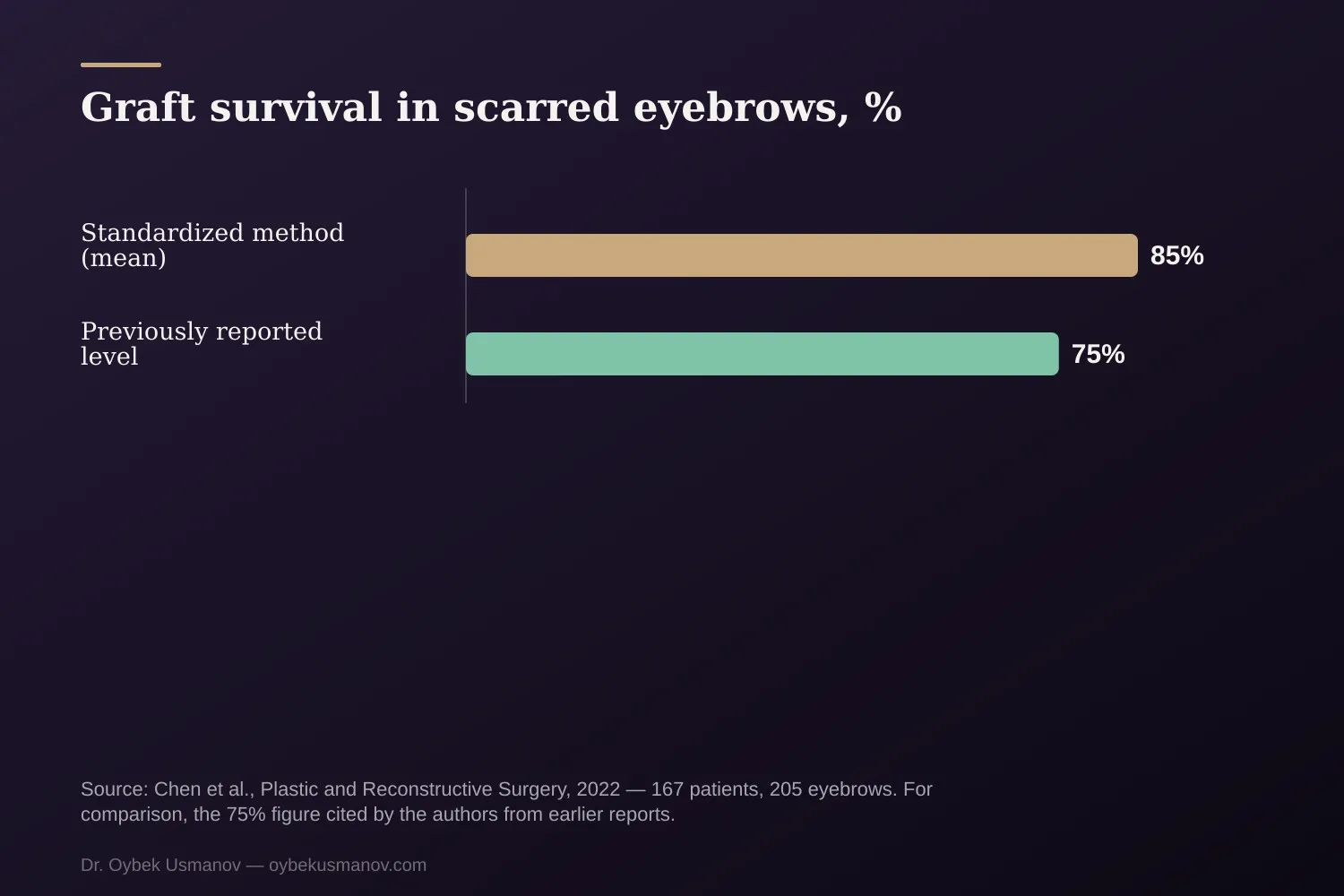
Scar tissue has a poorer blood supply, so survival is lower. In a series of 167 patients (205 eyebrows) with eyebrow loss from scarring, a standardized method with single-hair transplantation gave a mean graft survival of 85% (range 70–90%), and 95% of patients were highly satisfied with density and natural look. The authors compare this with 75% reported earlier (Chen et al., Plastic and Reconstructive Surgery, 2022, doi:10.1097/PRS.0000000000009564).
Preparing the scar also matters. In a randomized study of 30 patients with post-traumatic eyebrow scars, fractional laser before transplantation raised follicle survival, while without it asymmetry and curly hairs were more frequent (Xue et al., Journal of Cosmetic Dermatology, 2024, doi:10.1111/jocd.16518).
Honest expectations after severe burns
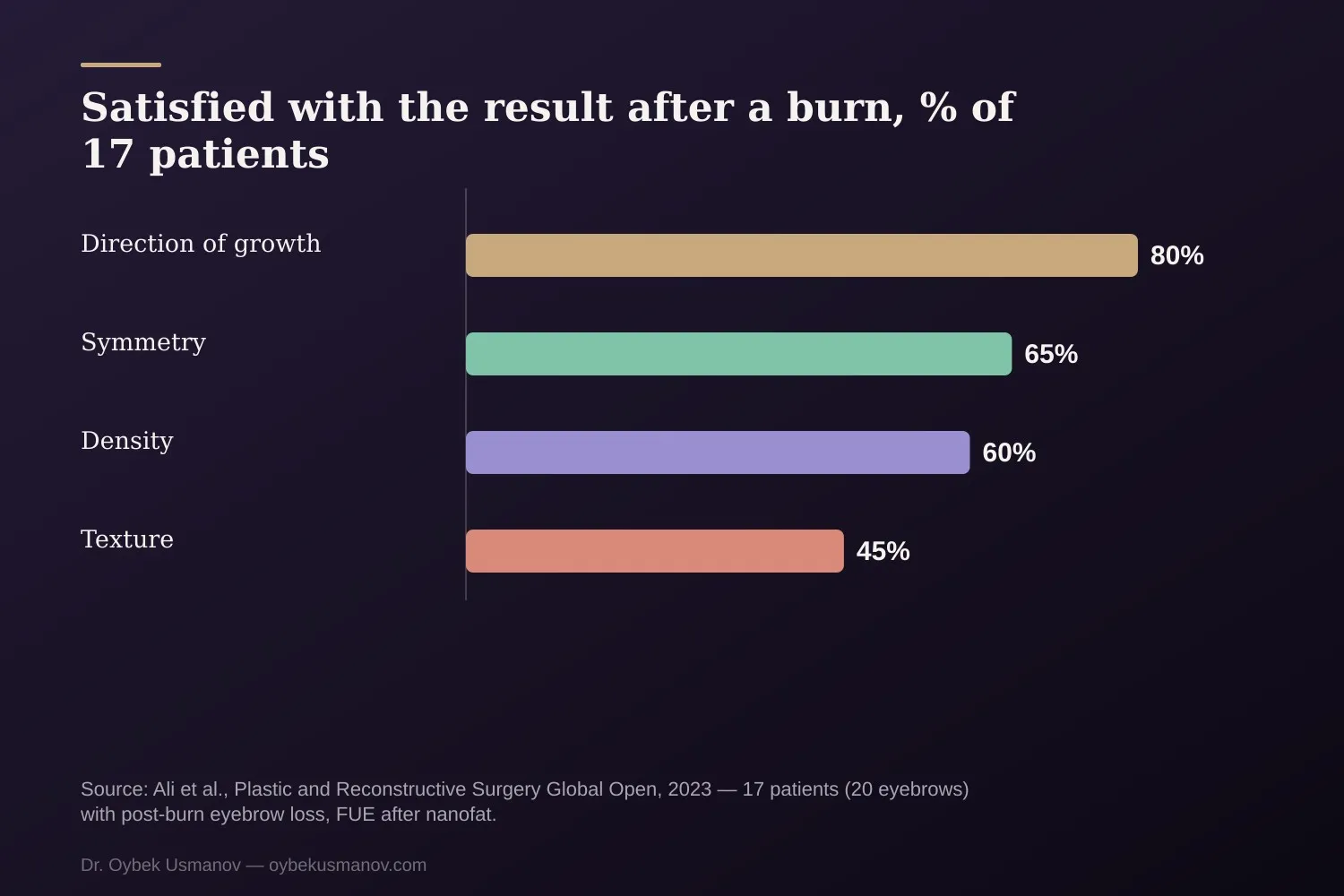
Not all results are equally good. In a series of 17 patients with eyebrow loss after deep burns who had FUE after scar preparation with nanofat, density on the transplanted side was about 89 hairs per cm² versus 134 on the healthy side. Satisfaction was 80% for direction, 65% for symmetry, 60% for density and 45% for texture (Ali et al., Plastic and Reconstructive Surgery Global Open, 2023, doi:10.1097/GOX.0000000000005331).
The honest takeaway: with marked scarring a result is real but may not be perfect, and it is important to discuss that with your surgeon beforehand.
What to consider before surgery
- The shape and width of the brow are set by the surgeon with you; face, age and fashion all play a part.
- Eyebrows do not grow at once: the hairs usually shed first and growth starts later.
- New eyebrows, like any transplanted hair, need trimming from time to time.
- If you have tattooed brows, say so: in one study patients without tattoos had higher satisfaction on average.
- Whether a second stage is needed is decided later, once the result has settled.
What we do
Eyebrow transplant is among the clinic’s services. Send photos of your face on WhatsApp and the surgeon will tell you whether a transplant suits you and what result to expect.
This article is general information and does not replace a consultation.