
treatment
Finasteride and minoxidil: why they are prescribed alongside a hair transplant

Almost everyone planning a transplant hears about medication from the surgeon: finasteride and minoxidil. Patients are often surprised: “Why pills if I am having surgery?” Here is why, what studies show and which risks you should know. Important: this is a general article. Medication and doses are prescribed only by a doctor after examination.
Why medication if you are having a transplant
A transplant puts hair back in the thinning area but does not stop androgenetic alopecia. Your own hair beside the transplanted hair keeps thinning, and over time this can look unnatural. So surgeons often combine surgery with treatment that slows progression. As of 2018 only topical minoxidil and oral finasteride were approved by the FDA and EMA for androgenetic alopecia (Lee et al., Journal of Drugs in Dermatology, 2018).
A 2025 network meta-analysis comparing combinations with minoxidil found that in men the most effective was finasteride combined with minoxidil (Xia et al., Frontiers in Medicine, 2025, doi:10.3389/fmed.2025.1638496).
What studies show about finasteride
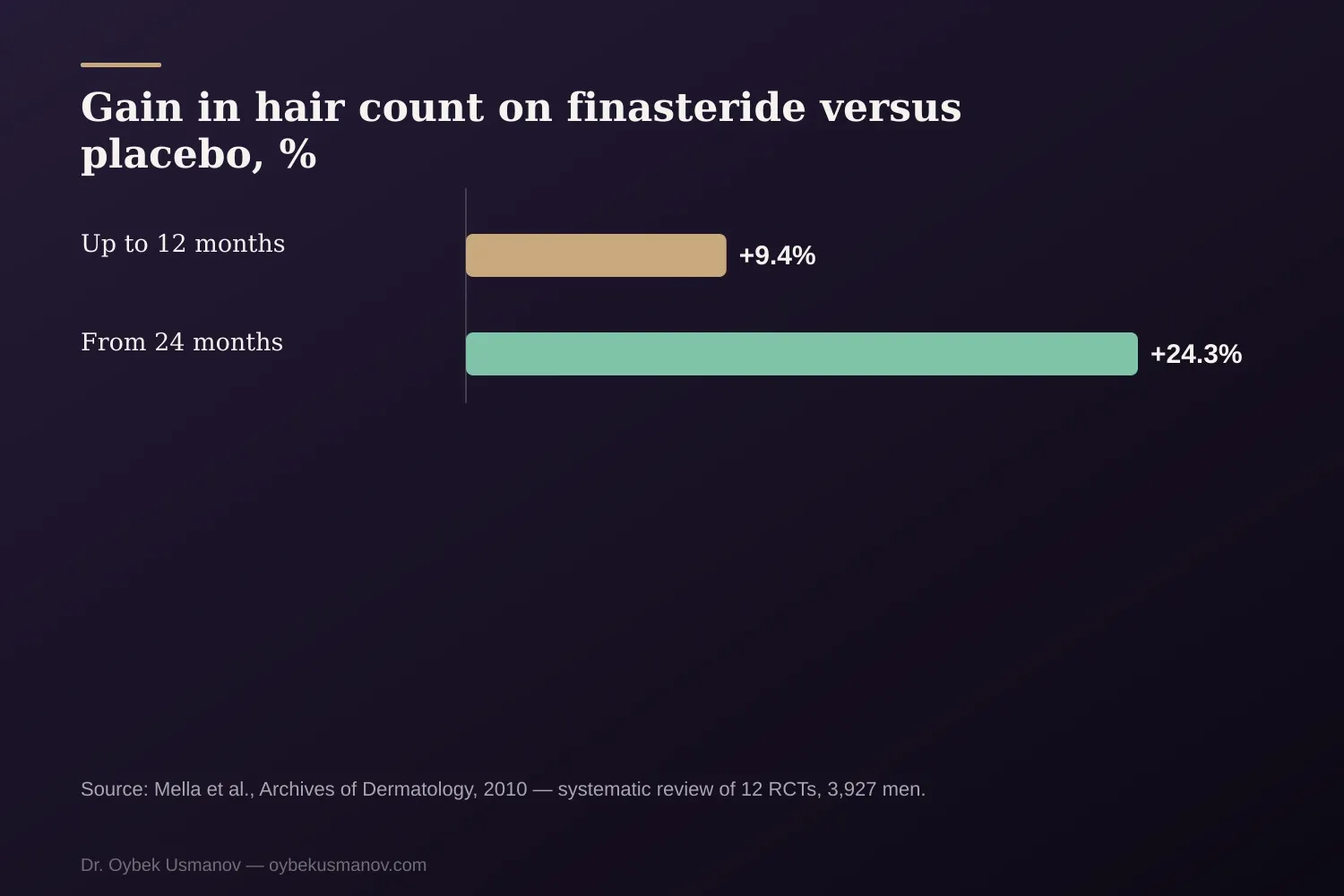
A systematic review of 12 randomized trials with 3,927 men compared finasteride with placebo. The proportion of men reporting improvement was higher both in the first year (relative risk 1.81) and in the long term. Hair count on finasteride rose versus placebo by 9.4% over a year and by about 24.3% at two years and longer (Mella et al., Archives of Dermatology, 2010, doi:10.1001/archdermatol.2010.256).
The same authors describe the risk honestly: erectile dysfunction was more common (relative risk 2.22; about one extra case per roughly 82 people), and the overall risk of sexual disturbances could be somewhat higher. The share who stopped because of sexual side effects was close to placebo.
What studies show about minoxidil
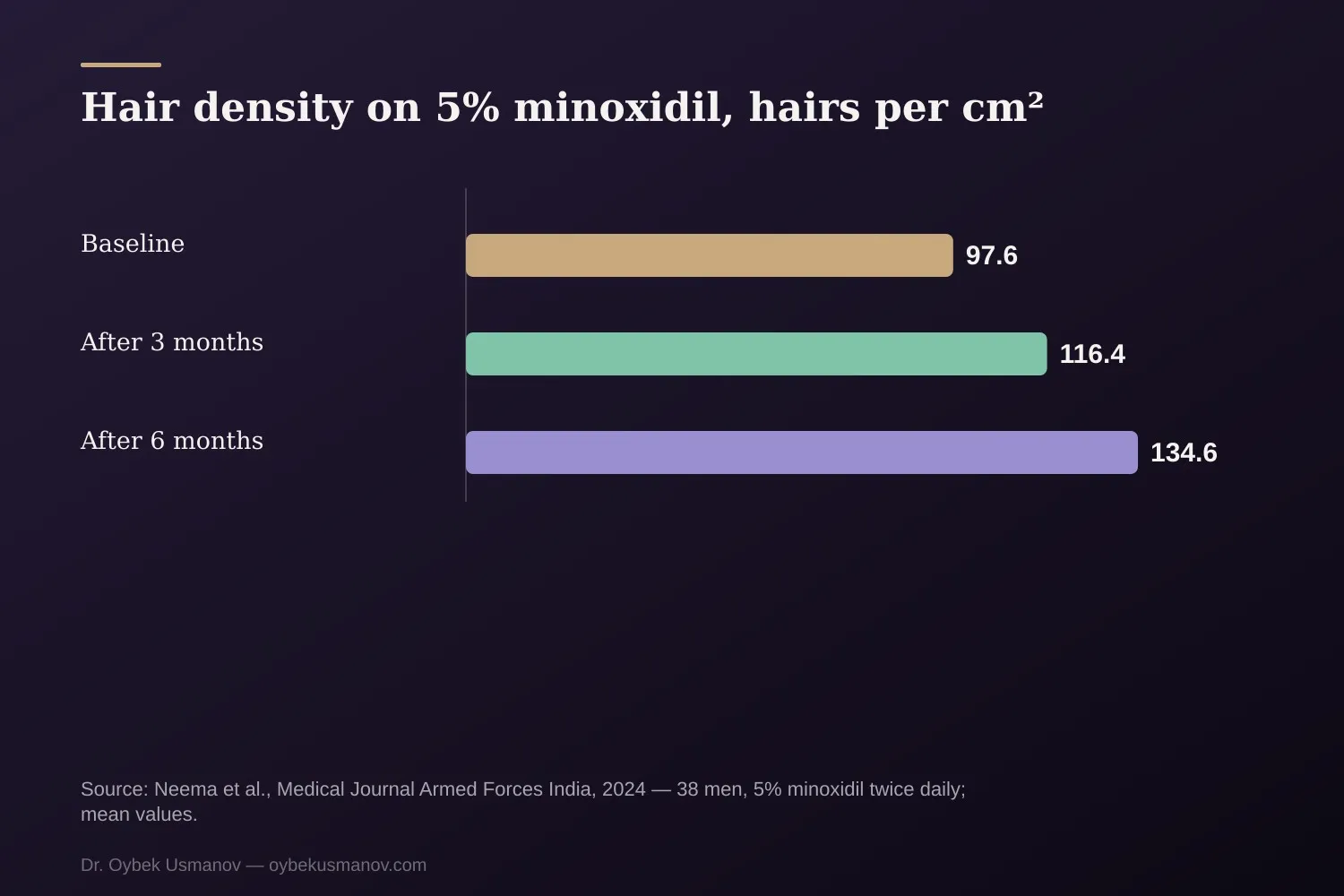
Minoxidil is applied to the scalp and remains the best-known treatment for androgenetic alopecia. In a randomized trial, 38 men who completed six months of 5% minoxidil twice daily saw mean density rise from 97.6 to 134.6 hairs per cm², with no major adverse events recorded. The result was close to that of low-level light therapy (Neema et al., Medical Journal Armed Forces India, 2024, doi:10.1016/j.mjafi.2024.03.006).
A meta-analysis of four randomized trials (279 patients) compared oral and topical minoxidil: no difference in hair density or diameter, while excess body hair was more common with oral use (Sobral et al., International Journal of Dermatology, 2024, doi:10.1111/ijd.17524). The choice of form and dose is a matter for the doctor.
What to discuss with your doctor first
- Your illnesses, blood pressure, heart and current medication: they decide whether the drugs suit you.
- Possible side effects and what to do if they appear.
- What happens if you stop: the effect is supportive, and on stopping the process usually resumes.
- Whether you need the drugs at all, in what form and for how long.
- For women the regimen is chosen differently; general advice does not apply here.
What we do
The surgeon will decide whether you need medical support before or after a transplant and explain the risks. Send photos of your head on WhatsApp and tell us which medication you take and whether you have chronic conditions.
This article is general information and does not replace a consultation.