
preparation
Smoking and hair transplants: does it affect graft survival and when to quit

“I smoke. Can I have a transplant?” is a question we hear often. Almost every clinic asks you to stop smoking before and after surgery. Let us look at what that rests on, what data exist and what they lack. A frank note up front: we found no study in PubMed that directly measured graft survival in smokers versus non-smokers.
What is known specifically about hair transplants
A review of FUE complications lists smoking among patient factors that influence complications, alongside comorbidities and medication (Romera de Blas et al., Frontiers in Medicine, 2026, doi:10.3389/fmed.2026.1750989).
Still, the picture is mixed. In a Japanese study of 621 patients after FUE, smoking, alcohol and diabetes were tested as possible factors for temporary hair loss in the recipient area, but only sex proved significant (Okochi et al., Aesthetic Plastic Surgery, 2023, doi:10.1007/s00266-023-03699-z). That is no excuse for smoking: it concerned one specific outcome, not graft survival and healing as a whole.
What is known about healing after surgery in general
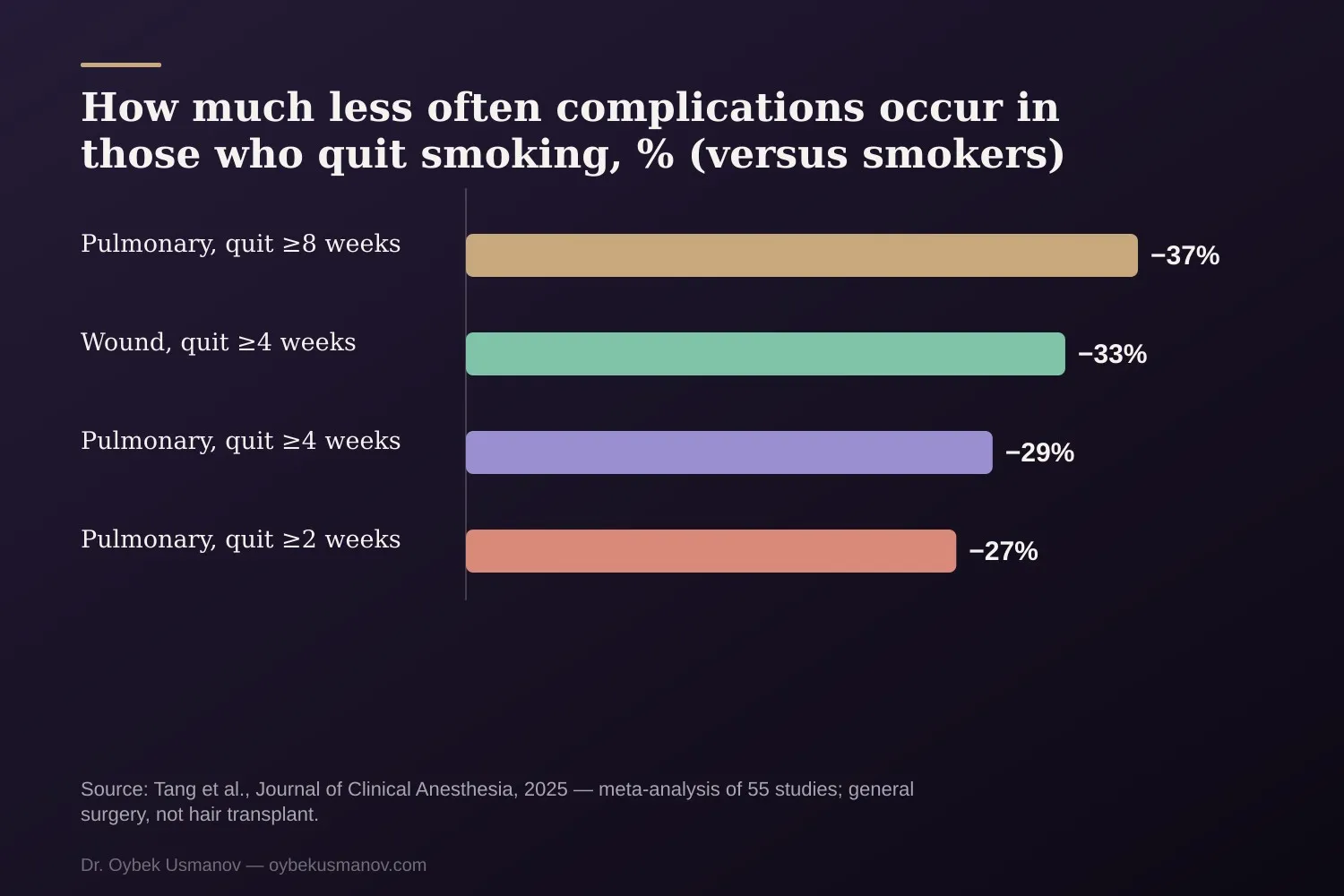
General surgery has plenty of data. A meta-analysis of 55 studies showed that the longer someone is off cigarettes before surgery, the better the outcomes. Compared with active smokers, quitting two weeks or more cut the risk of pulmonary complications by 27%, four weeks or more by 29%, eight weeks or more by 37%. With four weeks or more off cigarettes the risk of wound complications was 33% lower (Tang et al., Journal of Clinical Anesthesia, 2025, doi:10.1016/j.jclinane.2025.111967).
But short cessation did not significantly change surgical site infection or bleeding. And another meta-analysis of 24 randomized trials with 4,763 patients showed that smoking-cessation interventions raise the chance of quitting (relative risk 1.98) and cut overall complications by 27%, but for wound complications the effect was statistically non-significant with low-certainty evidence (Alhabdan et al., Updates in Surgery, 2025, doi:10.1007/s13304-025-02409-5).
Why surgeons still ask you not to smoke
The logic is clear: nicotine narrows blood vessels, reduces blood supply to the skin and slows healing, and blood supply is critical for a transplanted graft. We found no direct measurements of graft survival on this, so the fair statement is: a smoker has a higher risk of slower and more complicated healing, but there is no figure for graft loss.
What to do if you smoke
- Tell your surgeon at consultation: it is for assessing risk, not for judging you.
- The earlier you quit before surgery the better, and general data show benefit from two to four weeks.
- Your surgeon sets the exact period before and after surgery: it differs between clinics.
- Do not swap cigarettes for nicotine products without your surgeon’s approval: nicotine is still nicotine.
- If quitting is hard, ask your doctor for help: cessation interventions work.
What we do
Send photos of your head on WhatsApp and say whether you smoke and what medication you take. The surgeon will explain when to schedule the operation and how to prepare.
This article is general information and does not replace a consultation.