comparison
Hairline lowering: surgery or a hair transplant — which to choose
If the forehead looks too high, there are two paths. The first is surgical hairline lowering (forehead reduction): forehead skin is removed and the hair-bearing scalp advanced. The second is a hair transplant, which covers the forehead with new hair without touching its skin. These are different operations, and the choice depends on why the forehead is high.
We rely on PubMed publications. The data are mostly retrospective, and heterogeneity between studies is high.
What the difference is
A review calls hairline-lowering surgery an alternative to hair transplantation for an overly high hairline. Advantages include immediate results and significant density, and the best candidates are usually women with a stable frontal hairline and a mobile scalp: mobility makes advancement easier (Arnaoutakis, Facial Plastic Surgery Clinics of North America, 2025, doi:10.1016/j.fsc.2025.08.003).
In a series of 820 operations the mean forehead shortening was 25.5 mm (10 to 50 mm) and the mean satisfaction score 3.98 of 5 (Ekizceli, Hocaoğlu, Aesthetic Plastic Surgery, 2025, doi:10.1007/s00266-025-05421-7). In another series of 650 patients (95.5% women) mean skin excision was 2.29 cm, about 28% of forehead height (de Azevedo Marques, Aesthetic Plastic Surgery, 2025, doi:10.1007/s00266-025-04830-y).
What the risks of the operation are
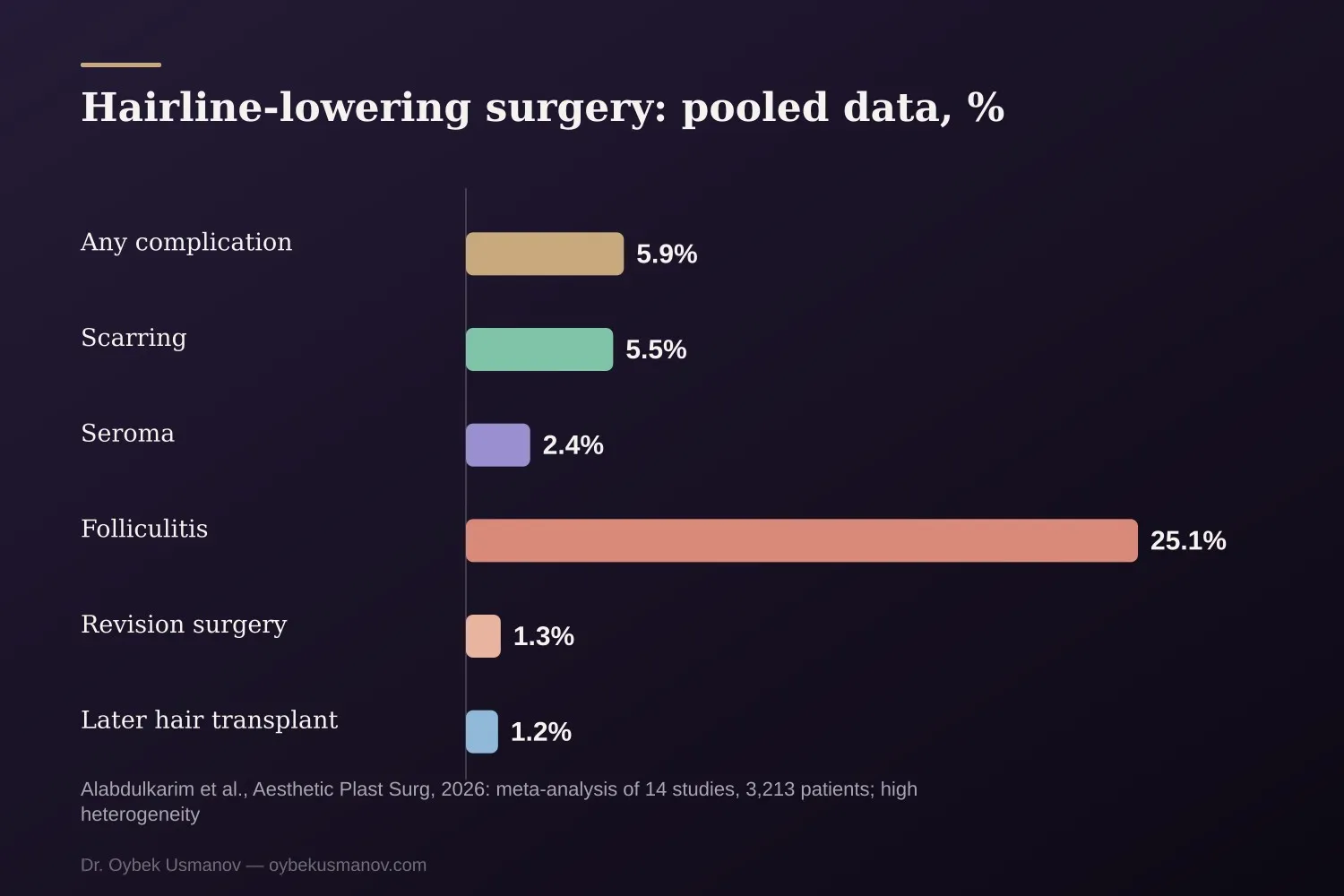
A meta-analysis of 14 studies (3,213 patients) found pooled rates of complications 5.9%, scarring 5.5%, seroma 2.4%, folliculitis 25.1%, hair loss at the incision 0.7% and revision surgery 1.3%; temporary loss of sensation occurred in almost everyone (97.3%), and a hair transplant was later needed by 1.2%. Satisfaction was 99.9%, but heterogeneity between studies is very high (Alabdulkarim et al., Aesthetic Plastic Surgery, 2026, doi:10.1007/s00266-026-05691-9).
A series of 98 patients supports the picture: temporary sensory disturbances in 91.8%, resolving within 6 months, and one (1%) hypertrophic scar (Martins et al., Aesthetic Plastic Surgery, 2025, doi:10.1007/s00266-025-05341-6).
What individual series show
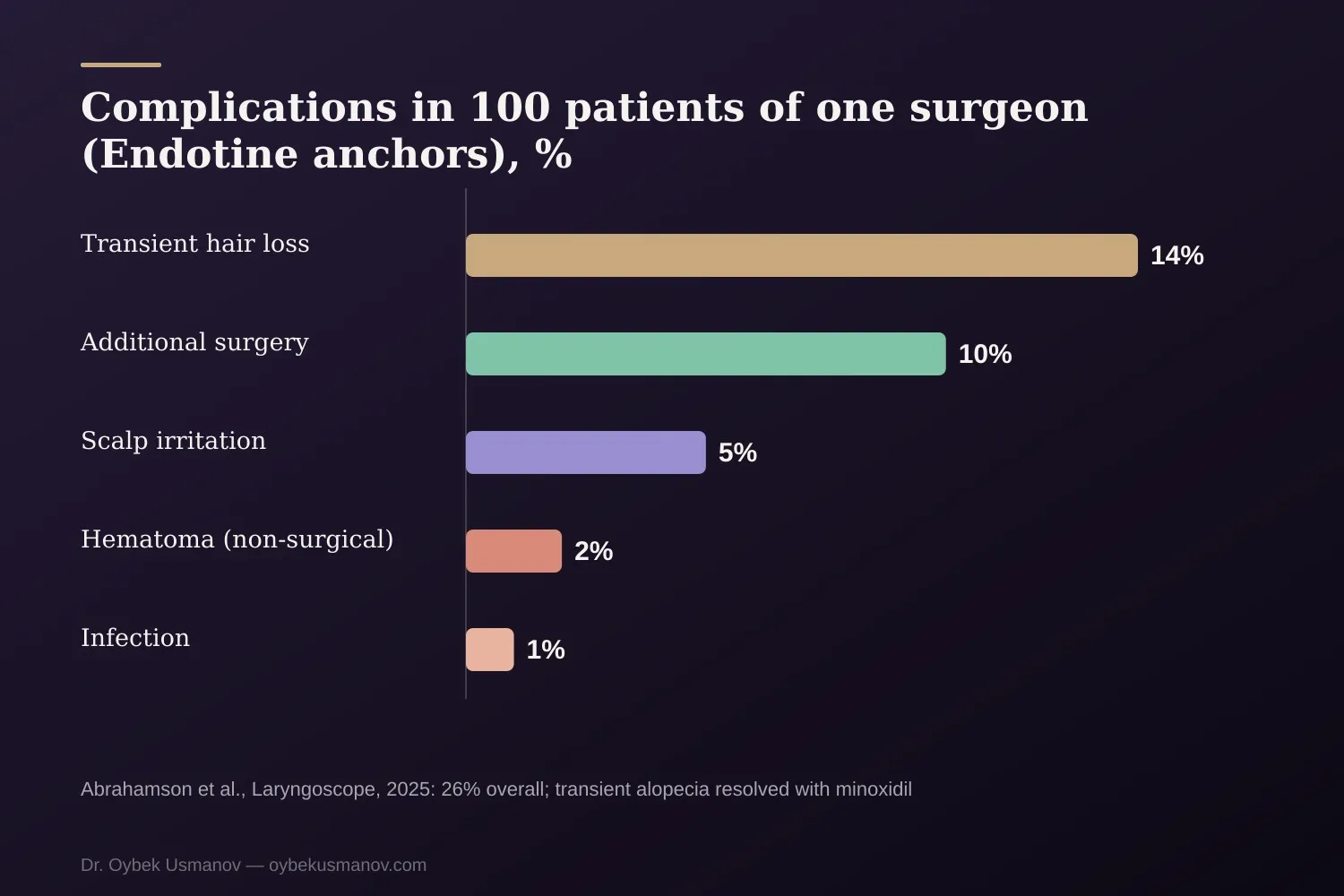
In a series of 100 patients of one surgeon (Endotine anchors), complications occurred in 26%: transient hair loss in 14% (resolved with minoxidil), additional surgery in 10% (scar revision, further lowering or hematoma evacuation), scalp irritation in 5%, hematoma without surgery in 2% and infection in 1% (Abrahamson et al., Laryngoscope, 2025, doi:10.1002/lary.70207).
In a series of 650 operations the author stresses managing expectations: forehead shortening and correction of temporal recesses are limited, scars and folliculitis are possible, and patient selection should consider hair conditions such as androgenetic alopecia and frontal fibrosing alopecia, which may affect the long-term result (de Azevedo Marques, 2025).
What suits whom
- If the forehead is high “by nature” and your own hairline is thick and stable, hairline-lowering surgery is considered.
- If hair loss is ongoing (for example androgenetic alopecia) or the hairline is receding, a transplant is the reference rather than skin-advancement surgery.
- Sometimes both are combined: first the line is advanced, then filled in with a transplant; the surgeon decides.
- The operation leaves a linear scar at the hairline; a transplant leaves no forehead scar, but the result appears gradually.
- Scalp mobility, hair density and your goals determine which option fits.
What we do
Send front and side photos of your head on WhatsApp: the surgeon will assess your hairline and say what a hair transplant can realistically do and when another approach is worth discussing.
This article is general information and does not replace a consultation.