
planning
Graft density: how dense can a hair transplant be and where is the limit

One of the most common pre-op questions: “Can I have as many grafts as possible, as densely as possible?” Intuitively, denser seems better. But tissue has a limit: each graft needs blood supply, and the skin cannot be packed endlessly in one session. Let us look at what is known.
There is no universal “right” number in the literature. Density is chosen for the task, skin quality, donor reserve and the surgeon’s experience.
What studies showed on survival at different densities
A classic small study tested 1 cm² templates in four Korean patients, onto which 20, 30, 40 and 50 one-hair follicular units were grafted. At 10 months survival at 20 and 30 was higher than at 40 and 50; the authors considered 30 an appropriate density for such grafts and noted repeated sessions would be needed for a better final result, but the sample was small (Lee et al., Dermatologic Surgery, 2006, doi:10.1111/j.1524-4725.2006.32166.x).
That does not make 30 a universal limit: it concerned specific one-hair units, a specific instrument and four patients.
What densities are used in practice
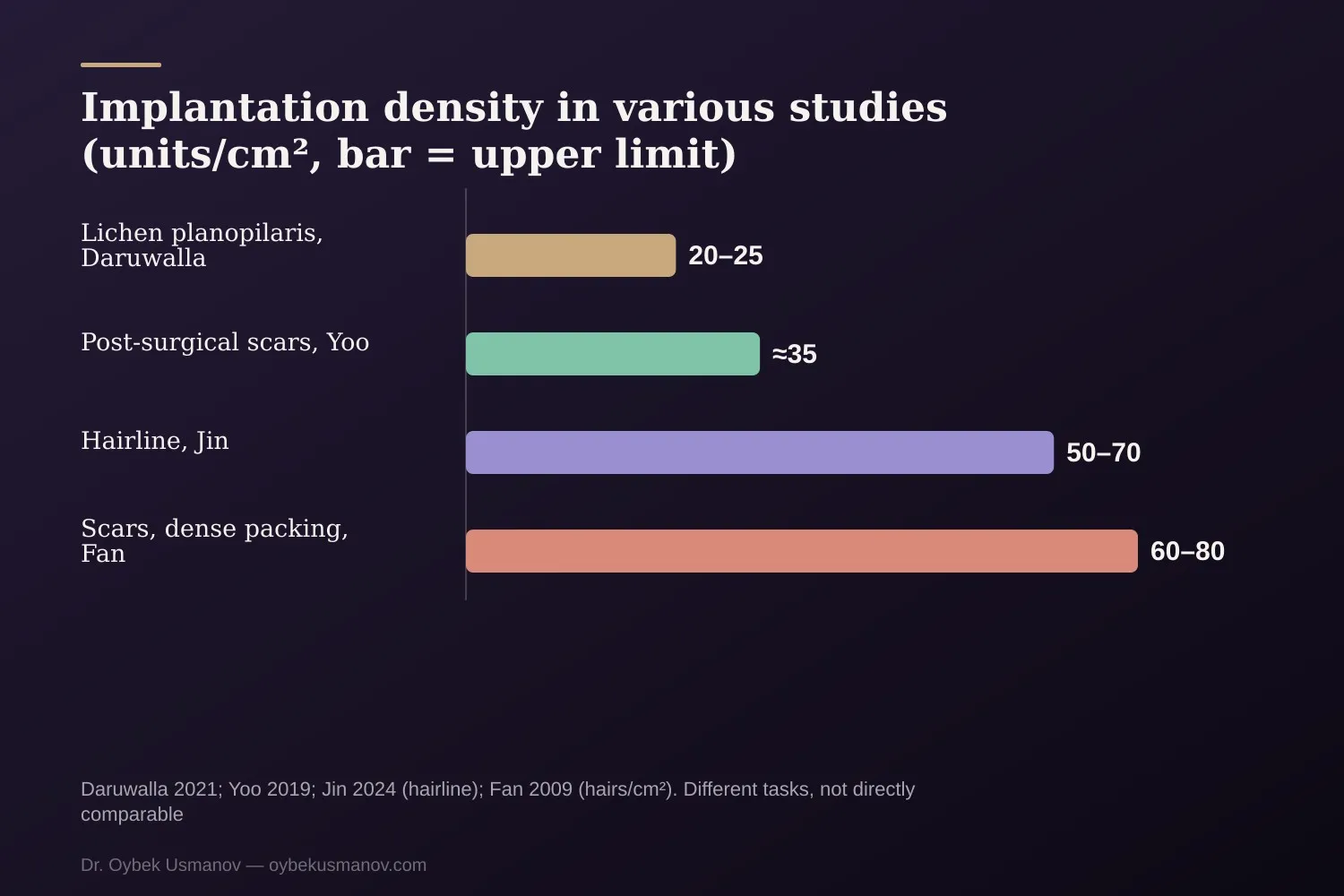
In hairline restoration with long-hair FUE, the planned implantation density was 50–70 units per cm² with a planned donor extraction density of 15–25 units per cm²; mean graft survival at 9 months was 93.1% (Jin et al., Journal of Cosmetic Dermatology, 2024, doi:10.1111/jocd.16136).
In inactive lichen planopilaris 20–25 units per cm² were used, giving about 79% survival at 12 and 24 months (Daruwalla et al., Dermatologic Surgery, 2021, doi:10.1097/DSS.0000000000003103); in post-surgical scars about 35 units per cm² gave 80.67% at 12 months (Yoo et al., BioMed Research International, 2019, doi:10.1155/2019/3423657). In large cicatricial defects, dense packing gave 60–80 hairs per cm² per session, and hair survival in ten control areas over 8 months was 98%, but 91 patients with 31–50% involvement needed a second session (Fan, Wang, Zhonghua Yi Xue Za Zhi, 2009, PMID 19595137).
The spread reflects different tasks: scar, hairline and ordinary bald skin each call for a different density.
The price of too dense a packing
- Folliculitis: in a multicenter study of 1,317 patients, density above 45 grafts per cm² was associated with higher odds of folliculitis (odds ratio 2.15) (Zhou et al., Plastic and Reconstructive Surgery, 2023, doi:10.1097/PRS.0000000000011175).
- A complications review lists dense graft packing among risk factors (Sturm et al., Journal of Craniofacial Surgery, 2026, doi:10.1097/SCS.0000000000013195).
- A second session: even with dense packing in extensive areas a repeat operation is often needed, and that is normal for a planned strategy.
- The donor reserve is finite: the more is taken, the more important it is to think about the future, not only today’s density.
What we do
Send photos of your head on WhatsApp: the surgeon will assess how many grafts you really need and what density is reasonable to plan in your situation.
This article is general information and does not replace a consultation.