methods
Long-hair FUE: a no-shave hair transplant — what it is and what is known

Many people dread a shaved head after a transplant and ask whether it can be done without shaving. The answer depends on what “no-shave” means. The topic is muddled even in publications and clinic advertising, so we start with the terms and then look at the data.
Note: this technique is harder than the standard one and does not suit everyone. The final decision is the surgeon’s after an exam.
“No-shave” comes in different kinds
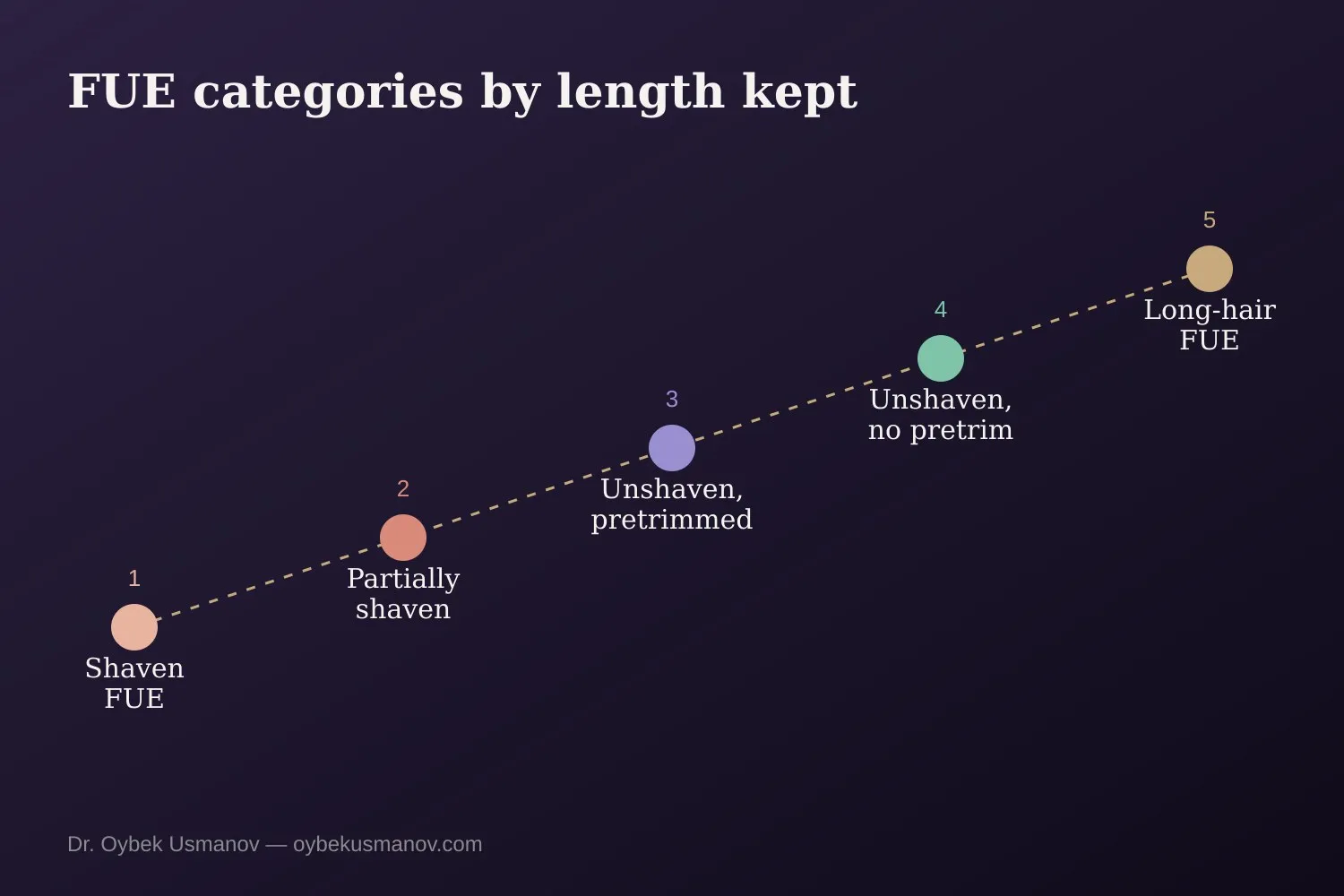
A 2026 review notes that the term “unshaven” is used inconsistently in publications and advertising, which undermines informed consent. The authors identify five categories: shaven FUE, partially shaven FUE, unshaven FUE with pretrimming, unshaven FUE without pretrimming and long-hair FUE. They propose defining “shaven” versus “unshaven” FUE only by the donor harvesting technique, regardless of whether the recipient area is shaved (Jimenez et al., Dermatologic Surgery, 2026, doi:10.1097/DSS.0000000000005049).
The practical lesson: ask the clinic exactly what it means when it promises “no shave”. Both the look of your head after surgery and the amount of work depend on it.
What studies show
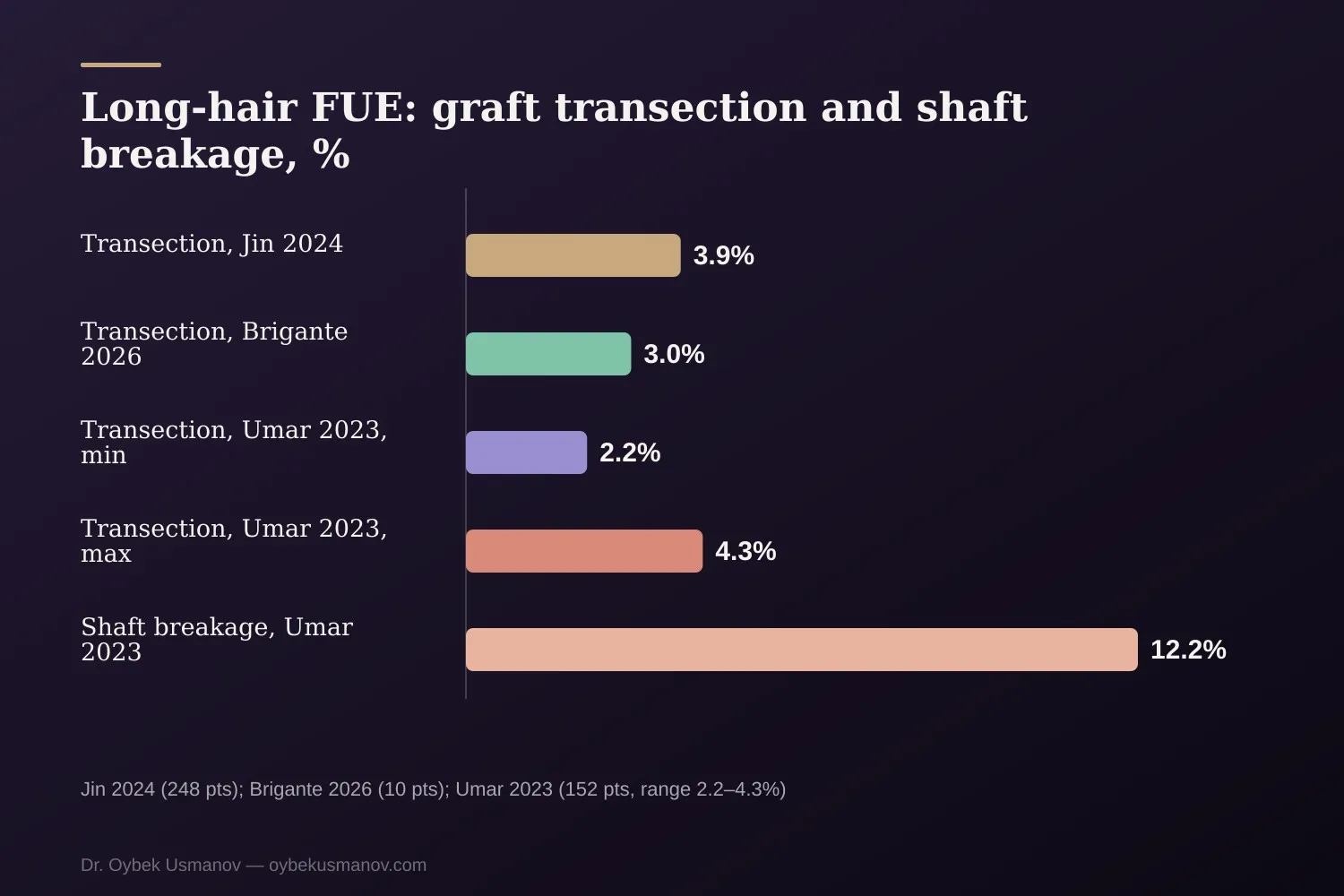
In a retrospective study of 248 patients (mostly women) who had hairline restoration with long-hair FUE, about 1,970 grafts were extracted on average in 3.2 hours, the transection rate was 3.9%, mean graft survival at 9 months was 93.1%, and satisfaction was high (4.7 of 5) (Jin et al., Journal of Cosmetic Dermatology, 2024, doi:10.1111/jocd.16136).
In a multicenter work of 152 patients, graft transection was 2.2–4.3%, shaft breakage of long hairs 12.2% and extraction speed about 440 grafts per hour; transection was higher in “difficult” donors with a thick, firm scalp (Umar et al., Clinical, Cosmetic and Investigational Dermatology, 2023, doi:10.2147/CCID.S442822).
In a small series of 10 patients, a “direct no-shave FUE” method gave an average of about 4,600 extracted units at 3% transection; the authors stress the need for larger studies (Brigante, Wells, Cureus, 2026, doi:10.7759/cureus.102271).
Limits: what to take into account
- The method is harder and needs experience: FUE is a “blind” technique, a review stresses it is not easy to master, and it is often sold as “not really surgery” (Anastassakis, Facial Plastic Surgery, 2023, doi:10.1055/s-0043-1777311).
- Shaft breakage of long hairs during extraction can be notable (12.2% in the multicenter work), so some hairs may be unusable.
- Not every head suits it: skin thickness and firmness and donor hair type affect the result.
- Studies are mostly small and retrospective; large head-to-head comparisons with standard FUE are few.
- It may fit fewer grafts per session and take longer: the decision depends on the extent of baldness and your goals.
What we do
Send photos of your head on WhatsApp and say what matters to you — discretion or volume: the surgeon will explain which harvesting option fits and be frank about limits.
This article is general information and does not replace a consultation.