
comparison
Scalp micropigmentation or a hair transplant: what to choose and what is known

Scalp micropigmentation (SMP) is the application of pigment into the skin that imitates short hair and creates visual density. It is not a treatment and does not grow hair, it is cosmetic camouflage. A hair transplant, on the other hand, returns living, growing hair. Which is better depends on your hair density, area, expectations and budget.
We rely on PubMed publications: data are limited, and many studies are small.
What SMP is and what it gives
SMP is a method of camouflaging hair loss or scars on the scalp: pigment is placed between follicles in a stippled pattern resembling closely cut hair (Nguyen et al., Skin Appendage Disorders, 2022, doi:10.1159/000524135).
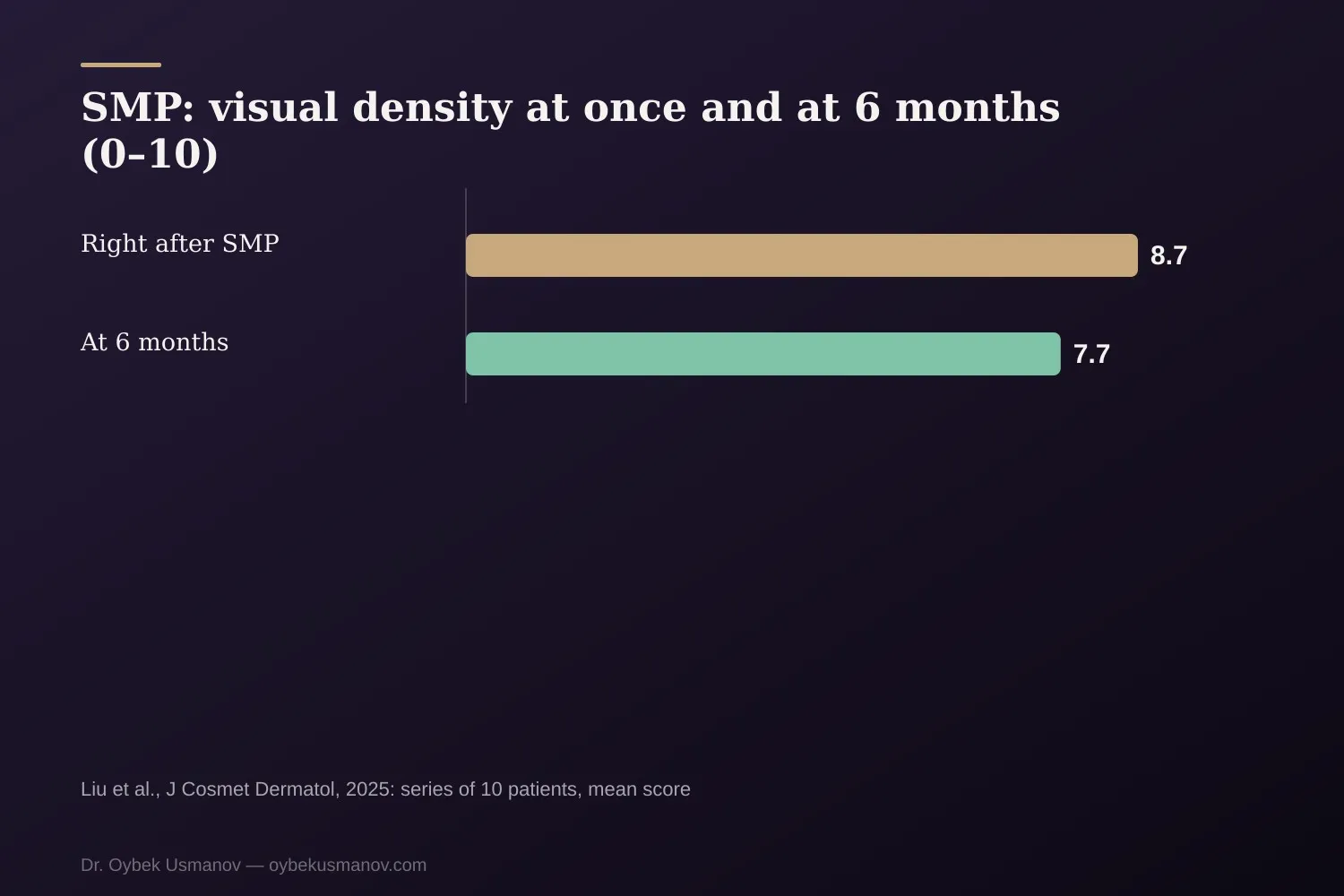
In a series of 10 patients (6 with androgenetic and 4 with scarring alopecia) on a standard three-session protocol, visual density right after the procedure averaged 8.7 of 10 and fell to 7.7 at 6 months. Fading was greater in scarring patients. Satisfaction was high (2.7 of 3), with no adverse events; the authors call for studies of long-term pigment retention (Liu et al., Journal of Cosmetic Dermatology, 2025, doi:10.1111/jocd.70375).
How to choose between SMP and a transplant
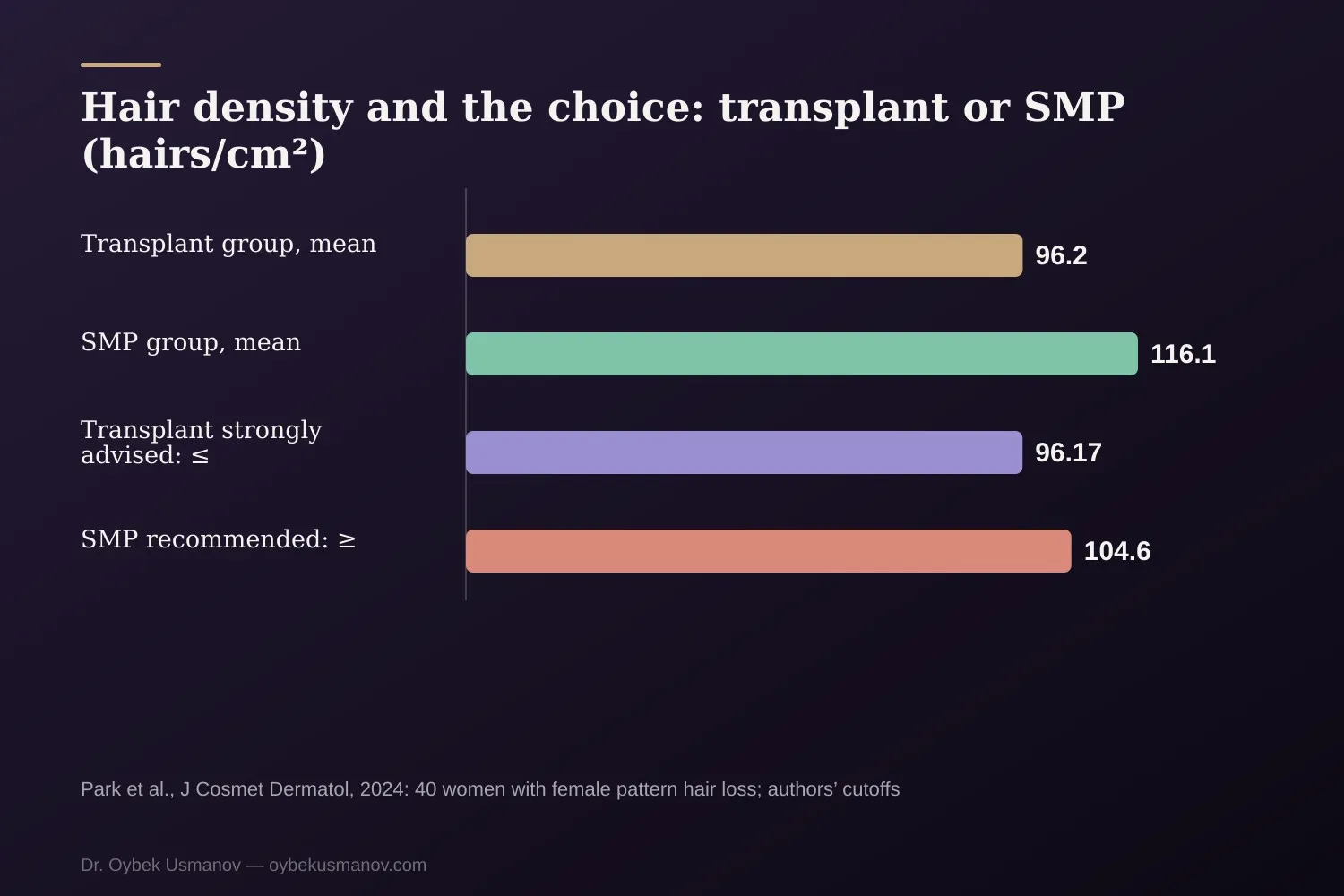
In a retrospective study of 40 women with female pattern hair loss who successfully had a transplant (23) or SMP (17), hair density was the main factor in the choice. The authors propose guides: SMP is recommended at a density of 104.6 hairs per cm² or higher, and a transplant is strongly recommended at 96.17 or lower; the transplant group’s mean density was 96.16 and the SMP group’s 116.08 (Park et al., Journal of Cosmetic Dermatology, 2024, doi:10.1111/jocd.16429). It is a single small retrospective study in women, and the cutoffs cannot be applied to everyone.
The general logic: when enough of your own hair remains, SMP can give visual density, and when hair is sparse, a source of living hair is needed.
Risks and pitfalls of SMP
- Fading and changing colour: pigment lightens over time and can shift in shade with poor technique; correcting it is hard.
- Poor results: in a series of 120 patients needing revision after SMP, 89.2% of procedures had been done in tattoo or beauty salons; after revision (removal, repeat SMP, hair transplant) satisfaction averaged 4.5 of 5 (Park et al., International Journal of Dermatology, 2024, doi:10.1111/ijd.17260).
- Practitioner qualification: in a survey of 131 patients in Korea, all five who had SMP had it outside medical settings, and 82.5% of the others would prefer a physician (Kim, Kim, Annals of Dermatology, 2025, doi:10.5021/ad.25.104).
- SMP does not replace hair-loss treatment: it camouflages rather than stops the process; one review lists it as one means of camouflage alongside medication and transplantation (Park et al., Journal of Cosmetic Dermatology, 2022, doi:10.1111/jocd.15297).
- If a transplant is planned, tell your surgeon about earlier SMP: pigment can hinder assessment of the skin and change the approach.
What we do
Send photos of your head on WhatsApp and tell us what you have already tried: the surgeon will assess density and say whether a transplant makes sense or a simpler option will do.
This article is general information and does not replace a consultation.