the procedure
What happens to grafts outside the body: storage, solutions and time
Between extracting a graft from the donor area and implanting it in the recipient area, time passes. All that time the follicles are outside the body, and what and how they are held in may affect their condition. This part of surgery rarely makes advertising, but researchers study it.
We rely on PubMed publications. The studies are small and concern specific solutions; they do not support concluding that one solution is “best” for every clinic.
Why this is discussed at all
A review of FUE complications lists graft handling and ischemia time, that is, time without blood supply, among technical factors influencing complications (Romera de Blas et al., Frontiers in Medicine, 2026, doi:10.3389/fmed.2026.1750989). A Chinese expert consensus on improving graft survival names graft preservation among seven key issues, alongside preparation, harvest, graft dissection and trimming, implantation, postoperative care and complication prevention (Zhang et al., Plastic and Reconstructive Surgery, 2025, doi:10.1097/PRS.0000000000012228).
So it is not a trifle but a distinct stage that is studied and standardized.
Holding solution and post-operative shedding
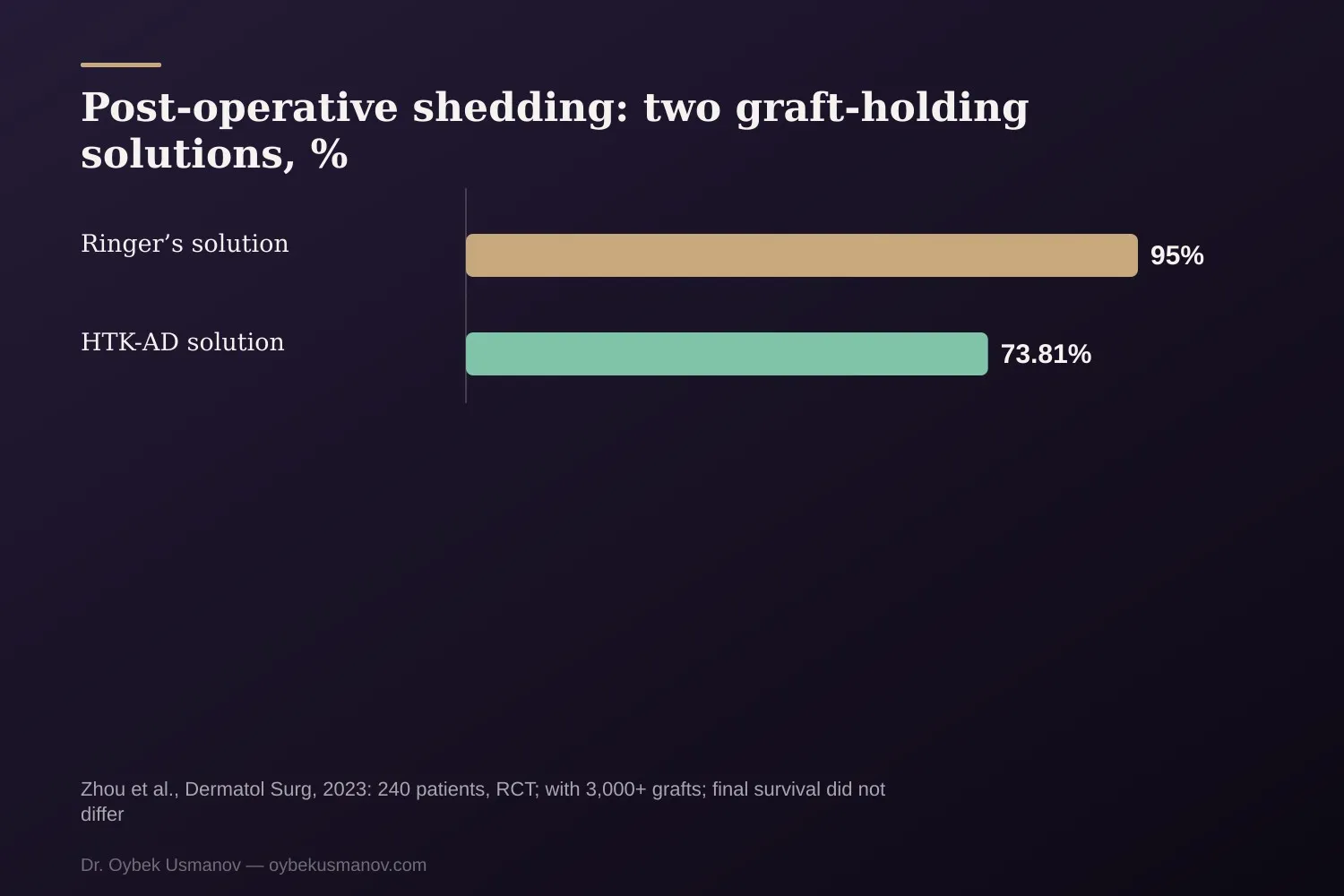
In a randomized study of 240 patients, two graft-holding solutions were compared: Ringer’s and a special HTK-AD solution (with adenosine triphosphate and deferoxamine). Grafts in HTK-AD kept dense collagen structure and higher cell viability, while those in Ringer’s became soft, which hindered implantation. With 3,000 grafts or more, post-operative shedding was seen in 73.81% versus 95%, started later, was lighter and shorter, and regrowth began earlier; final survival did not differ between groups (Zhou et al., Dermatologic Surgery, 2023, doi:10.1097/DSS.0000000000003799).
The takeaway for patients: the solution may influence how marked shedding is, not the final result. It is no reason to avoid surgery because of shedding: it is normal.
Another study: one centre and added treatments
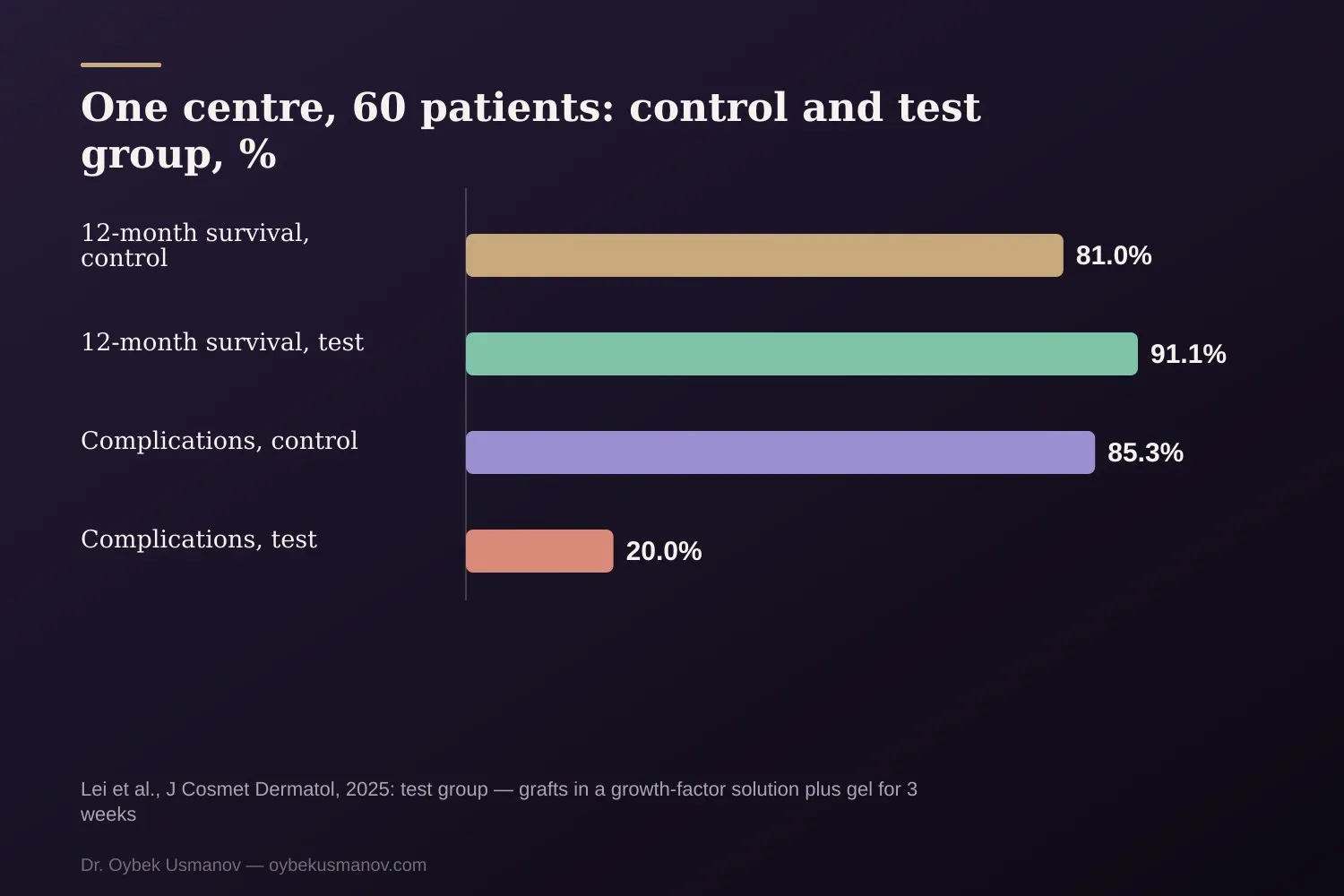
In a prospective randomized study of 60 patients with moderate-to-severe androgenetic alopecia, the test group’s grafts were placed in a growth-factor solution and a gel was applied for three weeks, while the control group used saline. At 12 months follicle survival was 91.1% versus 81.0%, complications 20.0% versus 85.3%, and satisfaction 96.7% versus 80.0% (Lei et al., Journal of Cosmetic Dermatology, 2025, doi:10.1111/jocd.70464).
It is a single small single-centre study, and it included extra treatment beyond storage. One cannot conclude that this approach suits or is needed by everyone. We do not advertise any specific preparations.
What to ask your surgeon
- What the grafts are held in, and at what temperature, while they wait for implantation.
- How long grafts spend outside the body and how the surgeon works to shorten it.
- How grafts are handled and how damage and drying out are avoided.
- Why post-operative shedding is no reason to panic: in the study with 3,000 grafts or more it occurred in 74–95% of patients, while final survival did not suffer.
- Whether any additional preparations are in the price, why, and what evidence exists for them.
What we do
Send photos of your head and questions about the operation on WhatsApp: the surgeon will explain how extraction and implantation go and how graft handling is organised.
This article is general information and does not replace a consultation.