causes of hair loss
Hair loss in menopause: what is known about hormones and when to see a doctor
After menopause many women notice thinner hair, a wider parting and lost volume. It is one of the commonest questions in the clinic. Below is what PubMed reviews show: no promises and no self-treatment.
This article is general information: diagnosis and treatment are for a doctor to determine in person.
What science says about hormones
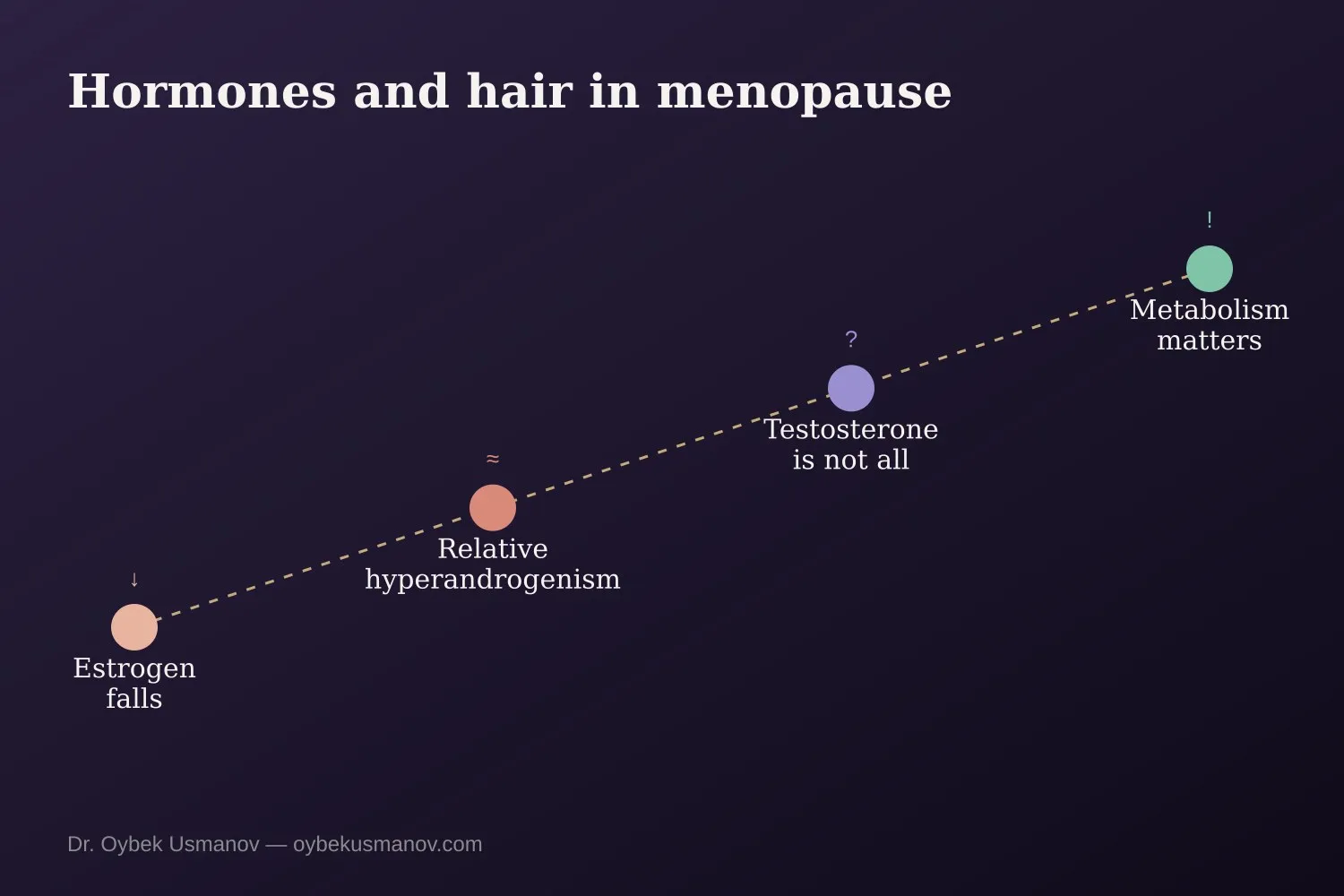
Female androgenetic alopecia is the most common cause of hair loss in women, and its frequency rises with age. This is attributed to hormonal changes in the menopausal transition: a drop in estrogen and a state of relative hyperandrogenism. But the mechanism is not fully clear: studies have failed to show a correlation between total and free testosterone and the prevalence of the disease. Among risk factors in postmenopausal women the review names insulin resistance, high body mass index and metabolic syndrome (Anderson et al., Climacteric, 2026, doi:10.1080/13697137.2026.2699762).
Another systematic review found that, among skin diseases in menopause, the strongest postmenopausal associations were for alopecia, especially frontal fibrosing alopecia and female pattern hair loss; earlier or surgical menopause conferred greater risk. Menopausal hormone therapy was linked to a higher risk of frontal fibrosing alopecia, but data are inconsistent and most studies used regimens less common today (Roster et al., American Journal of Clinical Dermatology, 2025, doi:10.1007/s40257-025-00994-0).
When it is not only “age-related” thinning
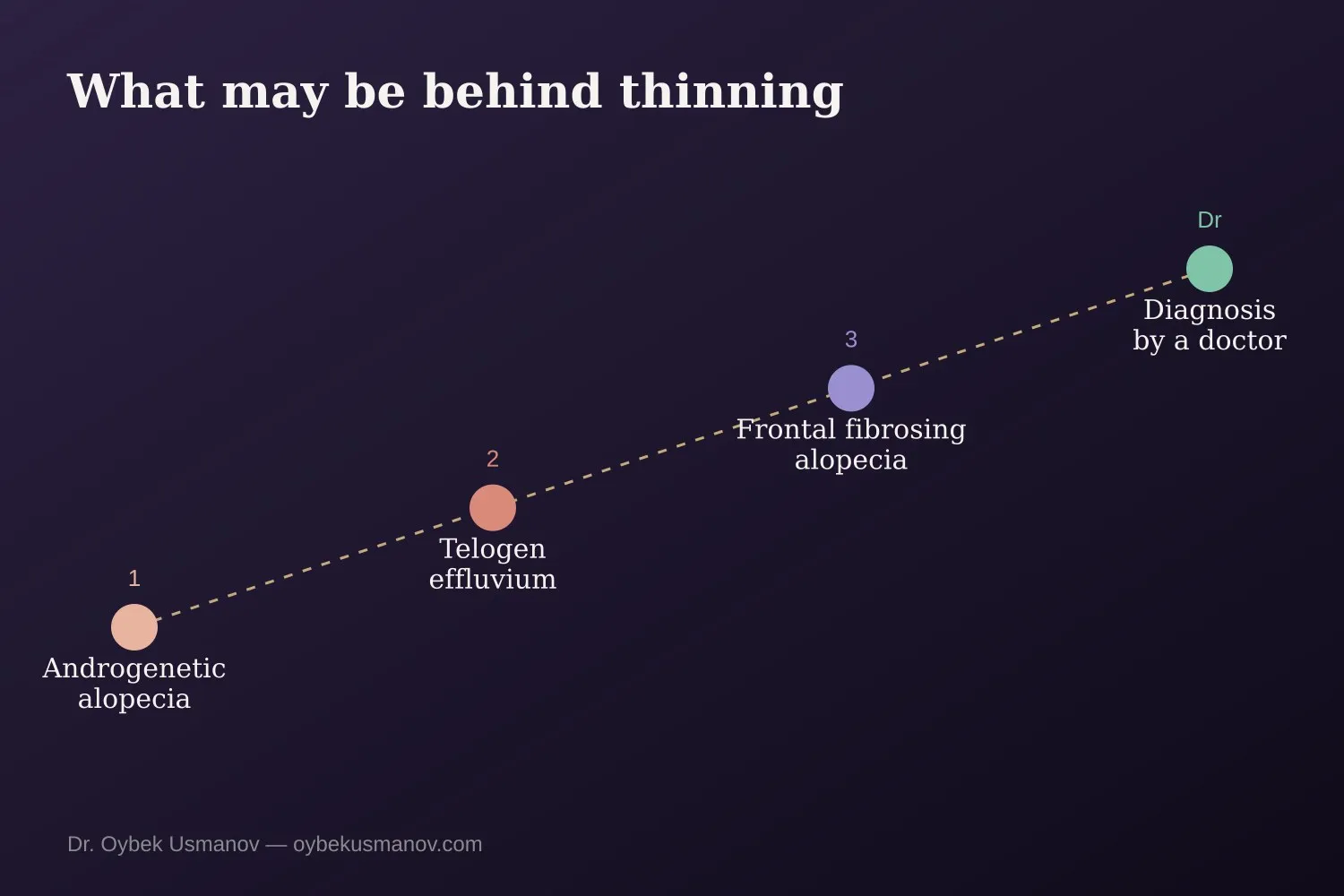
Frontal fibrosing alopecia is a scarring form; it mainly occurs in postmenopausal women and presents as slow recession of the frontotemporal hairline, often with loss of eyebrows and body hair. Its cause is unclear: genetic predisposition, hormones and chemical exposures are discussed (Alenezi et al., Journal of the American Academy of Dermatology, 2025, doi:10.1016/j.jaad.2024.10.126).
In a small survey of 19 women with frontal fibrosing alopecia (mean age 60.6 years), in 63.1% onset was after menopause, in most the diagnostic delay exceeded five years, and 47.4% had scalp itching or pain. This is a very small sample, and the authors’ conclusions need checking in larger studies (Owczarek et al., Journal of Clinical Medicine, 2025, doi:10.3390/jcm14124346).
The practical point: scarring alopecia needs early diagnosis, because lost follicles do not recover.
When to see a doctor
- If hair thins quickly or the hairline recedes.
- If eyebrows or body hair are falling out.
- If you have itching, pain, redness or scaling of the scalp.
- If shedding comes with fatigue, feeling cold or weight changes: tests are needed.
- Do not start hormones or supplements on your own: the doctor decides based on your whole health.
What we do
A hair transplant is not right for every woman: the decision depends on the type of alopecia and how stable it is. Send photos of your head on WhatsApp and tell us how long hair has been thinning: the surgeon will say honestly whether surgery makes sense.
This article is general information and does not replace a consultation.