
preparation
How to prepare for a hair transplant: what to do before surgery
“What should I do before a hair transplant?” is the question patients ask right after booking. The good news: the main steps are clear and backed by expert consensus. The bad: the literature has no universal “14-day rules”, and much depends on your surgeon and your health.
Below is what PubMed publications actually support, with a clear note of what to confirm with your own surgeon.
What the international expert consensus says
A consensus of 38 experts from 17 countries (Delphi method, 81 statements, 59 of them — 73% — reaching agreement) stresses several main ideas. Candidates for transplant should be selected carefully; before surgery the patient should have received adequate medical treatment for hair loss; comorbidities should be assessed and considered in planning; an individualized plan for perioperative care is drawn up for each patient; and some medications that raise bleeding risk are withdrawn before surgery (Vañó-Galván et al., Journal of Dermatological Treatment, 2023, doi:10.1080/09546634.2023.2232065).
Note that which medications to stop, and how many days ahead, is for your surgeon to decide. Do not stop or start medications on your own.
Treatment before surgery and health assessment
A 2025 review on transplant candidates names “optimization of medical therapy before transplant” as its own step alongside candidate selection and intraoperative considerations (Brinks et al., International Journal of Dermatology, 2025, doi:10.1111/ijd.17961). Put simply, a transplant does not replace treatment, it works alongside it.
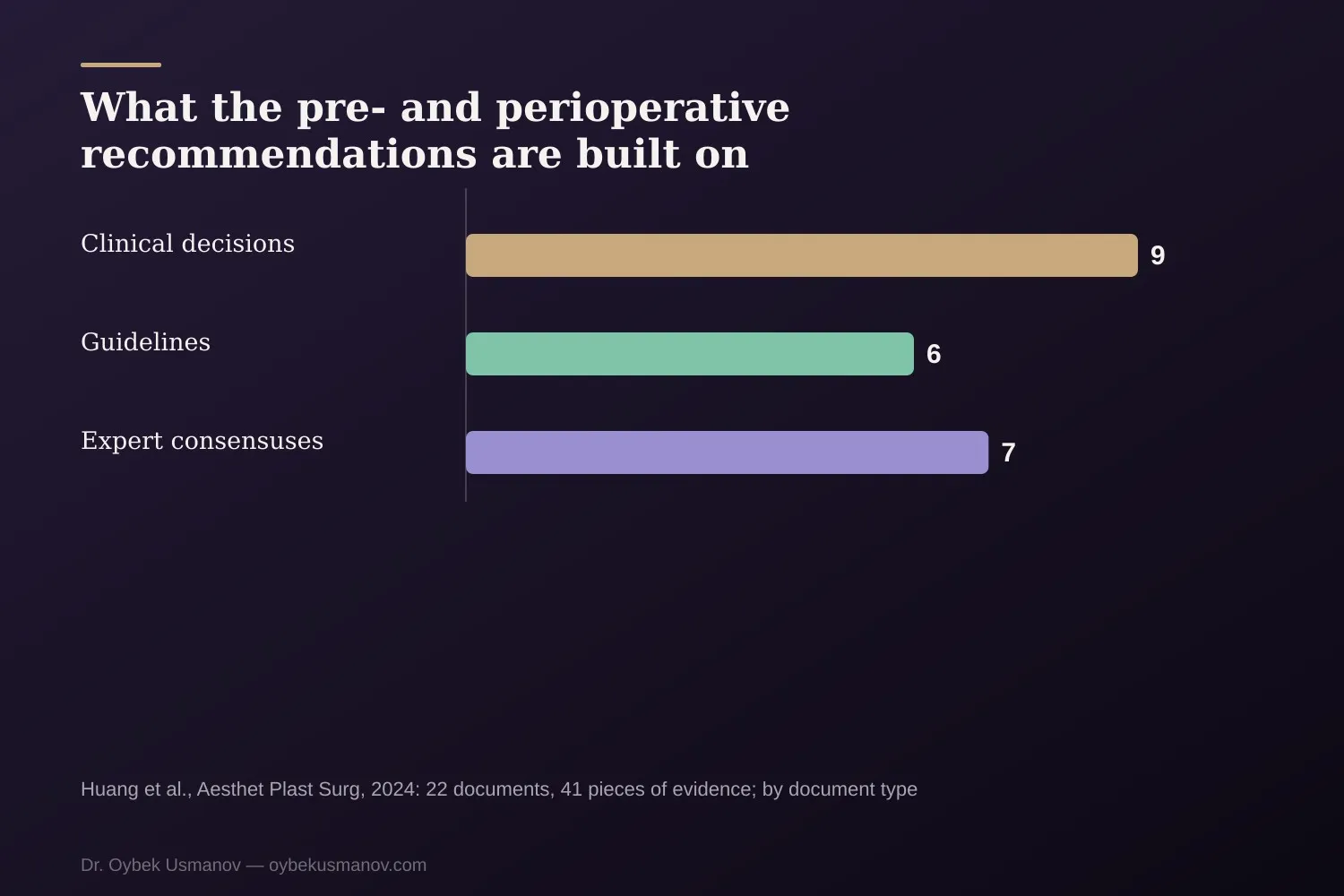
A summary of the best evidence for managing patients around surgery (22 documents: 9 clinical decisions, 6 guidelines and 7 expert consensuses; 41 pieces of evidence) covers assessment of transplant conditions, planning and preparation, anesthesia, surgery, wound care and medication (Huang et al., Aesthetic Plastic Surgery, 2024, doi:10.1007/s00266-024-04360-z). The authors note the evidence came from different countries and should be applied with local conditions in mind.
What to prepare and ask your surgeon
- Tell them about all conditions, medications and supplements, including those for blood pressure, clotting and allergies: the decision to stop anything is the surgeon’s.
- Smoking: general-surgery data show that quitting four weeks or more lowered the risk of wound complications by 33% (Tang et al., Journal of Clinical Anesthesia, 2025, doi:10.1016/j.jclinane.2025.111967). Your surgeon will give you a specific period.
- Ask whether tests are needed and which: generally they depend on your health (we will cover this separately).
- Clarify how to wash your hair before surgery, how to prepare it and whether the donor area needs trimming: clinics use different protocols.
- Plan accommodation, travel and free days: afterwards a gentle routine is needed, not work on day one.
- Write down your questions about aftercare, medication and sport in advance and ask them before surgery.
What we do
Send photos of your head and a list of medications on WhatsApp: the surgeon will draw up an individual preparation plan and answer your questions in advance.
This article is general information and does not replace a consultation.