tips
How to sleep after a hair transplant: position, pillow and what is actually known
“How do I sleep after a hair transplant?” is a question with huge demand. Frankly: we found no PubMed studies comparing sleeping positions after a transplant. So the tips below are common clinic practice and logic, not trial results. Your surgeon will give exact rules and timing in writing.
What is well studied is the problem those tips address: swelling. That is what we turn to.
Why head position comes up at all
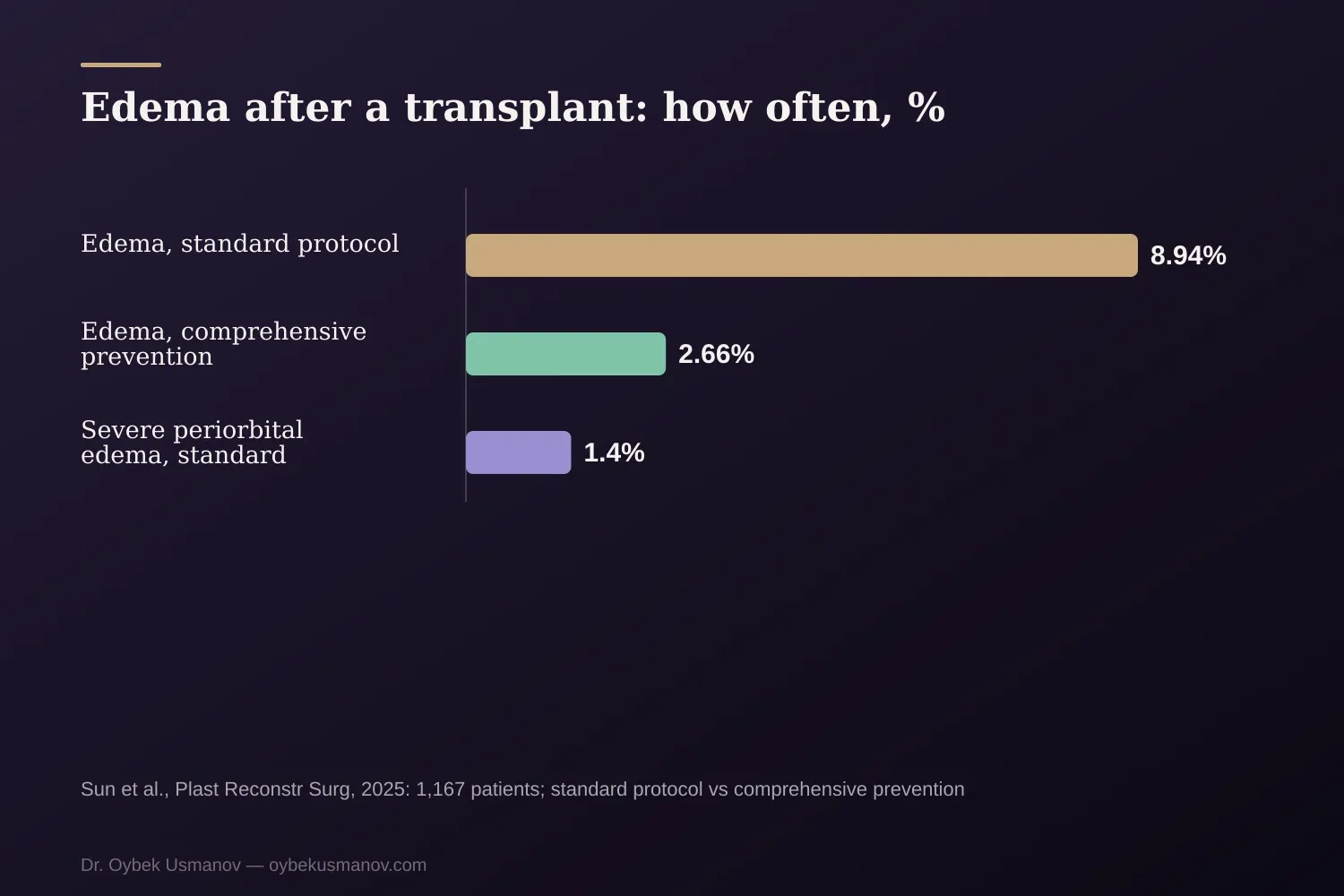
Edema is the most common complication of transplantation. In a multicenter study of 1,167 patients, edema occurred in 8.94% with the standard protocol and in 2.66% with comprehensive prevention; severe periorbital edema in the standard group occurred in 1.4% (Sun et al., Plastic and Reconstructive Surgery, 2025, doi:10.1097/PRS.0000000000012284). A review of FUE complications lists edema, pain, bleeding and infection as common early events (Romera de Blas et al., Frontiers in Medicine, 2026, doi:10.3389/fmed.2026.1750989).
The main protection against swelling is operative technique, while head position in sleep is a supporting measure. The literature has no data on how much it helps.
What clinics usually advise
Below is common advice we see in aftercare instructions. Timing differs between clinics from a few nights to two weeks, so we do not name a specific number.
- Sleep on your back with your head and upper body raised: it avoids pressure on the recipient area.
- Use a travel neck pillow or several pillows so you do not roll onto your side in your sleep.
- Do not press the transplanted area into the pillow or rub it on fabric: use a clean pillowcase.
- If the crown was transplanted and the donor area is at the back, ask your surgeon how to rest your head: the scheme depends on where the operation was done.
- Practice sleeping this way a couple of nights before surgery if you normally sleep on your side or stomach.
- Ask when you can return to your usual position: it depends on healing, not the calendar.
What else helps you sleep
Fear of damaging the grafts is a common cause of insomnia after surgery. The expert consensus stresses an individualized postoperative care plan and follow-up through the first year (Vañó-Galván et al., Journal of Dermatological Treatment, 2023, doi:10.1080/09546634.2023.2232065). That means you are entitled to ask your surgeon every question about the nights in advance.
If at night you get severe pain, growing swelling, bleeding or fever, do not wait for morning: contact the clinic.
What we do
Send photos of your head on WhatsApp and tell us how you usually sleep: the surgeon will advise which position and pillow suit you after your operation.
This article is general information and does not replace a consultation.