
fears
Is a hair transplant painful? Anesthesia, injections and what you feel
“Is a hair transplant painful?” is one of the most common questions before a consultation. The short answer from the literature: most of the pain comes not from the operation itself but from delivering local anesthesia. Details and honest limits follow.
We rely on PubMed publications. Sensations differ between people, so below we talk about averages, not a promise that you will feel nothing.
Where the pain is in the procedure
A review on pain control in hair transplantation says it plainly: most of the pain results from injecting the local anesthetic. Once anesthesia is achieved, the task is maintaining it, especially in long sessions with many grafts. That involves choice of agents, proper infiltration technique, blocks, timely repeat doses and analgesics, and preoperative sedation to reduce anxiety (Nusbaum, American Journal of Clinical Dermatology, 2004, doi:10.2165/00128071-200405010-00003).
So the start is usually the least pleasant part. A good clinic puts its effort into making exactly that part as gentle as possible.
What actually reduces injection pain: study data
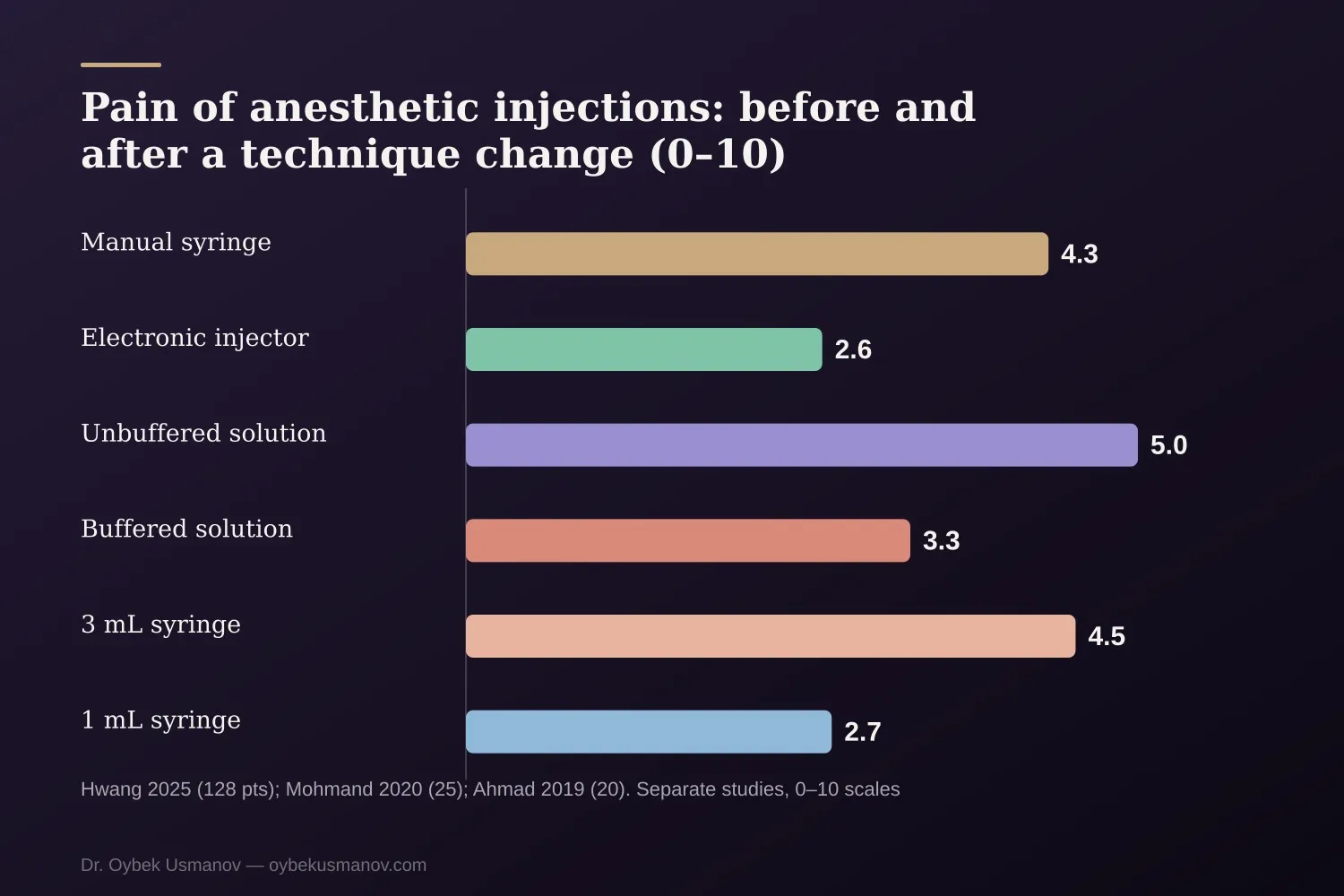
Several papers measured injection pain on a 0–10 scale and compared techniques. In a randomized comparison of 128 patients receiving anesthetic in the scalp (including for hair transplantation), a constant-speed electronic injector gave 2.63 points versus 4.30 with manual injection (Hwang et al., Plastic and Reconstructive Surgery Global Open, 2025, doi:10.1097/GOX.0000000000007209).
In a split-scalp study of 25 patients, a bicarbonate-buffered solution averaged 3.28 versus 4.96 unbuffered (Mohmand et al., Journal of Cosmetic Dermatology, 2020, doi:10.1111/jocd.13442). And in a study of 20 patients a 1 mL syringe gave 2.7 anteriorly while a 3 mL syringe gave 4.5 (Ahmad, Journal of Cosmetic Dermatology, 2019, doi:10.1111/jocd.12993).
Bars should not be compared between studies: samples are small and techniques and scales differ. But the direction is the same: small details of injection technique noticeably change the experience.
What you can do
- Tell your surgeon about your fear in advance: sedation and the pain-control plan are tailored to the patient.
- Mention any medications and substances, including cannabis: a case has been described where such a patient needed more anesthetic than usual, and the surgeon needs to know (Gupta et al., Journal of Dermatological Treatment, 2025, doi:10.1080/09546634.2025.2482009).
- During surgery, say if sensation returns anywhere: anesthesia can be topped up.
- After surgery, pain and tightness are usually managed with analgesics prescribed by your surgeon; the exact regimen is the surgeon’s to set.
- Do not just endure in silence: patient comfort is part of a quality operation.
What we do
If pain is your main worry, message us on WhatsApp: the surgeon will explain how pain control works here and answer questions before the consultation.
This article is general information and does not replace a consultation.