
fears
Is a hair transplant safe? Risks, complications and how they are reduced
A hair transplant is a surgical operation, even if minimally invasive, and every operation carries risks. The question “is it safe?” is better answered with figures from reviews than with “absolutely safe”. Below is what the literature shows and what the risk depends on.
Spoiler: according to reviews, common complications are mostly mild and self-limiting, while serious ones are rare, but they do occur. That is why patient selection, technique and aftercare matter.
What the literature says overall
A 2025 meta-analysis (45 papers, including 24 case reports and 21 observational studies) concludes that hair transplantation is generally safe: pain, swelling and discomfort were reported most often, and rare donor-site arteriovenous fistulas were mostly associated with punch-based FUE (Khatib et al., Aesthetic Plastic Surgery, 2025, doi:10.1007/s00266-025-05125-y).
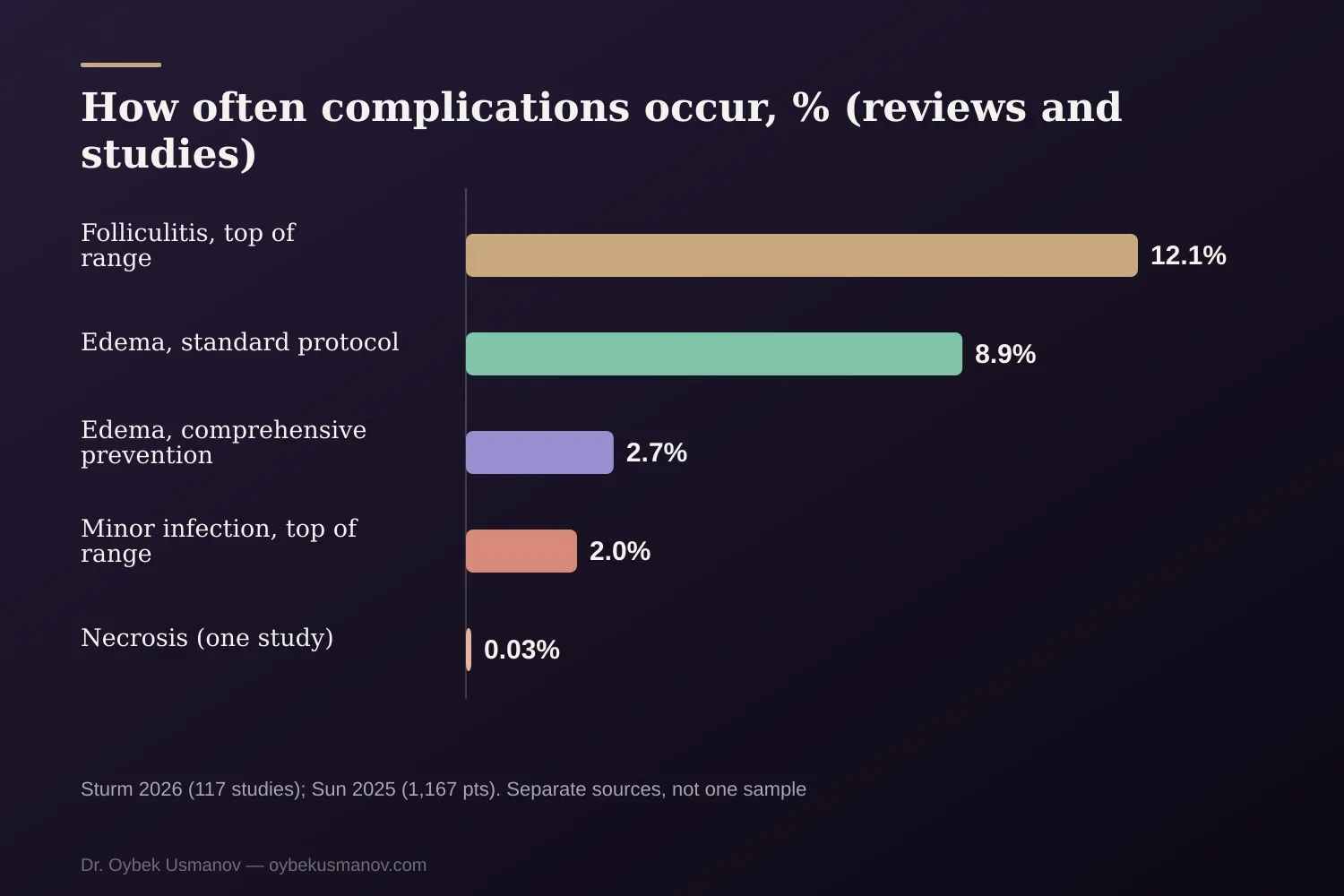
A more recent 2026 review (117 papers) divides complications into early (under 30 days) and late, minor and major. Common ones included pain, infection, folliculitis and edema. Minor infection ranged from 1.4% to 2.0%, folliculitis from 1.1% to 12.1%; necrosis was rare (0.03% in one study). Serious ones included arteriovenous fistula, necrosis and graft failure. The authors stress that definitions and reporting differ between papers, so exact rates are hard to pin down (Sturm et al., Journal of Craniofacial Surgery, 2026, doi:10.1097/SCS.0000000000013195).
Edema: the most common nuisance and how it is reduced
In a prospective multicenter study of 1,167 patients, edema after transplant occurred in 8.94% with the standard triamcinolone protocol and in 2.66% with comprehensive prevention (a modified solution injected into the subcutaneous layer, with excess solution removed). There was no severe periorbital edema in the comprehensive-prevention group, and bruising was also reduced (Sun et al., Plastic and Reconstructive Surgery, 2025, doi:10.1097/PRS.0000000000012284).
This shows that risk depends on a particular clinic’s technique, not just on the operation itself.
What the risk depends on
- Health: the review lists smoking, diabetes and chronic sun damage among risk factors.
- Technique: dense graft packing, excessive depth, vascular injury and epinephrine use are noted as risk factors.
- Summer and size of the operation: in the folliculitis study (Zhou et al., 2023) the link was with summer surgery, high graft counts and late start of care.
- Aftercare: per the expert consensus, an individualized plan and follow-up through the first year are needed (Vañó-Galván et al., 2023).
- Surgeon experience: reviews repeat that patient selection, technique and early recognition are key to fewer complications.
What we do
Send photos of your head on WhatsApp and tell us about chronic conditions, medication and smoking: the surgeon will assess risks before surgery and explain how to reduce them.
This article is general information and does not replace a consultation.