treatment
Rosemary oil for hair: what studies show and why it is no substitute for treatment
Rosemary oil is called a “natural alternative to minoxidil” and people are told to massage it into the scalp. What does science say? Below is what PubMed data show, where they are strong and where weak.
This article is general information: the choice of products for hair loss is for a doctor to determine after a diagnosis.
What the comparative trial showed
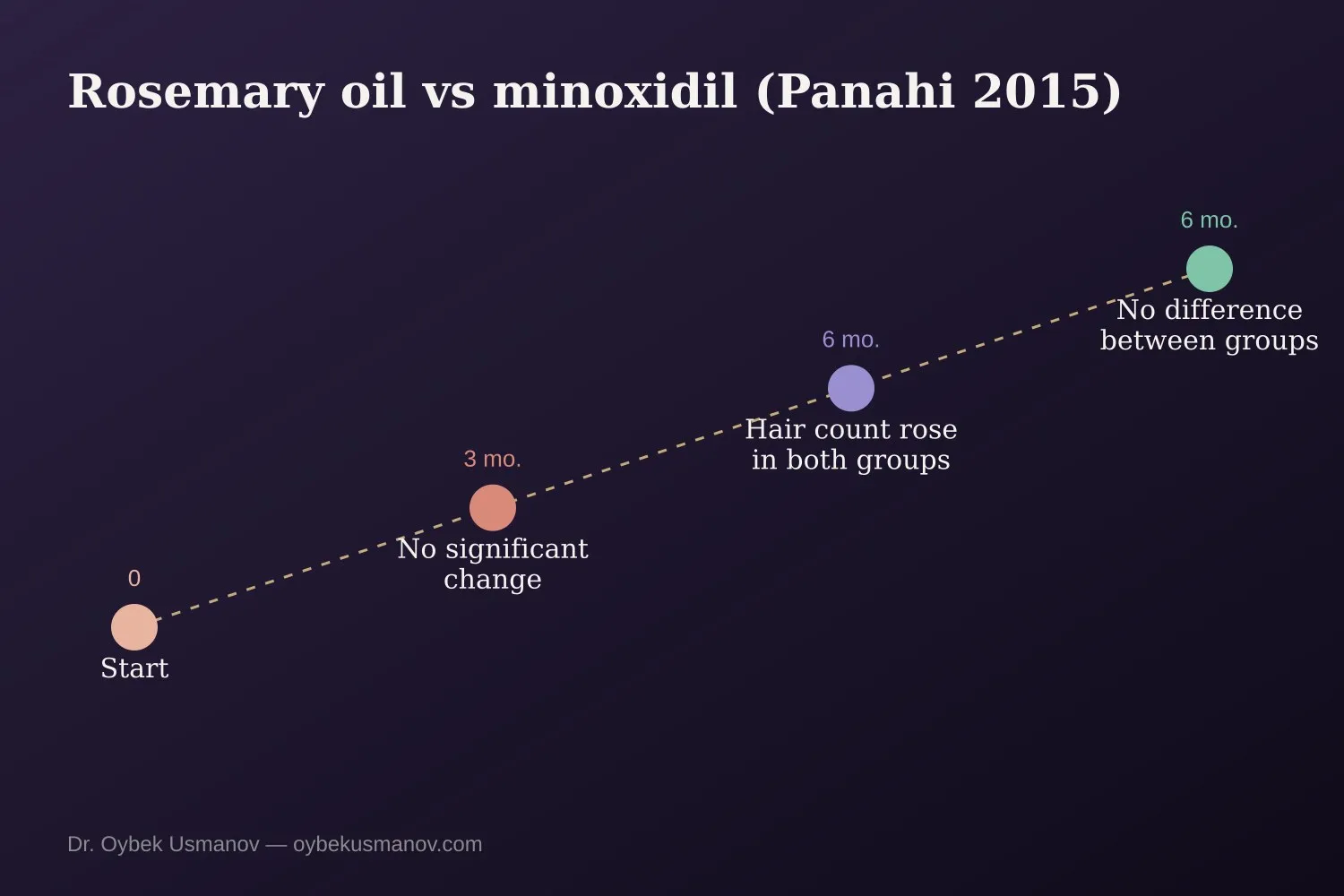
The study most often cited is a randomized trial in which 100 patients with androgenetic alopecia received rosemary oil or minoxidil 2% (50 each) for 6 months. At 3 months there was no significant change in hair count in either group. At 6 months hair count rose in both groups versus baseline, and no significant difference was found between groups. Scalp itching was more frequent in the minoxidil group, but rose in both groups (Panahi et al., Skinmed, 2015, PMID 25842469).
But note: it is one smallish two-arm study with no placebo group, and the abstract gives no actual gain figures. It cannot be taken as proof that the oil equals proven treatments.
What reviews and the doctors’ consensus say
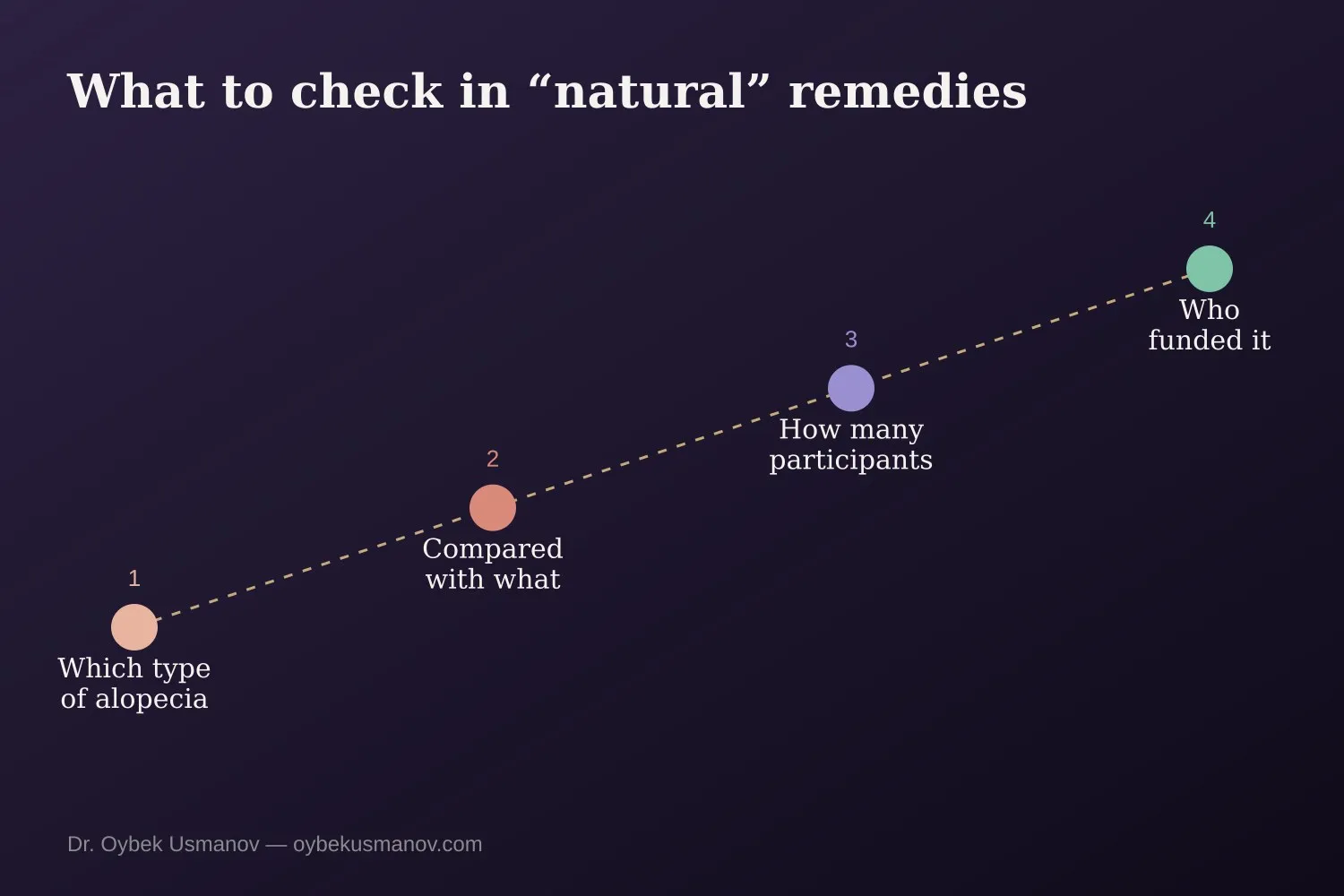
A review of “natural” topical products (rosemary oil, onion juice, coffee extract, pumpkin seed oil and others) notes that they were mostly studied in blends, and studies have small samples, no comparison with standard treatment, unequal groups, no stated type of alopecia and conflicts of interest. Such products may be considered an add-on or an option for those who cannot tolerate standard treatment (Bikash, International Journal of Trichology, 2025, doi:10.4103/ijt.ijt_8_23).
A Canadian consensus of 11 doctors (Delphi method) reviewed 45 interventions for androgenetic alopecia: 7 are recommended, including topical minoxidil, PRP and microneedling; 17 are not recommended, and that list includes rosemary oil, caffeine and topical herbal formulations. Among the authors are employees of a cosmetics company (Landells et al., Journal of Cutaneous Medicine and Surgery, 2025, doi:10.1177/12034754251368849).
And promotional trials and lab data
Two studies of commercial rosemary products enrolled healthy volunteers, and one had no comparison group; the authors include employees of the developer company. Such data do not prove benefit in androgenetic alopecia (Patel et al., Cureus, 2025, doi:10.7759/cureus.77066; Patel et al., Cureus, 2025, doi:10.7759/cureus.85906).
Many works are laboratory studies in animals: for example, in 15 mice, and the authors stress they cannot be extrapolated to humans (Mathenge et al., BioMed Research International, 2026, doi:10.1155/bmri/5037275).
What to do
- First find the cause of hair loss: androgenetic alopecia, telogen effluvium and others need different approaches.
- Do not postpone seeing a doctor for a “natural” remedy: in androgenetic alopecia time matters.
- Remember possible irritation: scalp itching was also reported in the oil trial.
- Do not mix several products at once: the doctor needs to know what you use.
- Do not take advertising promises as evidence.
What we do
If your hair loss turns out to be androgenetic alopecia, we will discuss options including transplant, and say honestly when it is not needed. Send photos of your head on WhatsApp and tell us what you already use.
This article is general information and does not replace a consultation.