causes of hair loss
Semaglutide, tirzepatide and hair loss: what meta-analyses show
GLP-1 drugs (semaglutide, tirzepatide and others) are used in diabetes and obesity, and patients increasingly ask whether they are to blame for hair loss. Below is what is known from PubMed, without panic and without promises.
This article is general information: prescribing and stopping drugs is up to the doctor who prescribed them.
What the meta-analysis shows
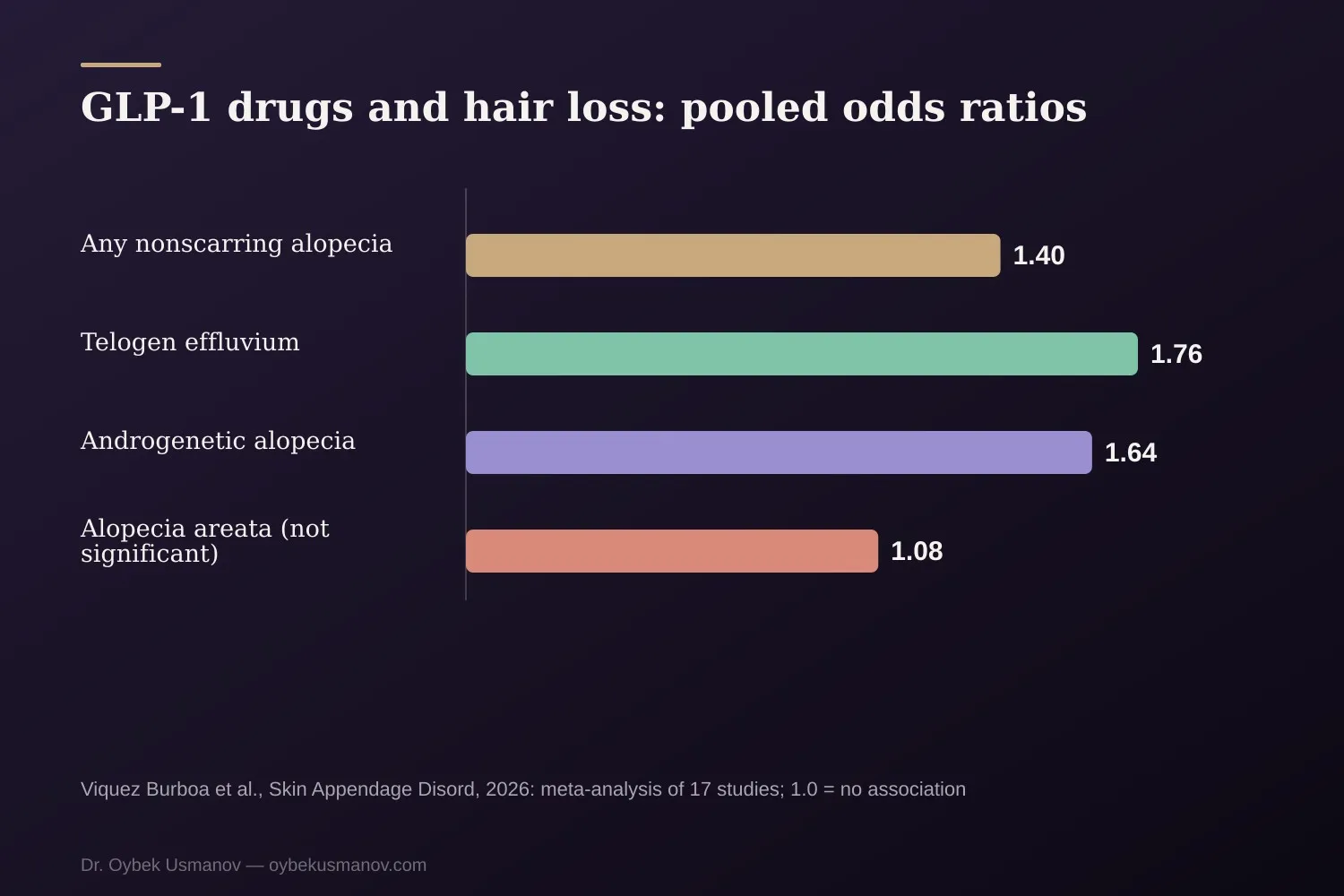
In a meta-analysis of 17 studies (1,091,743 patient exposures), GLP-1 use was linked to higher odds of nonscarring alopecia: pooled odds ratio 1.40 (95% CI 1.33–1.48). At 12 months, significant associations were found with telogen effluvium (adjusted odds ratio 1.76) and androgenetic alopecia (1.64); alopecia areata showed no significant link (1.08). Adverse-event database signals were highest for semaglutide (reporting odds ratio 2.46) and tirzepatide (1.73) (Viquez Burboa et al., Skin Appendage Disorders, 2026, doi:10.1159/000553070).
The authors attribute this mainly to weight loss and nutrient deficiency, and caution against premature discontinuation of the drug.
How common and why
A review by Leite Júnior and Ribeiro Junior points to a discrepancy: in controlled trials hair loss is noted in 3–7%, while in real-world cohorts in over 70%. Telogen effluvium predominates and is driven more by the size and speed of weight loss than by drug toxicity. The most robust predictors were female sex and weight reduction above 10%. Shedding is mostly transient and reversible (Leite Júnior & Ribeiro Junior, Acta Diabetologica, 2026, doi:10.1007/s00592-026-02812-3).
A systematic review likewise finds that semaglutide and tirzepatide are linked to the highest rates of hair loss, with women more often affected; with tirzepatide, which gives the greatest weight loss, it was more often telogen effluvium. Agents with less effect (liraglutide, dulaglutide and others) were studied less and carried a lower risk (Gupta et al., Science Progress, 2026, doi:10.1177/00368504261444578).
But the review by Piraccini and colleagues reminds us: there are no prospective controlled studies on this question and causality has not been established; the main hypothesis is telogen effluvium from rapid weight loss (Piraccini et al., Dermatology and Therapy, 2026, doi:10.1007/s13555-026-01792-0).
What to do
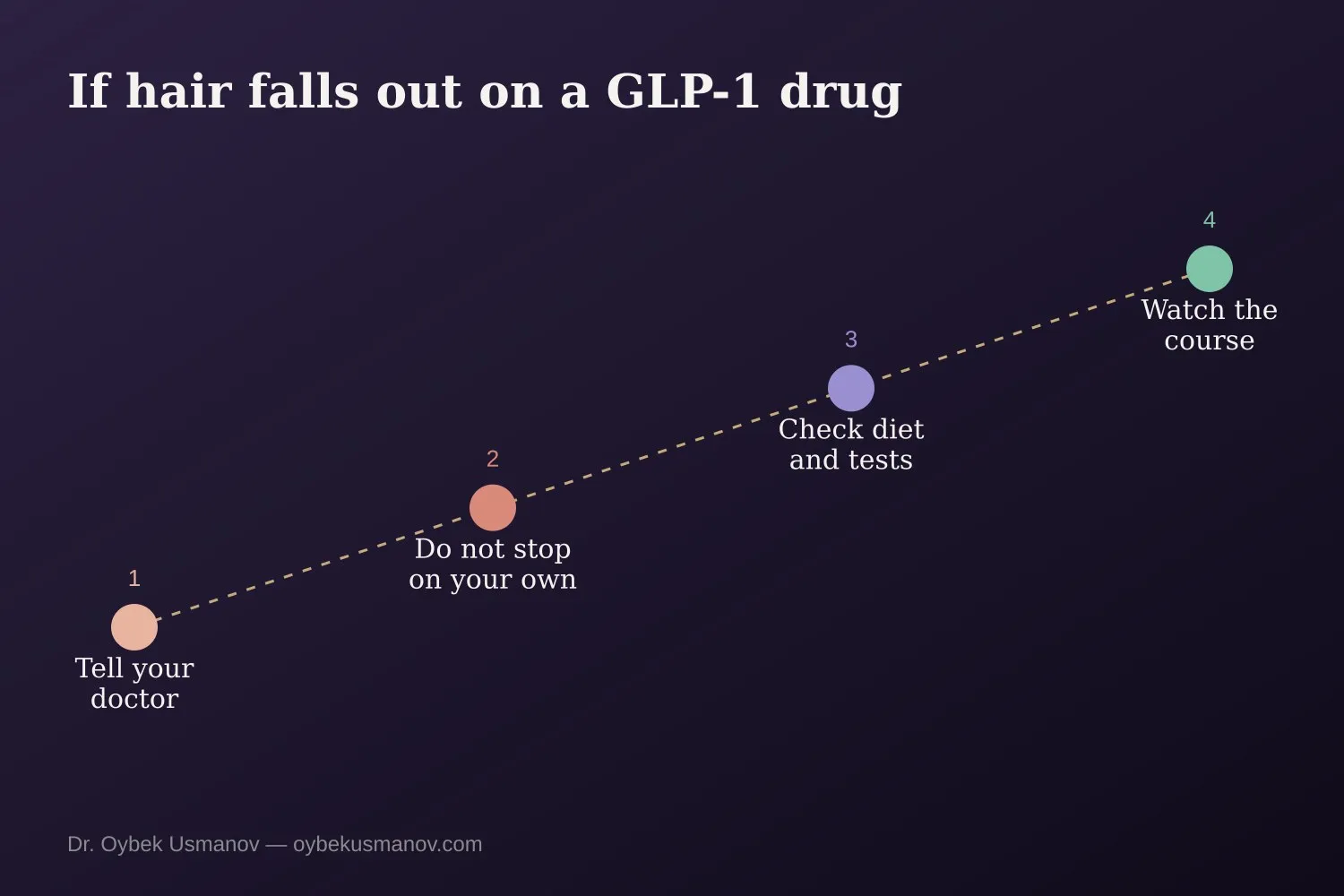
- Tell the doctor who prescribed the drug: they decide whether to continue.
- Do not stop or change treatment on your own.
- Check your diet: a sharp cut in calories and protein can worsen shedding; the plan is set by a doctor.
- Remember other causes: deficiencies, the thyroid, stress, androgenetic alopecia.
- If your parting thins or bald patches appear: see a dermatologist-trichologist.
What we do
If your hair loss turns out to be androgenetic alopecia, we will discuss options including transplant, and say honestly when it is not needed: once weight has stabilised and telogen shedding has settled, the picture is clearer. Send photos of your head on WhatsApp and tell us when shedding began and which drugs you take.
This article is general information and does not replace a consultation.