causes of hair loss
Hair loss from stress: what studies show and when to see a doctor
“It’s nerves” is a common explanation for hair loss. Partly it is fair: after severe stress or illness many people develop telogen effluvium (TE). But not all shedding is “from nerves”, and not all stress causes shedding. Below is what PubMed studies show.
This article is general information: the diagnosis is made by a doctor in person.
How stress relates to shedding
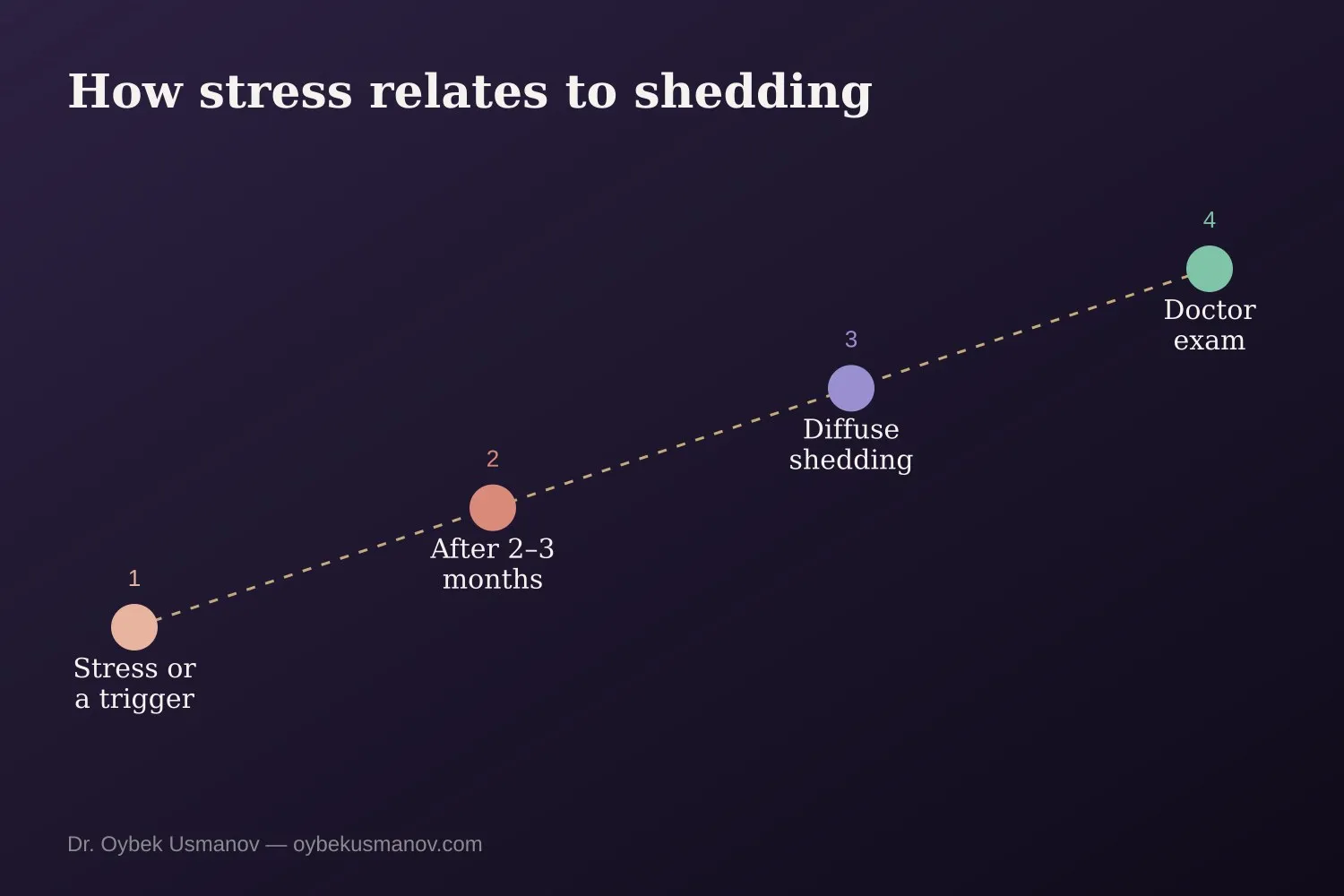
TE is diffuse shedding that occurs 2–3 months after a trigger; it can “unmask” existing conditions such as traction alopecia (Samrao & Mirmirani, Skin Appendage Disorders, 2022, doi:10.1159/000521705).
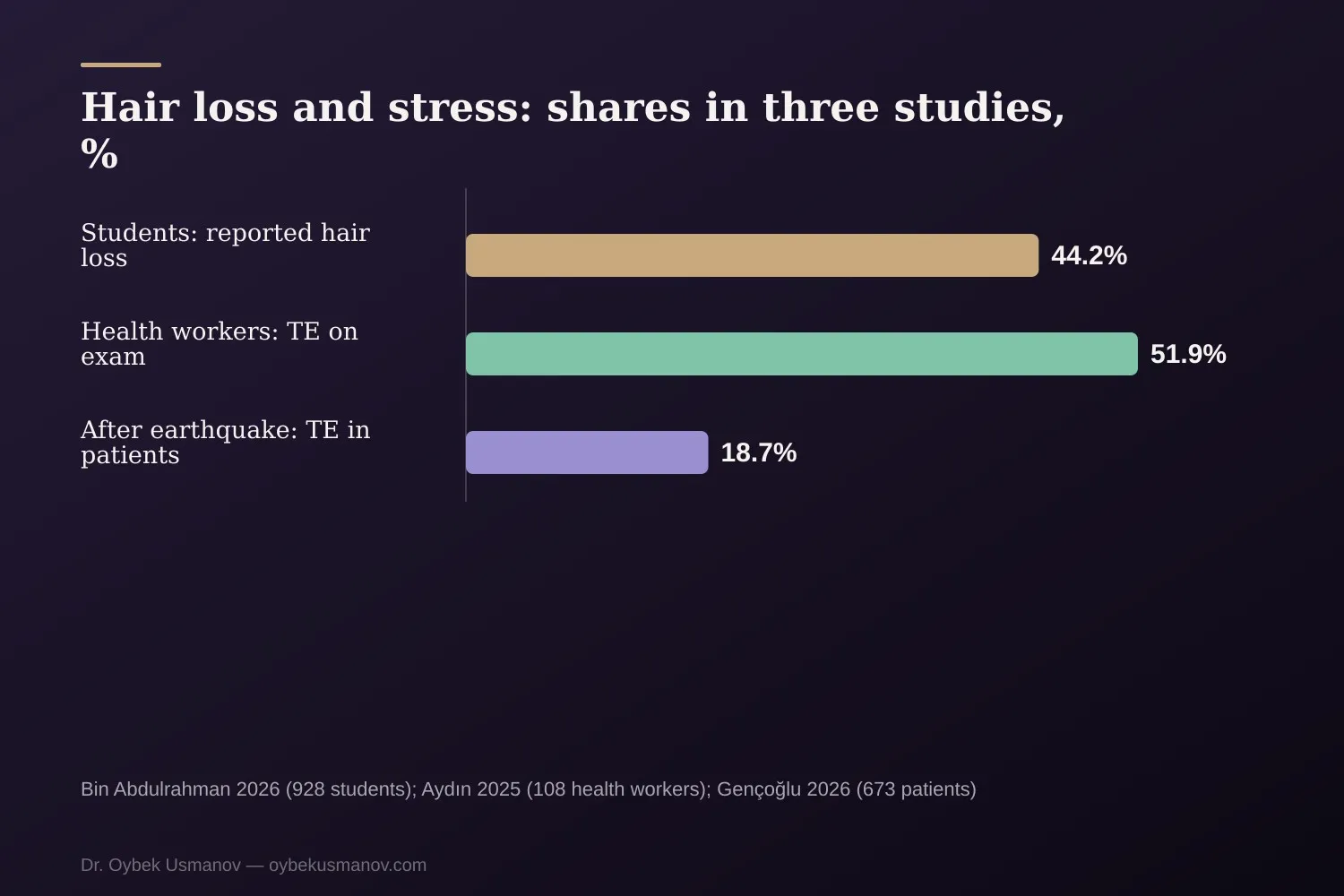
In a survey of 928 university students in Riyadh, 67.6% had moderate and 29.8% high stress; 44.2% reported hair loss (high stress was more common in women: 34.6% vs 19.7% of men) (Bin Abdulrahman et al., Journal of Family Medicine and Primary Care, 2026, doi:10.4103/jfmpc.jfmpc_1127_25). This is questionnaire self-report with no examination.
In 108 female health workers who had both an exam and trichoscopy, TE was found in 56 (51.85%) and was significantly associated with the experience of the “glass ceiling” (Aydın et al., Journal of Cosmetic Dermatology, 2025, doi:10.1111/jocd.70447). This is an association in a small sample, not proven causation.
A year after the 2023 earthquakes in Türkiye, among 673 dermatology patients TE was the most frequent diagnosis (18.7%), more so in patients with anxiety and PTSD (Gençoğlu & Cansel, Annals of Dermatology, 2026, doi:10.5021/ad.25.072).
The flip side: shedding hurts wellbeing too
In a prospective study of 205 TE patients and 105 healthy people, mean scores for quality of life, perceived stress, anxiety and depression were significantly worse in patients than in controls. No link with disease duration was found; the authors note larger studies are needed (Fişek Izci et al., European Journal of Dermatology, 2025, doi:10.1684/ejd.2025.4931).
So stress and shedding may feed each other. The conclusion “hair loss from nerves” is often too simple.
When to see a doctor
- If shedding goes on for more than a few months after a stressful event.
- If bald patches appear, your parting thins or hair looks fine and downy.
- If you have anxiety, insomnia or low mood: discuss that with a doctor, not only your hair.
- If you suspect another cause: illness, deficiency, childbirth, medicines.
- Do not start supplements or treatment on your own.
What we do
If your hair loss turns out to be androgenetic alopecia, we will discuss options including transplant, and say honestly when it is not needed. Send photos of your head on WhatsApp and tell us when it began and what preceded it.
This article is general information and does not replace a consultation.