causes of hair loss
Thyroid and hair loss: what is known and which tests are really needed
“Check your thyroid” is one of the commonest pieces of advice for hair loss. It is partly right, but in most women with diffuse shedding the tests show more than (and often something other than) thyroid problems. Below is what PubMed studies show.
This article is general information: tests are chosen and interpreted by a doctor.
What was found in women with diffuse shedding
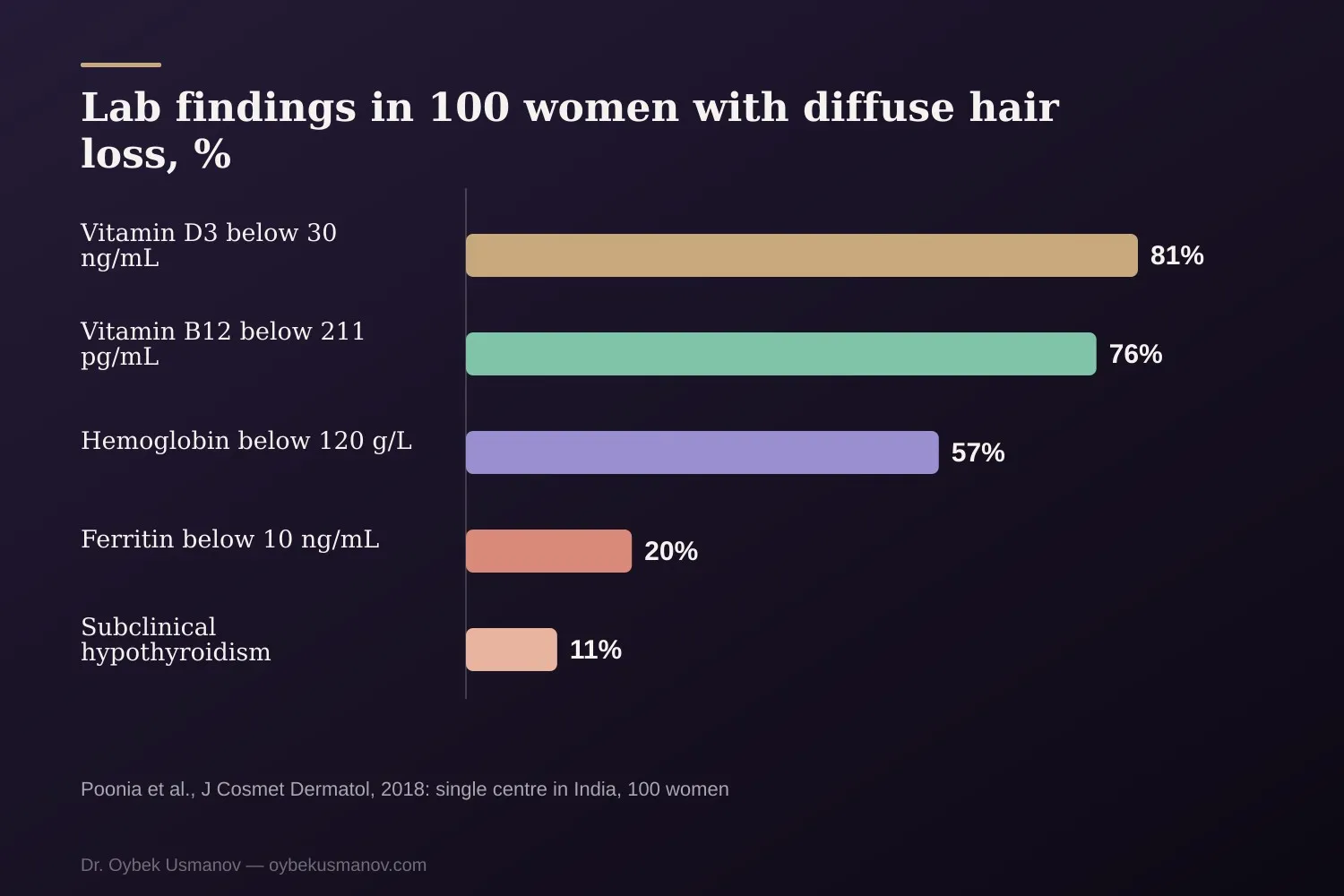
In a study of 100 women with diffuse nonscarring hair loss at one clinic in India, chronic telogen effluvium was diagnosed most often (62%), then female pattern hair loss (22%) and acute telogen effluvium (16%). Haemoglobin below 120 g/L was found in 57%, ferritin below 10 ng/mL in 20, vitamin B12 below 211 pg/mL in 76, vitamin D3 below 30 ng/mL in 81 patients, and subclinical hypothyroidism in 11% (Poonia et al., Journal of Cosmetic Dermatology, 2018, doi:10.1111/jocd.12559). The authors note that hair loss is multifactorial and that deficiencies may matter.
Note that the thyroid is not the leader here. This is one clinic with no comparison group, and the thresholds are those the authors used.
And in alopecia areata
In alopecia areata the picture differs. A meta-analysis of 50 studies showed that these patients more often have abnormal thyroid function tests, thyroid autoantibodies and autoimmune thyroid disease, with prevalence higher than in the general population (Lee et al., Journal of the American Academy of Dermatology, 2019, doi:10.1016/j.jaad.2018.10.066).
A meta-analysis of 17 studies (262,581 patients and 1,302,655 controls) clarified that alopecia areata is significantly associated with TPO and thyroglobulin antibodies, not with diagnosed hypo- or hyperthyroidism. The authors do not support routine thyroid screening in asymptomatic patients, but note a possible future risk in severe disease (Kinoshita-Ise et al., The Journal of Dermatology, 2019, doi:10.1111/1346-8138.14940).
Who should discuss tests
- Those with thyroid symptoms: fatigue, feeling cold, palpitations, weight changes.
- People with alopecia areata, especially severe or persistent.
- Those with diffuse shedding that has dragged on: a doctor usually looks at haemoglobin, ferritin and other markers.
- Do not start hormones or supplements on your own.
- A single TSH test settles nothing without an exam and other data.
What we do
If your hair loss turns out to be androgenetic alopecia, we will discuss options including transplant, and say honestly when it is not needed. Send photos of your head on WhatsApp and tell us how long hair has been falling.
This article is general information and does not replace a consultation.