causes of hair loss
Vitamin D and hair loss: what meta-analyses show and whether to get tested
Vitamin D is on almost every list of “tests for hair loss”. But what is actually known: does low vitamin D cause shedding, or is it simply common in these people? Below is what PubMed meta-analyses show.
This article is general information: interpreting tests and prescribing is up to a doctor.
What the meta-analyses show
In a meta-analysis of 23 studies (3,374 patients with nonscarring alopecia and 7,296 healthy people), people with hair loss had lower 25(OH)D and more frequent deficiency: odds ratio 3.11 (95% CI 2.29–4.22). Results varied widely between studies (Chen et al., Journal of Cosmetic Dermatology, 2023, doi:10.1111/jocd.16093).
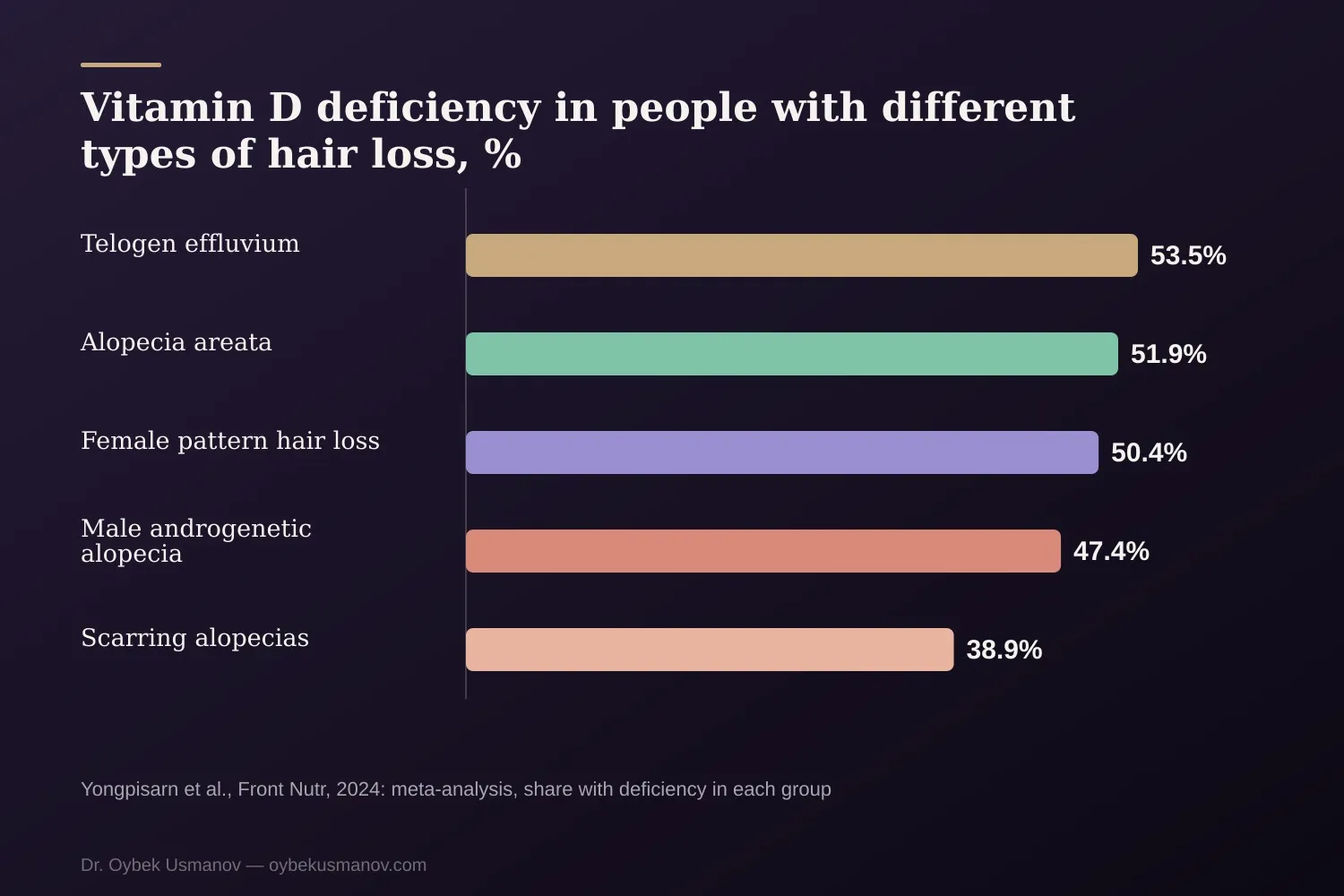
A more recent meta-analysis gave shares with vitamin D deficiency in different groups: 53.51% in telogen effluvium, 51.94% in alopecia areata, 50.38% in female pattern hair loss, 47.38% in male androgenetic alopecia and 38.85% in scarring alopecias. Versus controls, a statistically significant link was found only for alopecia areata (OR 2.84) and female pattern hair loss (5.24), but not for male androgenetic alopecia (Yongpisarn et al., Frontiers in Nutrition, 2024, doi:10.3389/fnut.2024.1479337).
For alopecia areata, a meta-analysis of 34 papers also found lower vitamin D and zinc, and vitamin D deficiency was associated with higher risk (OR 2.48) (Wu et al., Journal of Cosmetic Dermatology, 2025, doi:10.1111/jocd.16740). In a meta-analysis of comorbidities in alopecia areata, vitamin D deficiency was among the strongest associations (OR 10.13; 95% CI 4.24–24.20) (Ly et al., American Journal of Clinical Dermatology, 2023, doi:10.1007/s40257-023-00805-4).
What these data do not prove
These are comparisons, not proof of cause: low vitamin D may result from lifestyle or illness, or simply accompany shedding. The meta-analysis authors cautiously write that screening may be useful in alopecia areata and female pattern hair loss, while supplement treatment needs further study (Yongpisarn et al., Frontiers in Nutrition, 2024, doi:10.3389/fnut.2024.1479337).
Other authors suggest supplements and monitoring “may be helpful”, but that is a suggestion, not a trial result (Chen et al., Journal of Cosmetic Dermatology, 2023, doi:10.1111/jocd.16093).
So the honest conclusion: checking the level is reasonable, self-treatment is not. Doses are set by a doctor, and too much vitamin D can also be harmful.
Who should discuss a test
- People whose shedding has dragged on or is patchy.
- Women with thinning along the parting.
- People with little sun exposure or particular diets.
- Those with other complaints about their health.
- Do not start supplements without a test and a doctor’s advice.
What we do
If your hair loss turns out to be androgenetic alopecia, we will discuss options including transplant, and say honestly when it is not needed. Send photos of your head on WhatsApp and tell us how long hair has been falling.
This article is general information and does not replace a consultation.