causes
Why hair falls out: the main causes and how a doctor finds yours
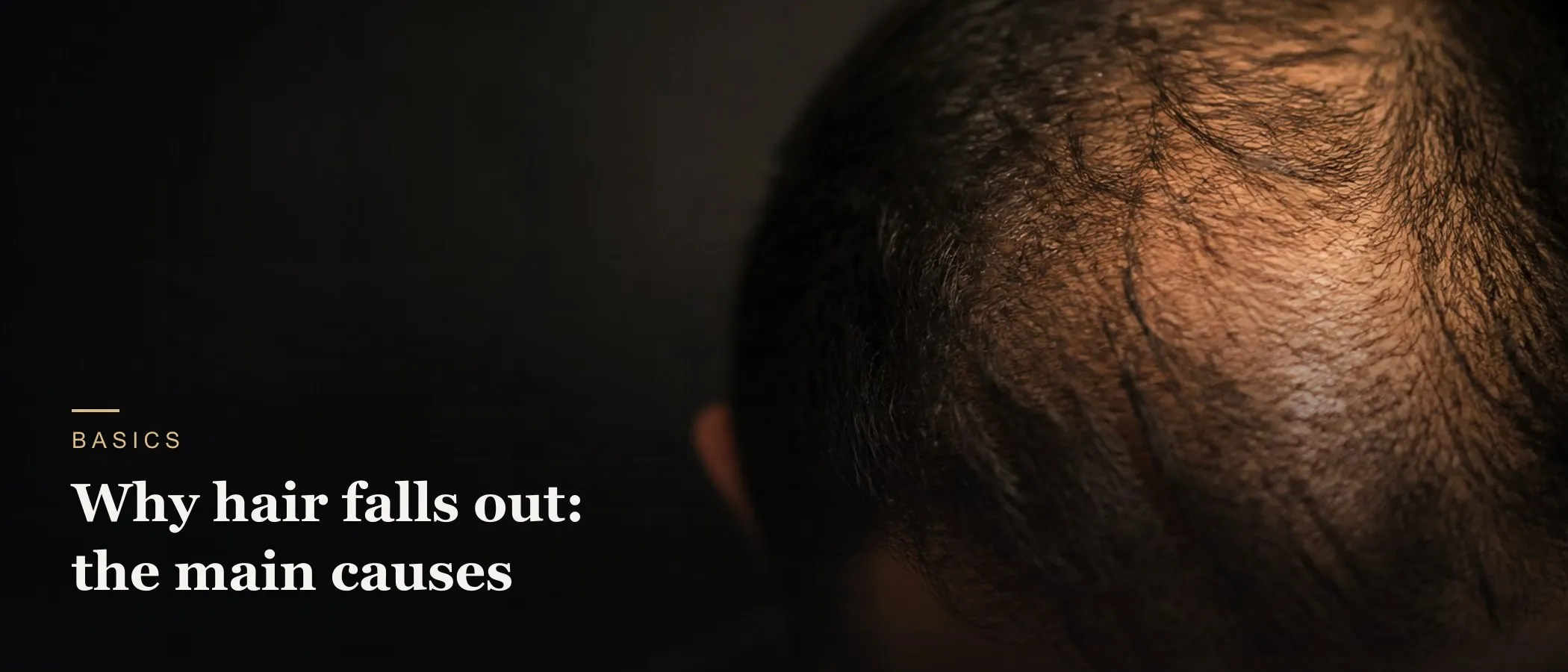
“Why is my hair falling out?” is the question that starts almost every road to treatment or a transplant. The causes are many and the treatments differ. So before thinking about surgery you need to understand what is really happening. Here are the main patterns of loss and how a doctor looks for the cause.
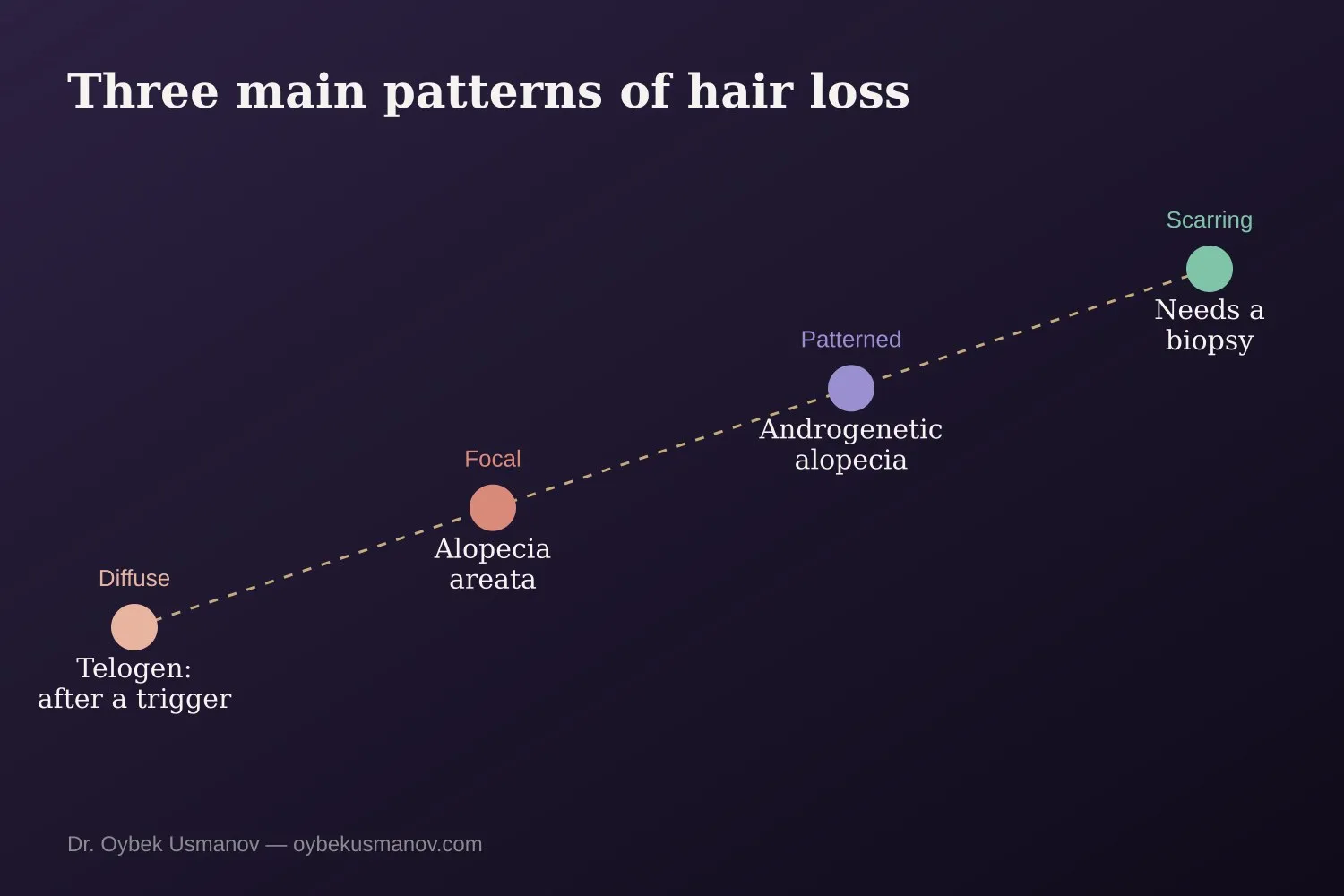
Three main patterns of hair loss
A 2026 primary-care review describes the approach: diagnosis rests on history and scalp inspection, and the pattern helps tell types apart. Diffuse loss is more often telogen effluvium, focal loss is alopecia areata, and patterned loss (receding temples or thinning at the crown) is androgenetic alopecia. Scarring forms are confirmed by biopsy (Walker et al., JAAPA, 2026, doi:10.1097/01.JAA.0000000000000405).
Androgenetic alopecia
The most common cause of gradual thinning. Androgens shorten the growth phase of the hair and follicles miniaturize, while estrogens may be protective. In women androgenetic alopecia affects nearly half over a lifetime but often goes undiagnosed and untreated. For women only topical minoxidil is FDA-approved; the other treatments are used off-label (Kearney et al., American Journal of Clinical Dermatology, 2026, doi:10.1007/s40257-026-01009-2).
In men it is also very common: according to one paper, male pattern hair loss affects more than half of men under 50 (Di et al., Journal of Cosmetic Dermatology, 2023, doi:10.1111/jocd.15858).
Loss after stress and other triggers
Telogen effluvium is one of the most common forms of diffuse non-scarring loss and usually resolves on its own. Many causes are linked, and stress is named most often (Jimeno Ortega & Stefanato, Italian Journal of Dermatology and Venereology, 2023, doi:10.23736/S2784-8671.23.07579-5). Typical triggers include childbirth or sudden weight loss; despite the distress, this loss has a high rate of remission (Chien Yin et al., Journal of Dermatological Science, 2021, doi:10.1016/j.jdermsci.2021.01.007).
This matters before a transplant: if the loss is trigger-driven, surgery is not needed, and the cause should be removed.
Receding temples: not always balding
Bitemporal hair loss has a broad list of causes. Traction alopecia, hair loss from constant pulling, is named as the most common. The list also includes scarring forms, seborrheic dermatitis and female pattern hair loss. The authors stress that in scarring forms time must not be lost (De Souza et al., Journal of Clinical and Aesthetic Dermatology, 2021).
How a doctor looks for the cause
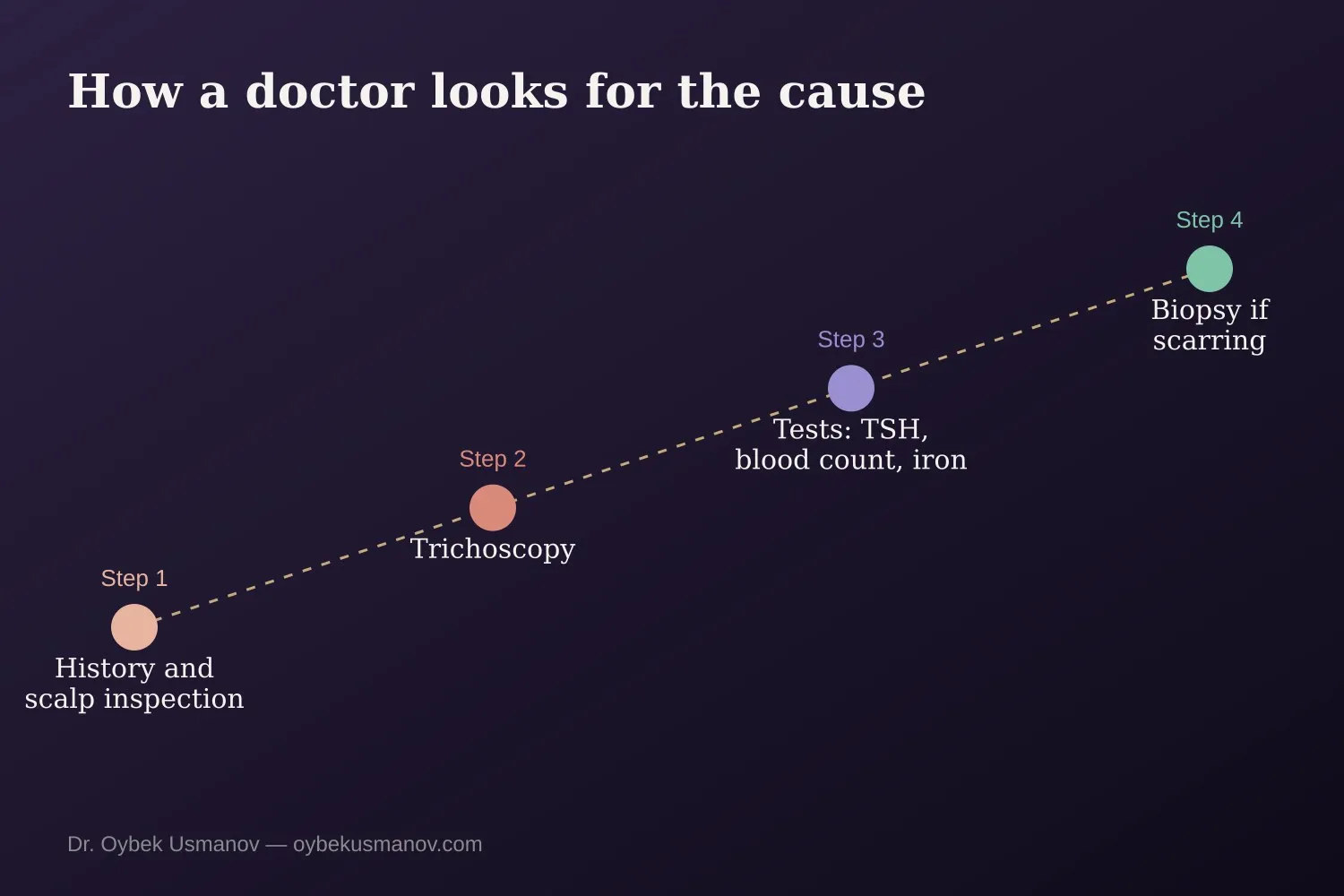
The doctor takes a history: when the loss began, what preceded it, which medication and illnesses. The scalp is examined, with trichoscopy if needed. The review names thyroid-stimulating hormone, a complete blood count and iron studies among the tests; a biopsy is used to confirm a scarring form (Walker et al., 2026).
When to see a doctor
- The loss is sudden, noticeable or does not stop.
- Hair thins in patches, there are smooth spots or redness, itching, burning of the scalp.
- There are general symptoms: weakness, weight change, cycle disturbances.
- The loss began after medication, illness, childbirth or severe stress.
- You are thinking about a transplant: the cause must be understood first.
What we do
Send photos of your head on WhatsApp and tell us when the loss began and what preceded it. The surgeon will say which tests are needed and whether a transplant suits you — and if not, what to do instead.
This article is general information and does not replace a consultation.