preparation
What tests do you need before a hair transplant: what is checked and why
“Which tests should I take before a hair transplant?” is a common consultation question. Let us be frank up front: we found no single list of tests “for everyone” in PubMed. The surgeon sets the list based on your health, medication and the operation plan. But there is data on what is usually checked in hair loss and what those checks actually give.
This article explains the logic and does not replace your surgeon’s orders. Do not take tests “just in case” without a recommendation, and do not skip those prescribed to you.
Tests have two jobs
The first is to find causes of hair loss that need treating before surgery. Expert consensus stresses that before a transplant the patient should have received adequate medical treatment for hair loss, and comorbidities should be assessed and factored into the plan (Vañó-Galván et al., Journal of Dermatological Treatment, 2023, doi:10.1080/09546634.2023.2232065).
The second is the safety of the operation itself: accounting for illnesses, medication and bleeding risk. Which tests to order for that is the surgeon’s call: we found no PubMed work giving a single list. Ask your surgeon which examinations and certificates you need.
What is usually checked in hair loss
A review on diagnosing hair loss says diagnosis rests on history, examination, laboratory tests and, when needed, scalp biopsy; in hair loss a complete blood count, ferritin, TSH and vitamin D 25OH are recommended (Jackson, Price, Dermatologic Clinics, 2012, doi:10.1016/j.det.2012.08.007).
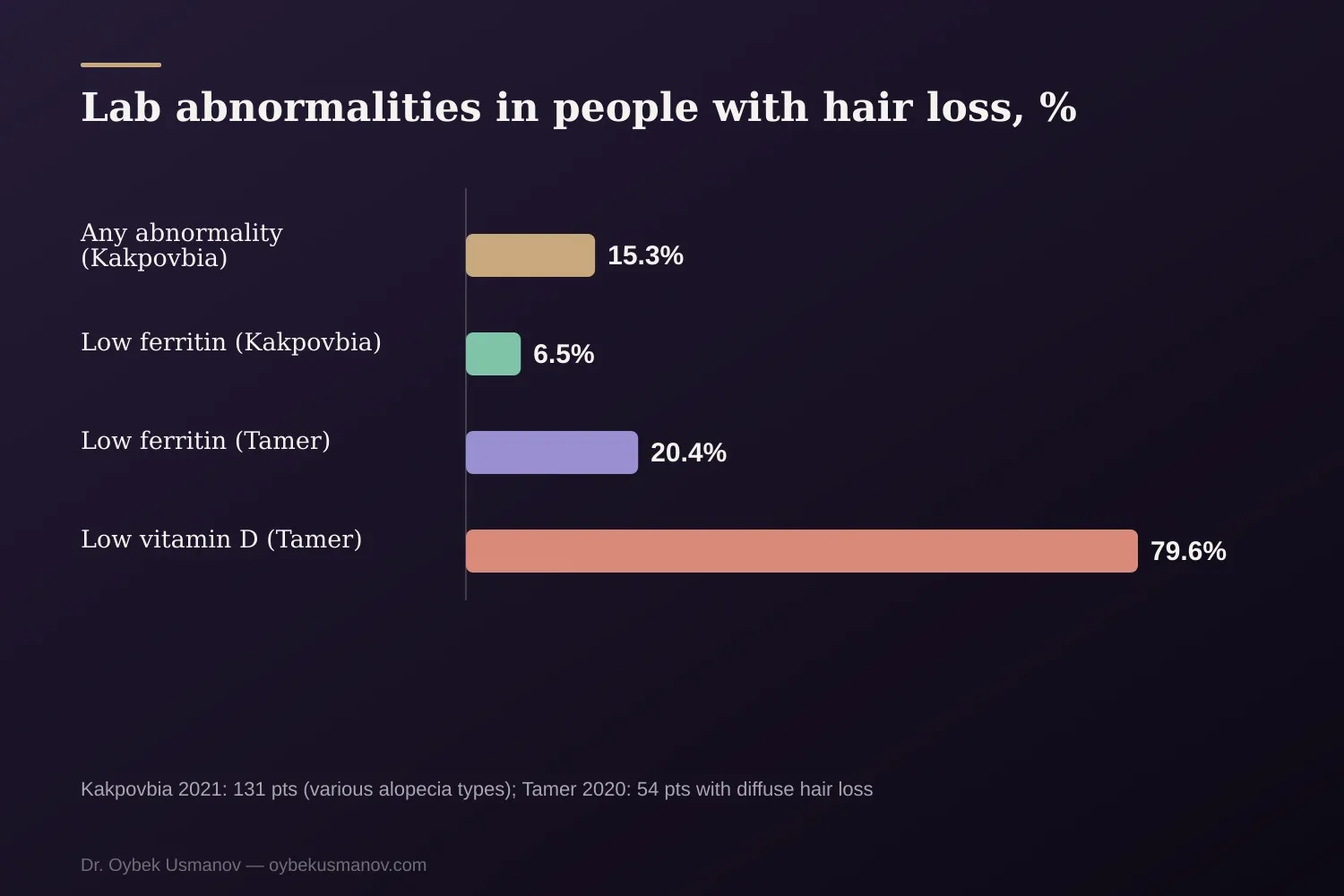
In a study of 54 patients with diffuse hair loss and 55 healthy people, mean ferritin was lower in patients (14.72 vs 25.30 ng/mL), as was vitamin D (14.03 vs 17.01 ng/mL); low ferritin was found in 20.4% and low vitamin D in 79.6% (Tamer et al., Postepy Dermatologii i Alergologii, 2020, doi:10.5114/ada.2020.96251). The sample was small and mostly women.
Does “fixing” the results help
In another study of 131 patients with non-scarring alopecia, lab abnormalities were found in 15.3% and ferritin deficiency in 6.5%. Supplements for an identified deficiency did not significantly change hair density or diameter, and the authors concluded the usefulness of such testing is limited (Kakpovbia et al., Journal of Drugs in Dermatology, 2021, doi:10.36849/JDD.5886). The study was retrospective, single-center and with short follow-up.
The takeaway for patients: tests are needed to exclude notable problems and assess risk, but they do not replace an exam and do not promise that “hair will grow after vitamins”.
- Tell your surgeon about all chronic conditions and medication, including those that affect clotting: only the doctor decides on stopping anything.
- Ask which tests and certificates you specifically need and how many days before surgery they must be ready.
- Do not start supplements on your own: data on their benefit for hair is limited.
- If you have diabetes, thyroid or heart disease, say so in advance: the operation plan accounts for such conditions.
What we do
Send photos of your head and a list of medications and conditions on WhatsApp: the surgeon will say which examinations you need, before you travel for surgery.
This article is general information and does not replace a consultation.